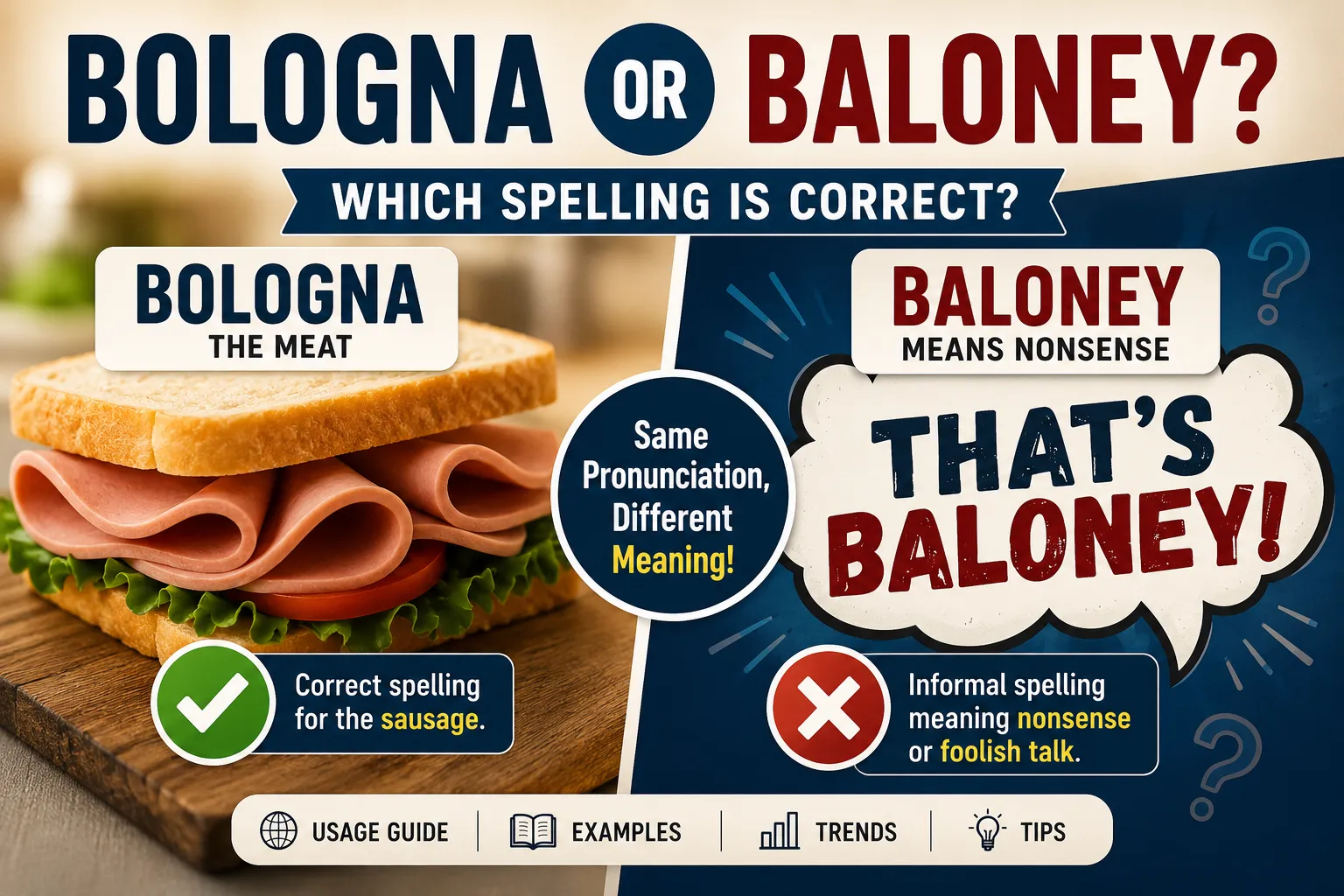
If you’re wondering bologna or baloney, the short answer is:
- Bologna is the original and correct spelling of the meat sausage. It is also the standard spelling found in dictionaries.
- Baloney is an accepted alternative spelling in American English when referring to nonsense, lies, or foolish talk. It is sometimes also used as a phonetic spelling because “bologna” is pronounced “buh-LOH-nee.”
Examples
- I made a bologna sandwich for lunch. ✅
- That’s complete baloney! ✅
- He bought fresh bologna from the deli. ✅
- Everything he said sounded like baloney. ✅
Most people search for “bologna or baloney” because they hear the word spoken but are unsure which spelling is correct. The confusion comes from the unusual pronunciation of bologna, which does not sound the way it is spelled. Since many English speakers hear “baloney,” they naturally wonder if that spelling is also correct. This guide explains the history behind both spellings, shows when each should be used, compares American and British English, and provides practical examples so you can confidently choose the right word in every situation.
The Origin of Bologna or Baloney
The word bologna comes from the Italian city of Bologna, famous for its traditional sausage called mortadella. When the sausage became popular in English-speaking countries, its name stayed the same.
However, English speakers pronounced the word differently over time. Instead of saying “bo-LOAN-ya,” many Americans began saying “buh-LOH-nee.”
Eventually, people started spelling the spoken version as baloney.
Today:
- Bologna remains the official spelling for the sausage.
- Baloney developed as an informal spelling and later became a slang word meaning nonsense.
This is why both words exist today but serve different purposes.
British English vs American English Spelling
The biggest difference is not actually between British and American spelling rules. Instead, it is about usage.
In both British and American English:
- Bologna is the standard spelling for the meat.
- Baloney is mainly an American informal spelling used to mean nonsense.
| Usage | Bologna | Baloney |
|---|---|---|
| Meat sausage | ✅ Standard | Rare |
| Means nonsense | Rare | ✅ Common in American English |
| Dictionaries | ✅ Standard | ✅ Informal/slang |
| Formal writing | ✅ Preferred | Only for slang meaning |
| Everyday speech | Common | Common in the US |
Examples
American English
- I ordered a bologna sandwich.
- That’s baloney.
British English
- Bologna is less common as a lunch meat in the UK.
- British speakers often say “rubbish” instead of “baloney.”
Which Spelling Should You Use?
The correct spelling depends on your audience.
If You Write for an American Audience
Use:
- Bologna for the meat.
- Baloney when you mean nonsense.
Example:
- The grocery store sells fresh bologna.
- That’s pure baloney.
If You Write for a British or Commonwealth Audience
Use:
- Bologna for the sausage.
- Instead of baloney, consider using:
- rubbish
- nonsense
- absurdity
If You Write for a Global Audience
Use bologna whenever referring to food.
Only use baloney when you intentionally mean “nonsense” and your audience is likely to understand American slang.
Common Mistakes with Bologna or Baloney
Many writers make the same mistakes.
| Incorrect | Correct | Why |
|---|---|---|
| I ate a baloney sandwich. | I ate a bologna sandwich. | Meat uses the original spelling. |
| That’s bologna! | That’s baloney! | Slang usually uses “baloney.” |
| Bologna means nonsense in formal writing. | Baloney is the slang form. | Formal writing prefers precise wording. |
| Bologna is pronounced as written. | Bologna is pronounced “buh-LOH-nee.” | English pronunciation changed over time. |
Tips
- Think food = bologna.
- Think nonsense = baloney.
This simple rule helps most people remember the difference.
Bologna or Baloney in Everyday Examples
Here are examples from real-life situations.
“The deli will provide fresh bologna for the event.”
News
“Local producers introduced a new premium bologna recipe.”
Social Media
“That rumor is complete baloney.”
Formal Writing
“The sandwich contains smoked bologna.”
Casual Conversation
“I don’t believe that. It’s baloney.”
School Writing
“The word bologna comes from Italy.”
Bologna or Baloney – Google Trends & Usage Data
Search interest shows that bologna or baloney is a common spelling question because pronunciation does not match spelling.
General usage patterns include:
| Country | Most Common Usage |
|---|---|
| United States | Bologna (food), Baloney (slang) |
| Canada | Bologna for food; Baloney also understood |
| United Kingdom | Bologna mainly for food; “baloney” is less common |
| Australia | Bologna for food; “baloney” appears mostly in American media |
| New Zealand | Similar to Australian usage |
People often search for:
- bologna or baloney
- how do you spell baloney
- why is bologna pronounced baloney
- bologna meaning
- baloney meaning
The keyword is especially popular among students, English learners, writers, and anyone editing documents.
Comparison Table: Bologna vs Baloney
| Feature | Bologna | Baloney |
|---|---|---|
| Original spelling | ✅ Yes | No |
| Refers to sausage | ✅ Yes | Informal only |
| Means nonsense | Rare | ✅ Yes |
| Formal writing | ✅ Preferred | Only for slang meaning |
| American English | Very common | Common |
| British English | Common | Less common |
| Dictionary accepted | ✅ Yes | ✅ Yes (informal) |
| Best for food | ✅ Yes | No |
| Best for slang | No | ✅ Yes |
Frequently Asked Questions
1. Is it spelled bologna or baloney?
Both are correct, but they have different uses. Bologna refers to the sausage, while baloney usually means nonsense.
2. Why is bologna pronounced “baloney”?
The pronunciation changed over time as the Italian word entered American English. The spelling stayed the same, but the spoken form became “buh-LOH-nee.”
3. Can I write “baloney sandwich”?
It is better to write bologna sandwich, especially in formal or professional writing.
4. Is baloney a real word?
Yes. Modern dictionaries recognize baloney as an informal American English word meaning nonsense or foolish talk.
5. Which spelling is more professional?
Use bologna when discussing food. Use baloney only when intentionally using informal slang.
6. Do British people use the word baloney?
It is understood by many people because of American media, but British English more often uses words like “rubbish” or “nonsense.”
7. Why do people confuse bologna and baloney?
The unusual pronunciation of bologna sounds almost exactly like baloney, leading many people to assume they are simply different spellings of the same word.
Conclusion
The confusion between bologna or baloney comes from one of the most unusual spelling and pronunciation pairs in English. Although they sound alike, they are not always used the same way. Bologna is the correct spelling for the famous sausage and should be your first choice whenever you are writing about food. It is the standard form recognized in dictionaries, recipes, menus, grocery stores, and formal writing. Baloney, on the other hand, is an accepted American English slang word that means nonsense, foolish talk, or something that is not believable. It is common in conversations, social media, and informal writing but is less suitable for professional contexts unless you intentionally want a casual tone.
If you write for an American audience, using both words correctly will make your writing sound natural. For British or international readers, bologna remains the safest spelling for food, while “nonsense” is often clearer than baloney. Remember the simple rule: food equals bologna, nonsense equals baloney. Following this guideline will help you avoid common mistakes and communicate with confidence.