Have you ever typed “cheif” and then wondered if it should be “chief” instead? You are not alone. The search query “chief or cheif” is common because these two spellings look almost the same. One small letter order creates the confusion.
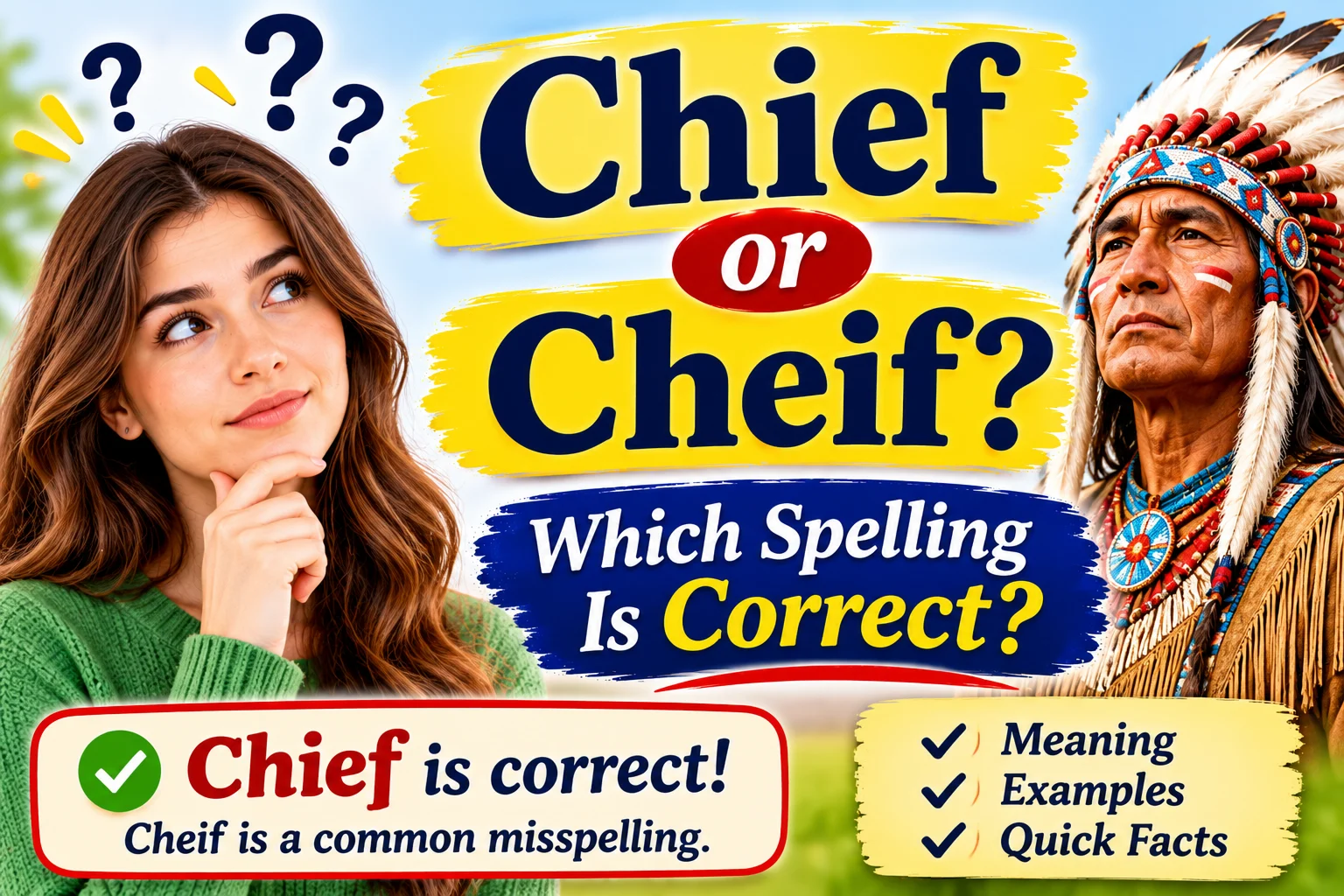
The quick answer is simple: chief is the correct modern English spelling. Cheif is a misspelling. You should use chief in emails, schoolwork, business documents, news articles, websites, and professional writing.
The word chief can mean a leader or someone with a high position. It can also mean “main” or “most important.” For example, we say police chief, chief executive officer, and chief reason.
People often search for “chief or cheif” because English spelling rules can be confusing. The familiar “i before e” rule may help with chief, but English has many spelling exceptions. This guide explains the correct spelling, word origin, British and American usage, common mistakes, everyday examples, search trends, and professional advice. By the end, you will know why chief is correct and why cheif should normally be avoided.
Chief is the correct spelling.
Cheif is a common spelling mistake and is not the standard modern spelling.
| Variation | Correct? | Example |
|---|---|---|
| chief | ✅ Yes | She is the police chief. |
| cheif | ❌ No | She is the police cheif. |
The word chief can be used as both a noun and an adjective.
As a noun:
The police chief spoke to reporters.
As an adjective:
Safety is our chief concern.
As a job title:
She became Chief Financial Officer.
As a leadership term:
He served as chief of staff.
A simple way to remember the spelling is:
C-H-I-E-F = chief
The letters I-E come before F.
The Origin of Chief or Cheif
The word chief has a long history. It came into English through Middle English and Anglo-French forms related to chief and chef. The deeper source is the Latin word caput, meaning “head.”
The original idea was connected to the head of something. Over time, chief developed meanings related to leadership, importance, and rank.
The word has been used in English for many centuries. Merriam-Webster records chief as dating back to the 14th century.
Interestingly, chief and chef are related. The French word chef originally meant “head” or “leader.” English later used chef in the specific sense of a professional cook.
Historical English spelling was not always fixed. Older texts contain different forms of words, including forms that may look unusual to modern readers. This helps explain why cheif can sometimes look believable.
However, historical spelling should not be confused with modern standard spelling.
Today, the correct form is:
chief
Not:
cheif
The spelling difference is usually caused by reversing the letters I and E.
British English vs American English Spelling
There is no British-American spelling difference for chief.
British English uses chief.
American English also uses chief.
| Feature | British English | American English |
|---|---|---|
| Correct spelling | chief | chief |
| Incorrect spelling | cheif | cheif |
| Pronunciation | /tʃiːf/ | /tʃiːf/ |
| Example | police chief | police chief |
| Job title | Chief Executive Officer | Chief Executive Officer |
For example, British English may say:
The police chief announced the new policy.
American English may say:
The police chief announced the new policy.
The spelling remains the same.
This is different from words such as colour/color or centre/center, where British and American English use different accepted spellings.
With chief, there is only one standard spelling:
chief
Which Spelling Should You Use?
Use chief in almost every standard English situation.
For US readers
Use chief in:
- Business documents
- Emails
- News articles
- Resumes
- Academic writing
- Government documents
- Job titles
Example:
The Chief Executive Officer approved the plan.
For UK and Commonwealth readers
Use chief as well.
Example:
The chief constable announced the new policy.
There is no need to change the spelling for British English.
For a global audience
Chief is the safest choice. It is understood and accepted across major varieties of English.
Do not change chief to cheif based on location. Unlike color/colour, this is not a regional spelling difference.
If you want your writing to look professional, always choose:
chief
rather than:
cheif
Common Mistakes with Chief or Cheif
Mistake 1: Writing “cheif”
❌ Cheif executive officer
✅ Chief executive officer
The letters I and E are in the wrong order in cheif.
Mistake 2: Writing “police cheif”
❌ The police cheif gave a statement.
✅ The police chief gave a statement.
Mistake 3: Writing “cheif reason”
❌ This was the cheif reason for the change.
✅ This was the chief reason for the change.
Here, chief means “main” or “most important.”
Mistake 4: Assuming “cheif” is British English
❌ Cheif is the British spelling.
✅ Chief is the standard spelling in both British and American English.
Mistake 5: Confusing spelling with pronunciation
Chief is pronounced roughly like “cheef.”
The pronunciation does not tell you that the spelling is cheif. The correct written form is:
C-H-I-E-F
Chief or Cheif in Everyday Examples
In emails
Correct:
Please send the report to the chief financial officer.
Incorrect:
Please send the report to the cheif financial officer.
In news writing
Correct:
The police chief spoke to reporters after the incident.
The word chief is common in news reports when describing leaders of departments or organizations.
In social media
Correct:
Our chief designer just launched the new collection.
Another example:
He is the chief of the organization.
Even in casual social media writing, chief is the correct spelling.
In formal writing
Correct:
The chief objective of the policy is to improve public safety.
Here, chief means main or most important.
In job titles
Common examples include:
- Chief Executive Officer
- Chief Financial Officer
- Chief Operating Officer
- Chief Technology Officer
- Chief Medical Officer
- Chief Information Officer
- Chief of Staff
In everyday conversation
You may hear:
Who is the chief?
Or:
The chief reason for the delay was bad weather.
In both cases, the spelling is chief.
Chief or Cheif – Google Trends & Usage Data
People search for “chief or cheif” because they are unsure which spelling is correct. The search is mainly a spelling-check query rather than a search for two different English words.
The word chief is widely used in professional and everyday English. It appears in business titles, police and military roles, government positions, news reports, and phrases such as chief concern and chief reason.
The incorrect form cheif can also appear in online searches, social media posts, comments, and informal writing. Its presence online does not make it a standard spelling.
Search interest can vary by country and context. For example, people may search for the word because they are writing a resume, checking a job title, preparing an article, or correcting an English spelling mistake.
Exact Google Trends numbers can change over time. Therefore, it is better to focus on the clear language rule:
Chief is the standard spelling. Cheif is normally a spelling error.
Chief vs Cheif: Side-by-Side Comparison
| Feature | Chief | Cheif |
|---|---|---|
| Standard spelling | ✅ Yes | ❌ No |
| Modern English | ✅ Yes | ❌ No |
| British English | ✅ Yes | ❌ No |
| American English | ✅ Yes | ❌ No |
| Means “leader” | ✅ Yes | ❌ No |
| Means “main” | ✅ Yes | ❌ No |
| Used in job titles | ✅ Yes | ❌ No |
| Used in formal writing | ✅ Yes | ❌ No |
| Common online spelling error | No | ✅ Yes |
FAQs About Chief or Cheif
1. Is “chief” or “cheif” correct?
Chief is correct. Cheif is normally a spelling mistake.
2. How do you spell chief correctly?
Spell it:
C-H-I-E-F
The correct word is chief.
3. Why do people spell chief as cheif?
The mistake usually happens because people reverse the letters I and E. The pronunciation can also make the correct spelling less obvious.
4. Is “cheif” a British spelling?
No. British English uses chief, just like American English.
5. What does chief mean?
As a noun, chief can mean a leader or person with high rank.
As an adjective, it can mean main, primary, or most important.
6. Is chief used in job titles?
Yes. Examples include:
- Chief Executive Officer
- Chief Financial Officer
- Chief Technology Officer
- Chief Operating Officer
- Chief Medical Officer
7. Is “cheif” ever correct?
In modern standard English, you should use chief. You may find unusual historical spellings in old texts, but cheif is not the standard modern form.
Conclusion
The answer to “chief or cheif” is clear: chief is the correct modern English spelling. Cheif is normally a spelling mistake caused by reversing the letters I and E.
The word chief has been used in English for centuries. It came through Middle English and French from the Latin word caput, meaning “head.” Today, it can describe a leader, a person with high rank, or something that is most important.
There is also no British-versus-American spelling difference. Both British English and American English use chief. The same spelling works for readers in the United States, United Kingdom, Canada, Australia, and other English-speaking countries.
You should use chief in emails, reports, resumes, articles, job titles, academic writing, and social media posts. Examples include police chief, chief executive officer, chief concern, and chief reason.
If you remember only one thing, remember this simple rule: chief is correct; cheif is not the standard modern spelling. Using the correct form will make your writing clearer, more accurate, and more professional.
Cankles or Kankles: Which Spelling Is Correct?

I am an English Literature expert and professional content writer with a passion for language, grammar, and effective communication. I specialize in creating well-researched, reader-friendly articles on English usage, spelling, vocabulary, writing techniques, and literary topics. My goal is to simplify complex concepts and provide accurate, engaging content that helps readers strengthen their language skills and communicate with confidence.