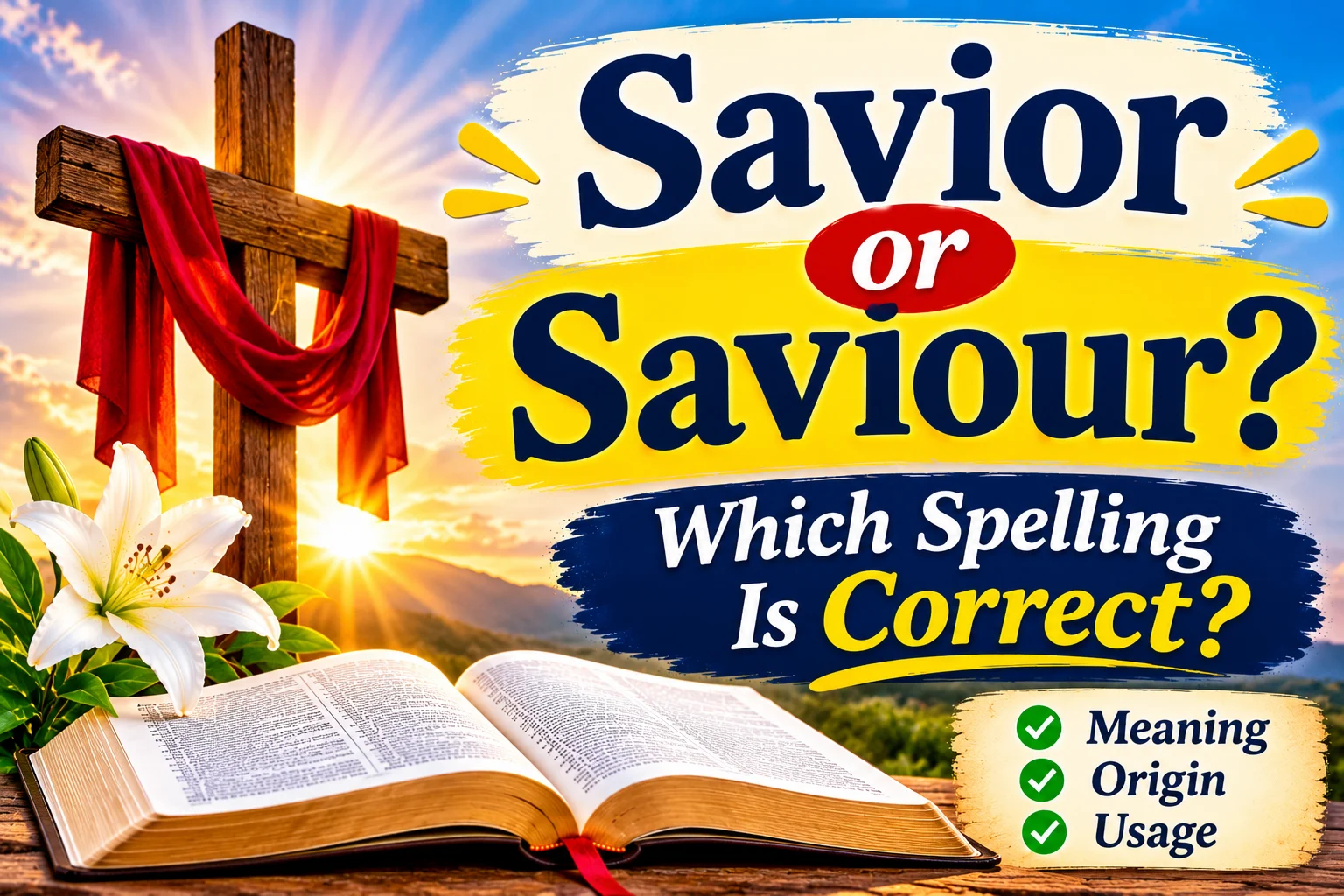
Have you ever written savior or saviour and wondered which spelling is correct? You are not alone. Both forms are common, and both have the same meaning. The main difference is where they are used.
Savior is the standard spelling in American English. Saviour is the standard spelling in British English and is also common in other varieties of English, such as Canadian, Australian, and New Zealand English.
This difference often causes confusion because the words sound the same. The extra u does not change the pronunciation or meaning. It reflects a spelling tradition.
People often search for “savior or saviour” when writing an email, article, school assignment, religious text, social media post, or professional document. They want to know which version looks correct for their audience.
The good news is simple: both spellings are correct. Your choice depends mainly on the type of English you are using.
This guide explains the difference between savior and saviour, where each spelling comes from, which countries prefer each form, and how to use the word correctly in everyday and formal writing.
Savior and saviour are both correct spellings.
The main difference is regional:
- Savior → American English
- Saviour → British English and many other varieties of English
Both words mean a person who saves someone from danger, harm, or difficulty.
Examples:
- American English: The firefighter was called a savior.
- British English: The firefighter was called a saviour.
The word also has an important religious meaning. In Christianity, Savior or Saviour can refer to Jesus Christ.
For example:
Christians believe Jesus is their Savior.
Christians believe Jesus is their Saviour.
Both sentences are correct. The spelling depends on the variety of English being used.
The Simple Rule
If you use American English, choose savior.
If you use British English, choose saviour.
If you are writing for an international audience, either may be understood, but it is best to follow the spelling style used by your publication, organization, or target audience.
The Origin of Savior or Saviour
The word savior/saviour comes from the verb save. It ultimately traces back through Old French and Latin roots connected with saving or preserving.
The English noun developed from the idea of a person who saves.
The spelling difference developed from broader differences between American and British English.
In British English, many words retained spellings with -our, such as:
- colour
- honour
- favour
- labour
- neighbour
- saviour
American English later adopted shorter forms for many of these words:
- color
- honor
- favor
- labor
- neighbor
- savior
The American spelling tradition was strongly influenced by dictionary maker Noah Webster. His dictionaries promoted spelling reforms and helped establish shorter forms in American English.
This is why the difference is not about pronunciation or meaning. It is mainly a matter of regional spelling style.
Why Does American English Drop the “u”?
American English often uses shorter spellings where British English keeps -our.
Compare:
British: saviour
American: savior
The same pattern appears in many other words.
This does not mean one spelling is more correct than the other. Each belongs to a recognized English spelling system.
British English vs American English Spelling
The clearest difference is the final -our versus -or.
| Word type | American English | British English |
|---|---|---|
| Save someone | savior | saviour |
| Color | color | colour |
| Favor | favor | favour |
| Honor | honor | honour |
| Labor | labor | labour |
| Neighbor | neighbor | neighbour |
For savior/saviour, the rule is easy:
American English → -or
British English → -our
American English Examples
He became a savior to the people in the village.
The rescue worker was seen as a savior.
Many Christians refer to Jesus as their Savior.
British English Examples
He became a saviour to the people in the village.
The rescue worker was seen as a saviour.
Many Christians refer to Jesus as their Saviour.
The meaning remains the same.
Comparison Table: Savior vs Saviour
| Feature | Savior | Saviour |
|---|---|---|
| Main variety | American English | British English |
| Meaning | Person who saves | Person who saves |
| Pronunciation | Same | Same |
| Spelling | -or | -our |
| Formal use | Correct | Correct |
| Religious use | Common | Common |
| Common in US | Yes | Less common |
| Common in UK | Less common | Yes |
| Common in Canada | Used, depending on style | Often used |
| Common in Australia | Less common | Common |
Which Spelling Should You Use?
Your audience should decide.
If You Write for an American Audience
Use savior.
This includes:
- US websites
- American schools
- US newspapers
- American businesses
- US government documents
- American social media
Example:
The rescue team was hailed as a savior after the successful operation.
If You Write for a UK Audience
Use saviour.
Example:
The rescue team was hailed as a saviour after the successful operation.
If You Write for Canada
Canadian English can use both British and American spelling patterns, depending on the word and style guide. Saviour is widely used in Canadian English, especially in formal and religious contexts.
If you are writing professionally in Canada, follow your organization’s style guide.
If You Write for Australia or New Zealand
Saviour is generally the preferred spelling.
If You Write for a Global Audience
Choose the spelling that matches your main target market.
For example:
- US customers → savior
- UK customers → saviour
- Australian customers → saviour
- International publication → Follow its house style
The most important rule is consistency. Do not switch between savior and saviour in the same document unless you are quoting a source that uses a different spelling.
Common Mistakes with Savior or Saviour
Mistake 1: Saying One Spelling Is Wrong
It is not correct to say that saviour is always wrong or savior is always wrong.
Both are accepted English spellings.
Correction: Choose the spelling that matches your variety of English.
Mistake 2: Mixing US and UK Spellings
A document may use:
The saviour showed great honor and favor.
This mixes British saviour with American honor and favor.
A US version would be:
The savior showed great honor and favor.
A UK version would be:
The saviour showed great honour and favour.
Mistake 3: Changing the Meaning
Savior and saviour have the same meaning.
The extra u does not create a different word.
Mistake 4: Confusing “Savior” With “Saviour”
Some writers think one spelling is religious and the other is not.
That is incorrect.
Both forms can describe an ordinary person who saves someone, and both can have a religious meaning.
Mistake 5: Ignoring Capitalization
When referring to Jesus Christ in Christian writing, Savior/Saviour is often capitalized.
Example:
Christians believe Jesus Christ is the Savior.
But when using the word in a general sense, lowercase is usually appropriate:
The firefighter was a savior for the trapped family.
Capitalization can vary by religious tradition and style guide.
Savior or Saviour in Everyday Examples
The word can appear in many types of writing.
In Emails
American English:
Thank you for your quick response. You were a real savior when we needed help.
British English:
Thank you for your quick response. You were a real saviour when we needed help.
In casual emails, either form works if it matches your normal spelling style.
In News Writing
American:
The swimmer was hailed as a savior after rescuing two children.
British:
The swimmer was hailed as a saviour after rescuing two children.
News organizations usually follow a specific national or editorial style.
In Social Media
American:
Coffee is my savior on Monday mornings. ☕
British:
Coffee is my saviour on Monday mornings. ☕
Here, the word can be used humorously. It does not have to have a religious meaning.
In Formal Writing
American:
The program became a financial savior for many small businesses.
British:
The program became a financial saviour for many small businesses.
The correct choice depends on the style of English used throughout the document.
In Religious Writing
Both spellings are used:
Jesus Christ is the Savior.
Jesus Christ is the Saviour.
If you are quoting a Bible translation or religious source, keep its original spelling.
Savior or Saviour – Google Trends & Usage Data
Searches for “savior or saviour” often come from people who know both spellings but are unsure which one fits their audience.
Search interest can vary by country because English spelling preferences vary by region.
In broad terms:
- United States: savior is the dominant form.
- United Kingdom: saviour is the dominant form.
- Australia: saviour is generally preferred.
- New Zealand: saviour is generally preferred.
- Canada: saviour is widely used, although Canadian spelling includes some American influences.
- International English: Both forms appear.
Search trends should be treated as evidence of search behavior, not as a grammar rule. A high number of searches for one spelling does not automatically make it the correct spelling.
For SEO, however, both terms matter. Someone searching “savior or saviour” wants a clear explanation of the spelling difference.
That means a useful article should naturally include related phrases such as:
- savior or saviour
- saviour or savior
- savior meaning
- saviour meaning
- American spelling of saviour
- British spelling of savior
- is saviour correct?
- is savior correct?
The best SEO strategy is to answer the spelling question directly instead of forcing the keyword into every paragraph.
Savior vs Saviour: Keyword Variations Side by Side
| Keyword variation | Meaning | Main usage |
|---|---|---|
| savior | A person who saves | American English |
| saviour | A person who saves | British/Commonwealth English |
| savior or saviour | Spelling comparison | Search query |
| saviour or savior | Spelling comparison | Search query |
| Savior | Religious title/name in some contexts | American English |
| Saviour | Religious title/name in some contexts | British/Commonwealth English |
The two main forms are interchangeable in meaning. The key difference is spelling tradition.
FAQs About Savior or Saviour
1. Is it “savior” or “saviour”?
Both are correct. Savior is the standard American spelling, while saviour is the standard British spelling.
2. Is “saviour” British or American?
Saviour is mainly associated with British English and is also common in other varieties, including Australian and New Zealand English.
3. Is “savior” American English?
Yes. Savior is the standard American English spelling.
4. Is “saviour” spelled with a “u”?
Yes. The British spelling is saviour, while the American spelling is savior.
5. Do savior and saviour mean the same thing?
Yes. They have the same meaning and pronunciation. The difference is spelling.
6. Is Jesus called Savior or Saviour?
Both spellings are used. Savior is common in American English, while Saviour is common in British and Commonwealth English.
7. Which spelling is better for SEO?
Neither is universally better. Use the form that matches your target audience. If you target both US and UK readers, naturally mention both “savior” and “saviour”.
8. Should I capitalize Savior or Saviour?
It depends on context and style. Religious references to Jesus may capitalize the word, while general uses are usually lowercase.
Conclusion: Savior or Saviour?
The choice between savior or saviour is simple once you know the regional rule. Both spellings are correct, and both have the same meaning. The difference is mainly based on English spelling tradition.
Use savior when writing in American English. Use saviour when writing in British English. The -or ending is typical of American spelling, while the -our ending is typical of British spelling.
The same pattern appears in words such as color/colour, favor/favour, and honor/honour. This makes savior/saviour easier to remember.
For professional writing, the most important thing is consistency. Pick the spelling that matches your audience, publication, school, company, or style guide. Do not switch between the two forms without a reason.
If you are writing for an international audience, both forms are easy to understand. Including both naturally can also help answer spelling searches such as “savior or saviour” and “saviour or savior.”
So, remember the simple rule: American English uses “savior”; British and many Commonwealth varieties use “saviour.” Neither spelling is wrong.
Cankles or Kankles: Which Spelling Is Correct?

I am an English Literature expert and professional content writer with a passion for language, grammar, and effective communication. I specialize in creating well-researched, reader-friendly articles on English usage, spelling, vocabulary, writing techniques, and literary topics. My goal is to simplify complex concepts and provide accurate, engaging content that helps readers strengthen their language skills and communicate with confidence.