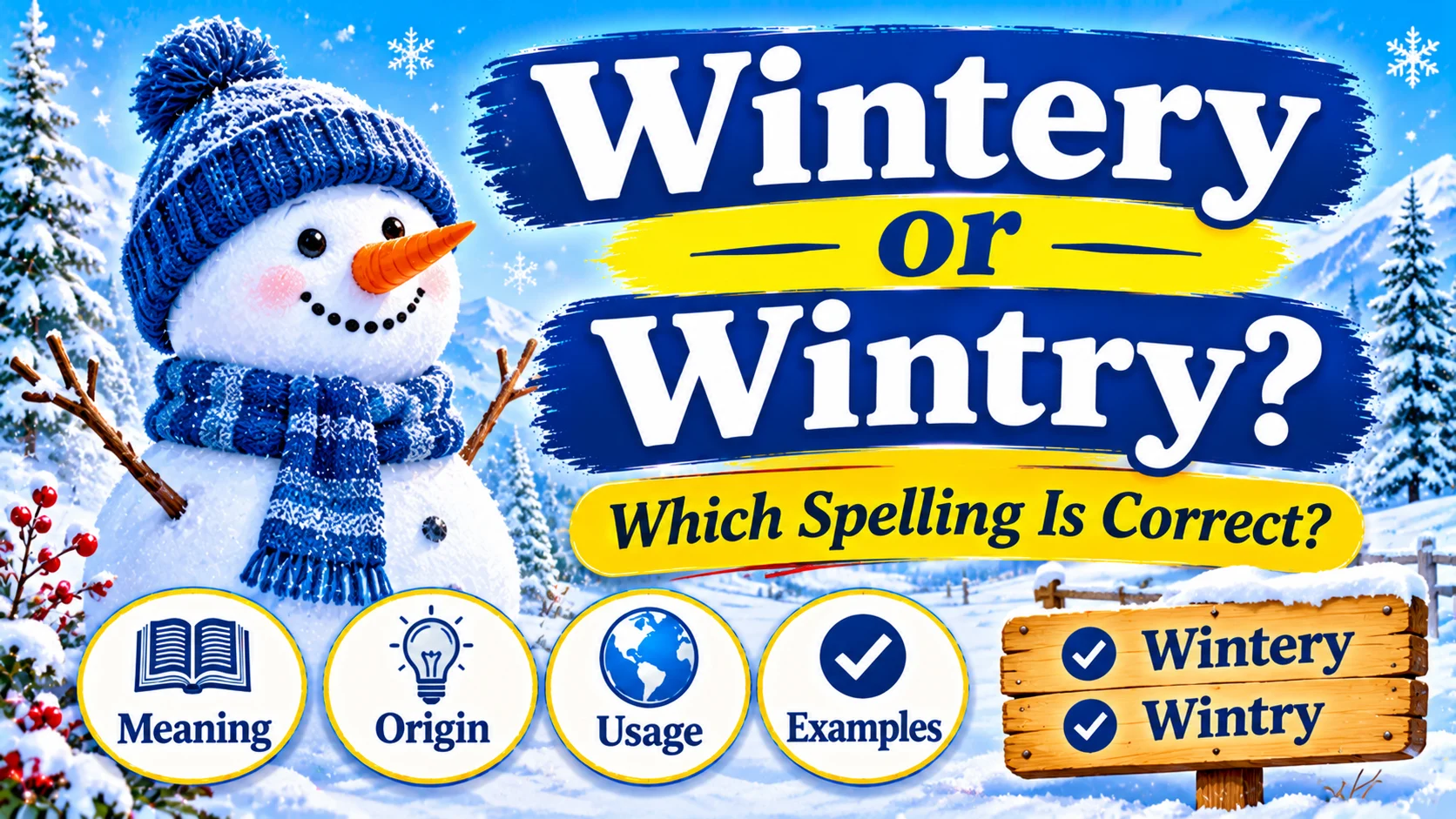
Have you ever typed wintery or wintry and stopped to wonder which spelling is right? You are not alone. The two forms look almost identical, sound similar, and describe the same basic idea. Yet one form is much more common in standard English.
The correct spelling to use in most situations is wintry. It means “of, relating to, or characteristic of winter.” For example, you can write, “The city woke to a cold, wintry morning.” Wintery is also recognized as a variant, but it is less common.
This spelling question matters because wintery looks logical. The noun is winter, so adding -y seems like it should produce wintery. English does not always work that way. The established form is wintry, with the second e removed.
People often search for “wintery or wintry” when writing emails, school assignments, articles, social media posts, or professional documents. They want to know which spelling looks correct and whether the other form is actually a word.
This guide explains the difference, the history behind both forms, regional usage, common mistakes, and the best spelling to use in formal writing.
Wintry is the preferred and more common spelling.
Wintery is also recognized as a less common variant. Both words have the same basic meaning: something related to, typical of, or characteristic of winter.
| Variation | Status | Meaning | Best choice? |
|---|---|---|---|
| wintry | Standard, preferred form | Of or like winter | Yes |
| wintery | Less common variant | Of or like winter | Usually no |
| winterly | Rare/old-fashioned | Related to winter | No for normal modern writing |
Examples:
- Preferred: The roads were dangerous because of wintry weather.
- Less common: The roads were dangerous because of wintery weather.
- Preferred: We enjoyed a beautiful wintry landscape.
- Less common: We enjoyed a beautiful wintery landscape.
The safest rule is simple: Use “wintry” in most writing.
The Origin of Wintery or Wintry
The word wintry is very old. It comes from Old English forms related to winter. The Old English word wintrig was used to describe something connected with winter.
Over time, the spelling changed as English developed. The modern form became wintry.
The spelling can seem strange because the base noun is winter. A reader may expect:
winter + y = wintery
That form does exist. However, English has long used the shorter form:
winter → wintry
The difference is not a difference in meaning. It is mainly a difference in spelling and frequency.
The shorter spelling became the normal form in modern standard English. Wintery survived as a variant, so it is not simply an invented spelling mistake.
Why Does “Wintry” Drop the “e”?
The spelling wintry reflects the historical development of the word rather than a simple modern rule.
English contains many words whose spelling cannot always be predicted by adding a suffix to the base word. That is why it is useful to learn wintry as the established adjective.
A simple memory trick is:
WINTER → WINTRY
Think of wintry as the standard shortened form.
British English vs American English Spelling
Unlike words such as color/colour or favor/favour, wintry does not have a major British-versus-American spelling difference.
Both American and British English use wintry as the main form. Wintery is also found as a less common variant.
This means you do not need to change the spelling based on whether your audience is in the United States or the United Kingdom.
| Feature | American English | British English |
|---|---|---|
| Preferred spelling | wintry | wintry |
| Variant | wintery | wintery |
| Meaning | Related to winter | Related to winter |
| Formal writing | Prefer wintry | Prefer wintry |
| News writing | Prefer wintry | Prefer wintry |
| Pronunciation | Similar | Similar |
Examples in both varieties:
- American: The forecast calls for wintry conditions.
- British: The forecast calls for wintry conditions.
- American: We drove through a wintry landscape.
- British: We drove through a wintry landscape.
So, if you are trying to choose between American and British spelling, wintry works well in both.
Which Spelling Should You Use?
For most writers, the answer is simple:
Use “wintry.”
If You Write for a US Audience
Use wintry in business writing, schoolwork, websites, journalism, and professional documents.
Example:
The region experienced severe wintry weather this week.
If You Write for a UK or Commonwealth Audience
Use wintry as well.
Example:
Wintry showers are expected across northern areas.
The spelling does not need to change just because your audience is British, Australian, Canadian, or from another English-speaking region.
If You Write for a Global Audience
Wintry is the clearest choice because it is the standard form and is widely recognized.
This is especially useful for:
- SEO content
- International websites
- Academic writing
- Business communication
- News content
- Product descriptions
- Professional reports
What About “Wintery”?
You can use wintery if you are intentionally following a source, quotation, house style, or established wording. But if you are choosing the spelling yourself, wintry is normally better.
Common Mistakes with Wintery or Wintry
Mistake 1: Calling “Wintery” Always Wrong
This is too strong.
Wintery is recognized as a variant in major dictionaries. It is simply less common than wintry.
Better advice: Use wintry as the standard choice.
Mistake 2: Assuming Both Forms Are Equally Common
They are not.
Wintry is much more established and common in standard written English. Wintery appears less often.
Mistake 3: Thinking “Wintry” Only Means Snowy
A wintry day does not have to include snow.
It can describe:
- cold weather
- frost
- ice
- winter winds
- gray skies
- short days
- a general winter feeling
For example:
It was a cold and wintry morning.
Mistake 4: Confusing “Wintry” With “Winter”
Winter is a noun.
Wintry is an adjective.
Examples:
Winter can be cold.
It was a wintry afternoon.
The word winter can also be used before another noun, such as winter weather or winter coat. However, wintry emphasizes the quality or character of winter.
Wintery or Wintry in Everyday Examples
The word appears in many types of writing.
In Emails
The recent wintry weather may cause delays on some roads. Please allow extra travel time.
This works well in workplace communication because wintry weather is clear and professional.
In News Writing
Wintry conditions are expected to affect roads across the region.
News writers often use wintry when discussing cold weather, snow, ice, or storms.
In Social Media
Nothing beats a quiet walk through the wintry woods. ❄️
Here, wintry creates a visual feeling. It does not have to describe a specific weather event.
In Formal Writing
The study area experiences long periods of wintry conditions during the colder months.
The standard spelling is the better choice in academic and professional work.
In Creative Writing
A wintry wind moved through the empty street.
Here, wintry can create mood as well as describe weather.
Emotional Meaning
Wintry can also describe something cold, distant, or unfriendly.
For example:
She gave him a wintry smile.
This suggests a cold or unfriendly response.
Wintery or Wintry – Google Trends & Usage Data
People often search “wintery or wintry” because both spellings appear online. Search interest may rise during winter or when people write about seasonal weather.
However, Google Trends should be read carefully. Search volume does not prove that one spelling is grammatically correct. People may search for either form simply because they are unsure.
Dictionary and usage evidence gives the clearer answer: wintry is the established preferred form, while wintery is less common.
Search behavior can also vary by context:
- Weather reports: wintry is common.
- News writing: wintry is common.
- Books: wintry is generally much more common.
- Informal web writing: both forms can appear.
- Professional writing: wintry is the safer choice.
- Search queries: both spellings may appear because users are checking the difference.
Why Search Data Can Be Misleading
Search engines record what people type. They do not automatically tell us which spelling editors prefer.
For SEO, this means wintery is still worth mentioning even though wintry should remain the main spelling.
A useful SEO strategy is to naturally target related searches such as:
- wintery or wintry
- wintry meaning
- is wintery a word
- wintry spelling
- wintery vs wintry
- is wintry correct
- wintery meaning
The goal is to answer the reader’s question clearly rather than repeat the keyword too often.
Wintery vs Wintry: Comparison Table
| Point | Wintry | Wintery |
|---|---|---|
| Part of speech | Adjective | Adjective |
| Basic meaning | Of or like winter | Of or like winter |
| Standard status | Preferred | Variant |
| Frequency | More common | Less common |
| US English | Preferred | Recognized variant |
| British English | Preferred | Recognized variant |
| Formal writing | Recommended | Usually avoid |
| News writing | Recommended | Less common |
| SEO use | Main keyword form | Useful related variation |
| Example | wintry weather | wintery weather |
The key difference is therefore usage, not meaning.
FAQs About Wintery or Wintry
1. Is it “wintry” or “wintery”?
Wintry is the preferred spelling. Wintery is a recognized but less common variant.
2. Is “wintery” a real word?
Yes. Wintery is recognized as a variant of wintry. It is less common than the standard form.
3. Is “wintery” a spelling mistake?
Not always. It is better described as a less common variant. For most formal writing, however, wintry is the better choice.
4. Does “wintry” mean snowy?
Not exactly. Wintry means characteristic of winter. It can describe snow, frost, cold, ice, wind, gray skies, or a general winter-like mood.
5. Is “wintry” American or British English?
It is used in both. There is no major US-versus-UK difference for this word. Both varieties use wintry.
6. Should I use “wintery” in formal writing?
Usually, no. Wintry is the safer and more standard choice for formal, academic, professional, and edited writing.
7. What is the noun form of “wintry”?
The noun wintriness describes the quality or state of being wintry.
Example:
The wintriness of the landscape made the scene feel quiet and cold.
8. What are the comparative and superlative forms?
The comparative is wintrier, and the superlative is wintriest.
Examples:
This year has been wintrier than last year.
January brought the wintriest weather of the season.
Conclusion:
When choosing between wintery or wintry, the safest answer is wintry. It is the standard and more common spelling used to describe something related to, typical of, or characteristic of winter. Wintery is also recognized as a variant, but it is less common.
The confusion is easy to understand. The noun is winter, so wintery looks like the natural result of adding -y. But English spelling does not always follow the simplest pattern. The established adjective is wintry.
There is also no major British-versus-American spelling difference. Writers in both varieties can use wintry with confidence.
For emails, school assignments, news reports, websites, business documents, and formal writing, choose wintry. Use wintery mainly when you are following a source or want to reflect a less common variant.
The simple rule is easy to remember:
Winter → wintry.
If you remember that one line, you will almost always make the right spelling choice.
Fulfillment or Fulfilment? Which Spelling Is Correct?

I am an English Literature expert and professional content writer with a passion for language, grammar, and effective communication. I specialize in creating well-researched, reader-friendly articles on English usage, spelling, vocabulary, writing techniques, and literary topics. My goal is to simplify complex concepts and provide accurate, engaging content that helps readers strengthen their language skills and communicate with confidence.