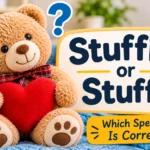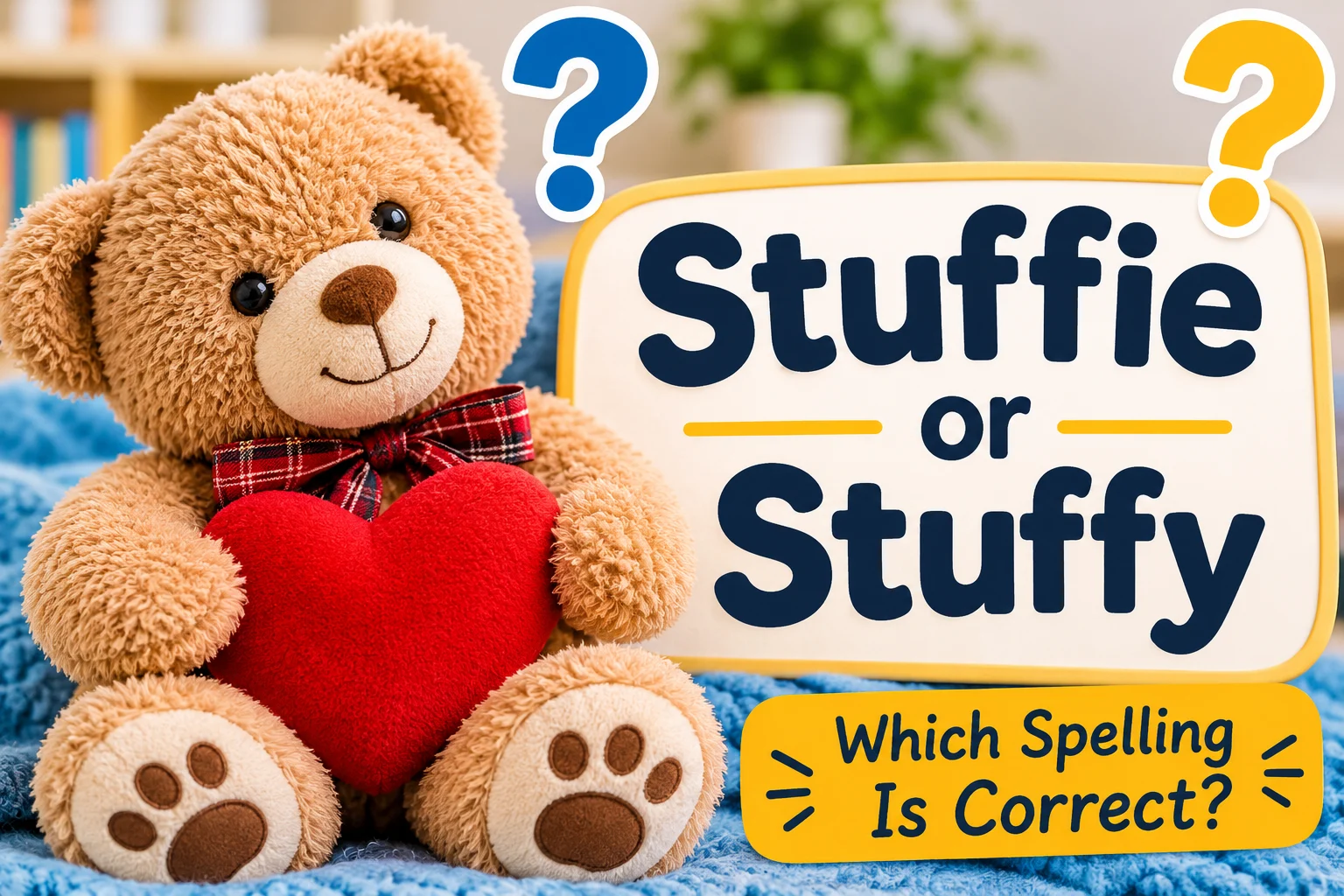
One small spelling change can completely change a word’s meaning. That is exactly what happens with stuffie or stuffy. These words look almost the same, but they usually refer to very different things.
If you are writing about a child’s favorite stuffed animal, you may wonder whether to call it a stuffie or a stuffy. The answer depends on what you mean and, in some cases, where your readers live. Stuffie is an informal noun used for a stuffed toy or stuffed animal. Stuffy is a standard adjective that can describe a room with poor air circulation, a person who is overly formal, or something that feels old-fashioned.
People search for stuffie or stuffy because both spellings appear online, especially in parenting, pet, toy, and social media content. A spelling mistake can change the meaning of a sentence.
This guide explains the difference in simple terms. You will learn the origins of both words, regional usage, common mistakes, everyday examples, search trends, and which spelling is best for different audiences.
Stuffie and stuffy are both correct, but they usually have different meanings.
- Stuffie = an informal word for a stuffed toy or stuffed animal.
- Stuffy = an adjective meaning poorly ventilated, overly formal, or old-fashioned.
Examples
“My daughter sleeps with her favorite stuffie.”
“The room feels stuffy.”
“He brought his favorite stuffie on the trip.”
“The office has a stuffy atmosphere.”
So, if you mean a soft stuffed toy, use stuffie.
If you mean something that feels airless or too formal, use stuffy.
The Origin of Stuffie or Stuffy
The two words come from the same basic root: stuff.
The verb stuff has been used in English for centuries. It means to fill something with material or place something inside it.
The adjective stuffy developed from stuff with the suffix -y. It can mean filled with stale air or lacking fresh air. It can also describe someone or something that seems excessively formal.
For example:
“The classroom was stuffy.”
Over time, stuffy also developed a figurative meaning:
“The club has a stuffy atmosphere.”
Stuffie is different. It is a modern informal formation based on stuffed or stuffed animal. The ending -ie gives the word a cute or familiar tone.
Similar informal words include:
- doggie
- kitty
- blankie
- sweetie
Because stuffie is informal, it appears often in family conversations, parenting communities, children’s language, product descriptions, and social media.
The spelling difference exists because the words have different functions and meanings.
British English vs American English Spelling
The distinction between stuffie and stuffy is not mainly a British-versus-American spelling rule.
Stuffy is a standard English adjective in both American and British English.
Stuffie is an informal noun. Its use can vary by region, family, age group, and online community.
| Meaning | American English | British English |
|---|---|---|
| Stuffed toy | stuffie / stuffed animal | stuffie / soft toy / cuddly toy |
| Poorly ventilated | stuffy | stuffy |
| Too formal | stuffy | stuffy |
| Example | “Her stuffie is on the bed.” | “Her soft toy is on the bed.” |
| Airless room | “The room is stuffy.” | “The room is stuffy.” |
British speakers may prefer soft toy or cuddly toy when referring to a stuffed animal. American speakers often use stuffed animal or, informally, stuffie.
Which Spelling Should You Use?
Your choice depends on the meaning and audience.
For American readers
Use stuffie if you mean a stuffed toy and want an informal, friendly tone.
“Bring your favorite stuffie to the sleepover.”
For professional or general writing, stuffed animal may be clearer.
Use stuffy when describing air, people, places, or attitudes.
“The room became stuffy.”
For British readers
Stuffy has the same standard meanings.
For a stuffed toy, soft toy or cuddly toy may sound more natural than stuffie.
However, British readers can understand stuffie, especially in informal online writing.
For Commonwealth audiences
Usage varies between countries. Terms such as soft toy, cuddly toy, and stuffed toy may be more familiar in some regions.
For a global audience
If clarity matters most, use stuffed toy, stuffed animal, or soft toy rather than relying on stuffie.
Use stuffy normally when describing air, behavior, or atmosphere.
Common Mistakes with Stuffie or Stuffy
Mistake 1: Using “stuffy” for a stuffed animal
Incorrect:
“My child loves her stuffy.”
This can be understood in some informal contexts, but stuffie is clearer if you mean the toy.
Better:
“My child loves her stuffie.”
Or:
“My child loves her stuffed animal.”
Mistake 2: Using “stuffie” to describe a room
Incorrect:
“The bedroom is stuffie.”
Correct:
“The bedroom is stuffy.”
Mistake 3: Treating “stuffie” as formal English
Stuffie is informal.
For a formal product description or report, use:
“stuffed animal”
or
“stuffed toy.”
Mistake 4: Assuming “stuffie” and “stuffy” are interchangeable
They are not usually interchangeable.
“I packed my stuffie.”
means you packed your stuffed toy.
“I packed my stuffy.”
could be unclear or may be interpreted differently.
Mistake 5: Confusing spelling with pronunciation
The two words may sound similar in casual speech, but their meanings and spellings are different.
Stuffie or Stuffy in Everyday Examples
In an email
Informal:
“Please remind Emma to bring her stuffie to school.”
More formal:
“Please remind Emma to bring her favorite stuffed animal.”
In news writing
News writing usually avoids stuffie unless it appears in a quote or is part of a specific name.
“The child was holding a stuffed animal.”
But a direct quote may say:
“I can’t sleep without my stuffie.”
Stuffy is more common in standard news writing:
“The room was hot and stuffy.”
On social media
Stuffie works well in casual posts:
“Meet my new stuffie! 🧸”
It is especially common in posts about children, toys, collecting, and pets.
In formal writing
Use clearer terms:
“The child brought a stuffed animal to the appointment.”
Instead of:
“The child brought a stuffie.”
For rooms or writing styles, use stuffy normally:
“The meeting room felt stuffy.”
In product descriptions
A toy seller may use both terms:
“This soft stuffed animal makes a perfect stuffie for children.”
Here, stuffie adds a friendly, playful tone.
Stuffie or Stuffy – Google Trends & Usage Data
Search interest for stuffie and stuffy reflects their very different meanings.
Stuffy is an established English adjective. People may search it because they want to understand a description of a room, person, writing style, or atmosphere.
Stuffie is more closely linked to informal online language. Searches can come from parents, toy shoppers, collectors, pet owners, and social media users.
Country can also affect the preferred term for a stuffed toy. American content often uses stuffed animal, while British content frequently uses soft toy or cuddly toy.
Google Trends can compare search interest by country and over time. However, Trends provides relative interest, not an exact number of searches. Results can also reflect different meanings of the same word.
For SEO, the safest approach is to explain the difference clearly and use related terms naturally. Include stuffie, stuffy, stuffed animal, stuffed toy, and soft toy only when they match the searcher’s intent.
Stuffie or Stuffy: Variations Side by Side
| Word | Part of speech | Meaning | Example |
|---|---|---|---|
| stuffie | Noun | Informal stuffed toy | “She hugged her stuffie.” |
| stuffy | Adjective | Lacking fresh air | “The room is stuffy.” |
| stuffy | Adjective | Too formal or old-fashioned | “He dislikes stuffy rules.” |
| stuffed animal | Noun | Soft toy shaped like an animal | “She has a stuffed animal.” |
| stuffed toy | Noun | Soft toy filled with material | “The stuffed toy is washable.” |
| soft toy | Noun | British/common international term for a soft toy | “The child chose a soft toy.” |
| cuddly toy | Noun | Soft toy meant for cuddling | “He sleeps with his cuddly toy.” |
FAQs About Stuffie or Stuffy
Is “stuffie” a real word?
Yes. Stuffie is an informal noun used for a stuffed toy or stuffed animal. It is especially common in casual and online language.
Is “stuffy” the same as “stuffie”?
No. Stuffy is normally an adjective. It can describe a room without enough fresh air or a person, style, or place that feels overly formal.
Which is correct for a stuffed animal: stuffie or stuffy?
Stuffie is the clearer informal choice. In standard writing, stuffed animal or stuffed toy is even clearer.
Is “stuffie” American English?
It is especially familiar in American informal English, but it can be understood in other English-speaking regions too.
Do British people say “stuffie”?
Some do, especially in informal or online contexts. However, soft toy and cuddly toy are often more natural in British English.
Is “stuffy” a formal word?
Yes. Stuffy is a standard English adjective. It is suitable for both casual and formal writing when its meaning is correct.
Should I use “stuffie” in professional writing?
Usually, no. If you mean a stuffed toy, stuffed animal, stuffed toy, or soft toy is clearer and more professional.
Conclusion
The choice between stuffie or stuffy depends mainly on meaning. Stuffie is an informal noun for a stuffed toy or stuffed animal. Stuffy is a standard adjective that can describe a room with poor airflow, an overly formal person, or an old-fashioned style.
The two words share the root stuff, but they developed different uses. The spelling is not simply a British or American difference. Regional preferences matter, especially when people choose terms such as stuffed animal, soft toy, or cuddly toy.
For casual American writing, stuffie is a friendly choice for a stuffed toy. For professional or global writing, a clearer term such as stuffed animal or stuffed toy is often better. Use stuffy when you describe air, behavior, style, or atmosphere.
If you remember only one rule, make it this: a stuffie is a toy; stuffy describes something else. Choosing the right form keeps your writing clear and prevents a small spelling difference from changing your meaning.
Taught or Tought: Which Spelling Is Correct?

I am an English Literature expert and professional content writer with a passion for language, grammar, and effective communication. I specialize in creating well-researched, reader-friendly articles on English usage, spelling, vocabulary, writing techniques, and literary topics. My goal is to simplify complex concepts and provide accurate, engaging content that helps readers strengthen their language skills and communicate with confidence.