Have you ever stopped while writing and wondered whether you should use taught or tought? You are not alone. Thousands of people search for this question because the two words look very similar. Many writers, students, and English learners type tought by mistake and want to know if it is a real English word.
This confusion happens because English has many words with unusual spelling. Words like caught, bought, and thought make people think that tought might also be correct. In reality, only one spelling is accepted in standard English.
In this guide, you will learn the correct spelling, where the word comes from, how British and American English treat it, common mistakes to avoid, and real examples from daily writing. By the end, you will know exactly when to use taught and why tought should be avoided.
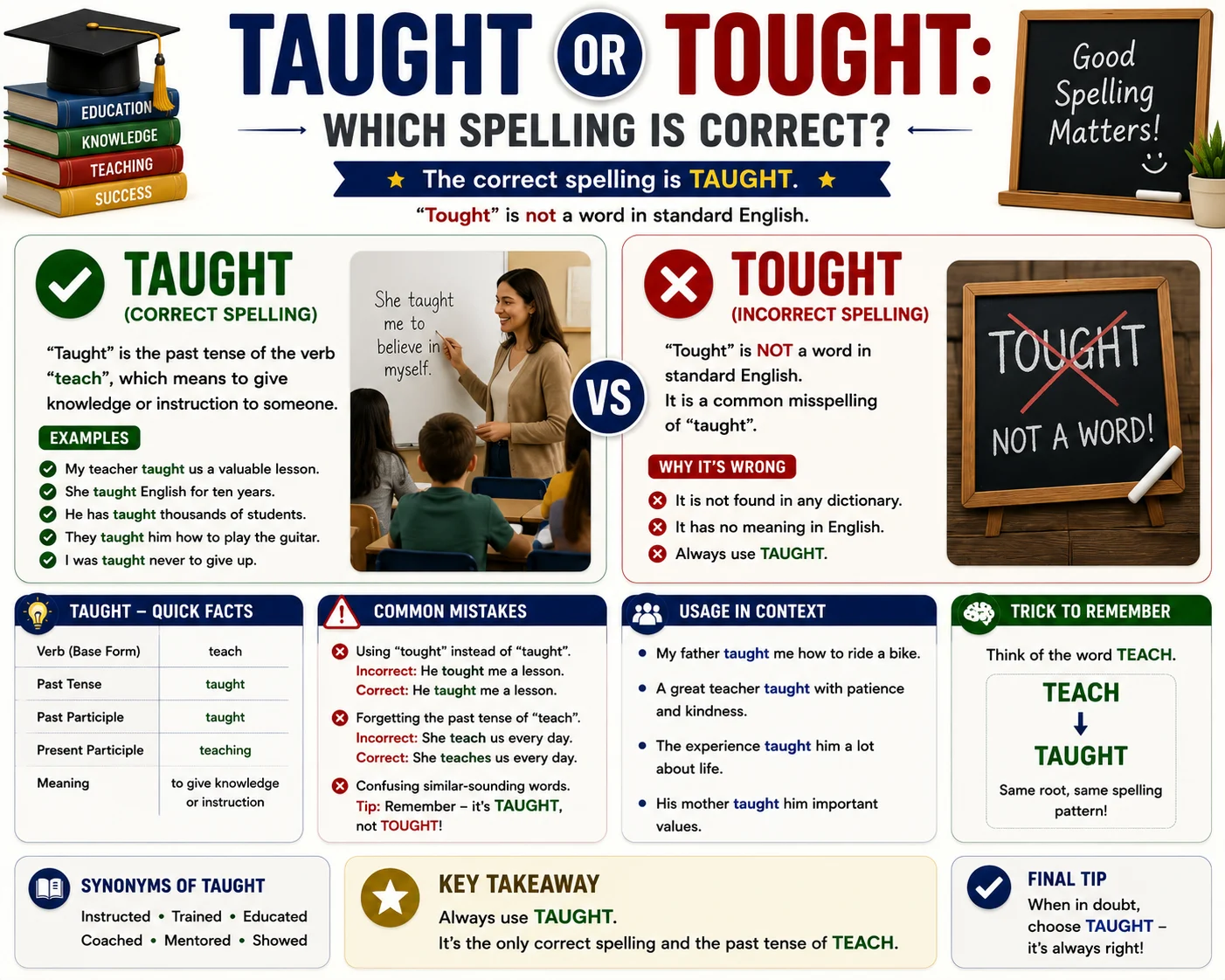
Correct spelling: Taught
Incorrect spelling: Tought
Taught is the past tense and past participle of the verb teach.
Examples
- ✅ My teacher taught me math.
- ✅ She taught English for ten years.
- ❌ My teacher tought me math.
- ❌ He tought us science.
The word tought is simply a spelling mistake. It is not a standard English word.
The Origin of Taught or Tought
The word taught comes from the Old English word tǣhte, which was the past tense of teach. Over many centuries, English spelling changed, but taught remained the accepted form.
Many people write tought because English contains words with similar letter patterns, such as:
- thought
- bought
- fought
- sought
These words all use -ought, so writers sometimes assume teach follows the same rule. It does not. The correct past tense is taught, ending in -aught.
British English vs American English Spelling
Unlike many English words, taught has the same spelling in both British English and American English.
There is no regional spelling difference.
| British English | American English | Correct? |
|---|---|---|
| taught | taught | ✅ Yes |
| tought | tought | ❌ No |
Examples
British English
- She taught history at college.
American English
- He taught science in high school.
The spelling stays exactly the same worldwide.
Which Spelling Should You Use?
Always use taught, no matter who your audience is.
For US readers
Use taught.
For UK readers
Use taught.
For Australia, Canada, New Zealand, and other Commonwealth countries
Use taught.
For international audiences
Use taught because it is the only accepted English spelling.
There is never a situation where tought is correct in standard English.
Common Mistakes with Taught or Tought
Many people confuse these spellings because of similar English words.
| Incorrect | Correct |
|---|---|
| I tought him. | I taught him. |
| She tought English. | She taught English. |
| They have tought us. | They have taught us. |
| He was tought well. | He was taught well. |
Why the mistake happens
People often mix taught with:
- thought
- bought
- fought
Although these words look alike, they have different spellings and meanings.
Taught or Tought in Everyday Examples
In emails
Thank you for everything you taught me during training.
In news
The award went to a teacher who taught for over thirty years.
On social media
My grandfather taught me how to fish.
In formal writing
The professor taught several advanced courses before retiring.
Every example uses taught because it is the correct spelling.
Taught or Tought – Google Trends & Usage Data
Search data shows that taught is the correct and widely used spelling across English-speaking countries.
People often search for tought because they are unsure of the spelling or because of a typing mistake.
Where confusion is common
- United States
- United Kingdom
- Canada
- Australia
- India
- Pakistan
In these countries, people frequently search “taught or tought” to confirm which spelling is correct.
Usage comparison
| Variation | Status | Usage |
|---|---|---|
| taught | Correct | Very common |
| tought | Incorrect | Misspelling |
| teach | Base verb | Very common |
| teaching | Related form | Very common |
| teacher | Related noun | Very common |
Comparison Table
| Word | Correct | Meaning | Example |
|---|---|---|---|
| taught | ✅ Yes | Past tense of teach | She taught English. |
| tought | ❌ No | Misspelling | Never use it. |
| teach | ✅ Yes | Present tense | I teach math. |
| teaching | ✅ Yes | The act of educating | Teaching is rewarding. |
FAQs
Is tought a real English word?
No. Tought is not a standard English word. It is a common spelling mistake.
Is taught the past tense of teach?
Yes. Taught is both the past tense and past participle of teach.
Why do people write tought?
People often confuse it with words like thought, bought, and fought.
Is taught spelled differently in British English?
No. British and American English both use taught.
Can I use tought in formal writing?
No. It is considered a spelling error.
How can I remember the correct spelling?
Remember that teach changes to taught, not tought.
Is taught used in schools and business writing?
Yes. It is the correct spelling in education, business, academic writing, and everyday communication.
Conclusion
Knowing the difference between taught and tought is simple once you understand the rule. Taught is the only correct spelling and is the past tense of teach. It is accepted in British English, American English, and every other major variety of English. On the other hand, tought is only a misspelling. It appears because English contains many similar-looking words, but it should never be used in professional, academic, or everyday writing.
Whenever you describe someone giving lessons or sharing knowledge in the past, choose taught. Whether you are writing an email, school assignment, business report, blog post, or social media update, this spelling is always correct. If you accidentally type tought, simply replace it with taught. Remembering this small difference will improve your writing, help you avoid common spelling mistakes, and make your English look more polished and professional.
Grimey or Grimy: Which Spelling Is Correct?

I am an English Literature expert and professional content writer with a passion for language, grammar, and effective communication. I specialize in creating well-researched, reader-friendly articles on English usage, spelling, vocabulary, writing techniques, and literary topics. My goal is to simplify complex concepts and provide accurate, engaging content that helps readers strengthen their language skills and communicate with confidence.