Have you ever typed “openned” and wondered if it was correct? You are not alone. Many English learners, students, writers, and professionals search for “openned or opened” because English spelling rules can be confusing. Some words double the final letter before adding -ed, while others do not. This makes it easy to guess the wrong spelling.
The good news is that the answer is simple. Once you understand the spelling rule behind the word, you will never have to second-guess it again. Whether you are writing an email, a school assignment, a business report, or a social media post, using the correct spelling helps your writing look professional and clear.
In this guide, you will learn the correct spelling, why the mistake happens, how British and American English treat the word, common errors to avoid, and real-life examples. By the end, you will know exactly when to use opened and why openned is always incorrect.
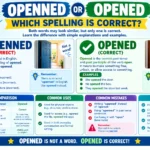
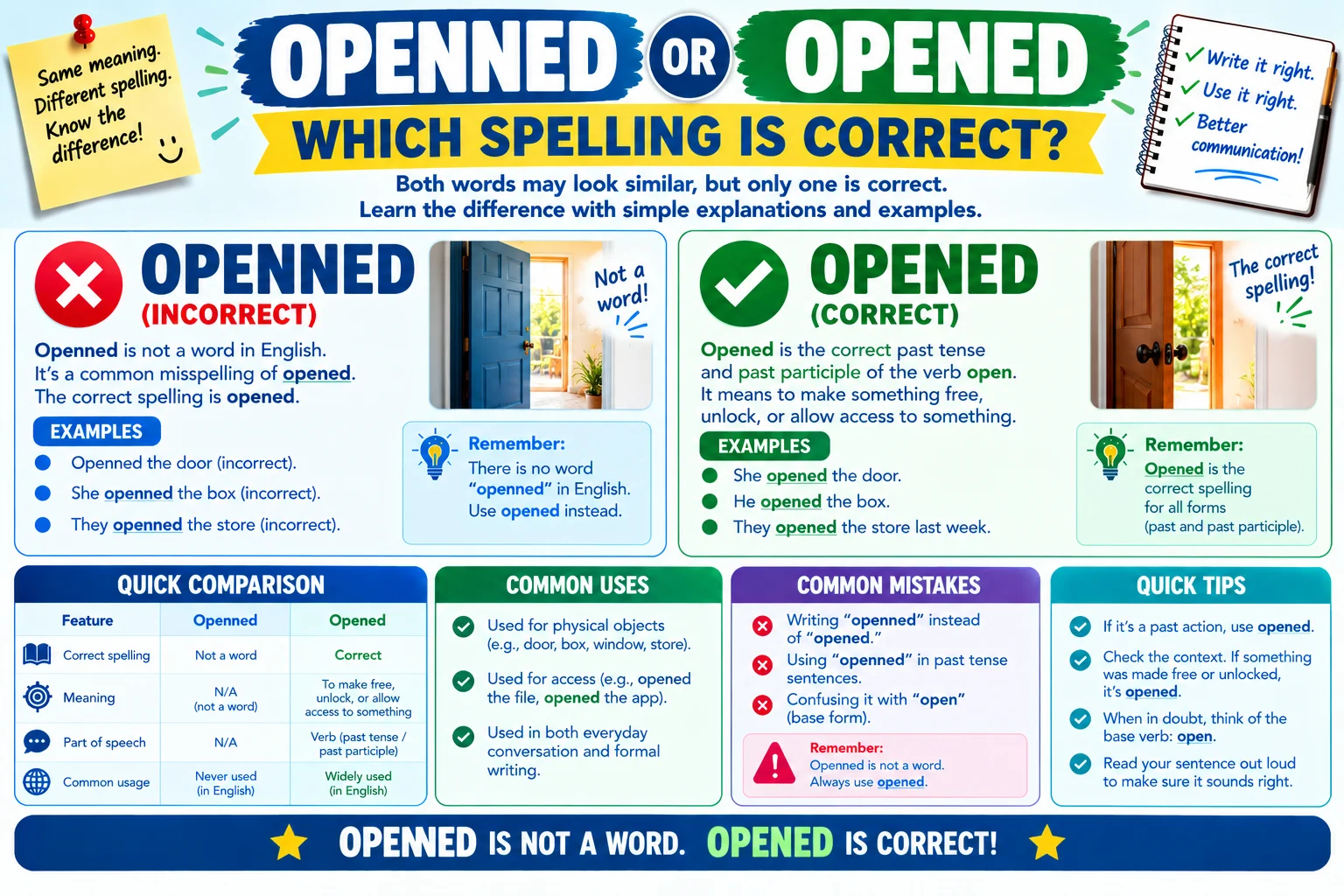
The correct spelling is opened.
Openned is not a correct English word.
The verb open forms its past tense by adding -ed.
Correct examples:
- She opened the window.
- They opened a new store yesterday.
- I opened your email this morning.
Incorrect examples:
- ❌ She openned the window.
- ❌ He openned the door.
Quick rule:
- Open → Opened ✅
- Open → Openned ❌
The Origin of Openned or Opened
The word open comes from Old English openian, which means “to make open” or “to uncover.”
Over hundreds of years, the spelling became open, and its regular past tense became opened by simply adding -ed.
Many people mistakenly write openned because English sometimes doubles the final consonant before adding -ed.
For example:
- Plan → Planned
- Stop → Stopped
- Drop → Dropped
However, open does not follow this pattern because the stress is not on the final syllable. Therefore, the final n is not doubled.
British English vs American English Spelling
There is no spelling difference between British English and American English for this word.
Both varieties use opened.
| British English | American English | Correct? |
| Opened | Opened | ✅ Yes |
| Openned | Openned | ❌ No |
Examples
British English
- The museum opened at 10 a.m.
American English
- The restaurant opened last week.
No matter where you write English, opened is always the correct spelling.
Which Spelling Should You Use?
Your audience determines many spelling choices in English, but not this one.
If your audience is in the United States
Use opened.
If your audience is in the United Kingdom
Use opened.
If your audience is in Canada, Australia, New Zealand, or other Commonwealth countries
Use opened.
If you write for a global audience
Use opened because it is the only accepted spelling worldwide.
Common Mistakes with Openned or Opened
Here are the mistakes people make most often.
| Incorrect | Correct |
| Openned | Opened |
| Openning | Opening |
| Openning the file | Opening the file |
| Openned yesterday | Opened yesterday |
Why do people write “openned”?
People often copy the spelling pattern from words like:
- Planned
- Stopped
- Preferred
Since those words double the final consonant, many assume open should become openned. That assumption is incorrect.
Openned or Opened in Everyday Examples
- I opened your attachment this morning.
News
- The airport opened after repairs.
Social Media
- Just opened my birthday gifts!
Formal Writing
- The company opened three new offices this year.
School Assignment
- The teacher opened the discussion with an interesting question.
Openned or Opened – Google Trends & Usage Data
Searches for “openned or opened” are common because many people are unsure about English spelling rules.
In English-speaking countries such as the United States, the United Kingdom, Canada, Australia, and India, users frequently search this keyword while writing emails, homework, articles, and business documents.
The correct word opened appears millions of times in books, newspapers, websites, and professional writing. The spelling openned mainly appears as a typing mistake or spelling error rather than as an accepted English word.
Keyword Comparison
| Variation | Correct | Notes |
| Opened | ✅ Yes | Standard English spelling |
| Openned | ❌ No | Common spelling mistake |
| Open | ✅ Yes | Base verb |
| Opening | ✅ Yes | Present participle and noun |
| Opens | ✅ Yes | Third-person singular |
| Opening up | ✅ Yes | Common phrase |
Frequently Asked Questions
Is “openned” a real English word?
No. Openned is not recognized as a correct English word.
Why is “opened” spelled with one “n”?
Because open follows the standard rule of adding -ed without doubling the final consonant.
Is “opened” correct in British English?
Yes. British English uses opened.
Is “opened” correct in American English?
Yes. American English also uses opened.
Why do people spell it as “openned”?
They often confuse it with verbs like planned and stopped, which double the final consonant.
How can I remember the correct spelling?
Think of the base word:
Open + ed = Opened
No extra n is needed.
Can spell check catch “openned”?
Most modern spell checkers mark openned as incorrect and suggest opened.
Conclusion
The confusion between openned or opened is common, but the correct answer is clear. The only correct spelling is opened, which is the regular past tense of the verb open. The spelling openned is a mistake that comes from applying the wrong spelling rule. While some English verbs double the final consonant before adding -ed, open does not because its stress pattern does not require it.
The good news is that this rule stays the same in every major variety of English. Whether you write for readers in the United States, the United Kingdom, Canada, Australia, or anywhere else, opened is always the correct choice. Using the right spelling improves clarity, strengthens your credibility, and helps your writing appear more professional. If you ever hesitate, remember the simple formula: Open + ed = Opened. Keeping this rule in mind will help you avoid one of the most common spelling mistakes and write with greater confidence every time.
Loss or Lost: Difference, Meaning, and Correct Usage Explained

I am an English Literature expert and professional content writer with a passion for language, grammar, and effective communication. I specialize in creating well-researched, reader-friendly articles on English usage, spelling, vocabulary, writing techniques, and literary topics. My goal is to simplify complex concepts and provide accurate, engaging content that helps readers strengthen their language skills and communicate with confidence.