Have you ever stopped while writing and wondered whether you should use kneeled or knelt? You’re not alone. Many English learners, students, writers, and professionals search for this question because both words appear in books, websites, and everyday conversations.
The confusion comes from the fact that kneeled and knelt are both accepted past tense forms of the verb kneel. However, one is more common in certain countries, while the other is preferred in different writing styles. Understanding the difference helps you sound natural and write with confidence.
This guide explains everything you need to know about kneeled or knelt. You’ll learn their meaning, history, regional differences, common mistakes, and when to use each one. You’ll also see practical examples, comparison tables, FAQs, and usage advice so you can choose the right spelling for any audience.
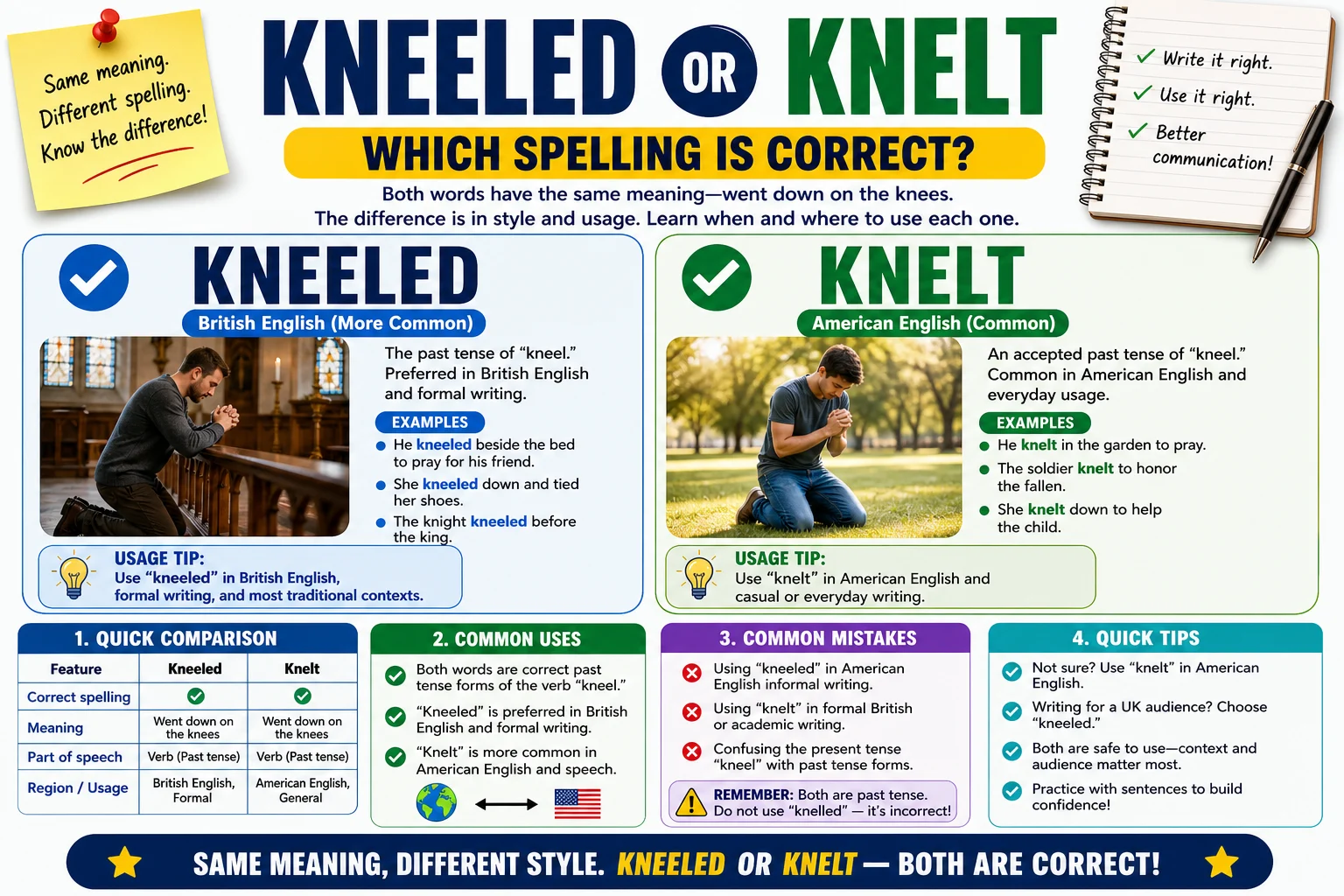
Both kneeled and knelt are correct.
- Knelt is the traditional and more common past tense of kneel.
- Kneeled is also correct and is widely accepted, especially in American English.
Examples
- She knelt beside the child to help.
- He kneeled during the ceremony.
- The players knelt before the game.
- The firefighter kneeled next to the injured man.
Quick Tip: If you are unsure, knelt is accepted almost everywhere.
The Origin of Kneeled or Knelt
The verb kneel comes from Old English and has existed for hundreds of years. Like many old English verbs, it originally formed its past tense using an irregular ending.
That is why knelt became the traditional past tense.
Over time, English began making many verbs regular by adding -ed. This created the form kneeled, which follows the normal English grammar pattern.
Today:
- Knelt keeps the older irregular form.
- Kneeled follows the regular verb pattern.
Because both forms have been used for many years, dictionaries recognize both as correct.
British English vs American English Spelling
Regional English plays a big role in choosing between kneeled and knelt.
- British English strongly prefers knelt.
- American English uses both, although knelt is still very common.
- Canadian, Australian, and New Zealand English usually prefer knelt.
Comparison Table
| Feature | Knelt | Kneeled |
|---|---|---|
| Correct? | Yes | Yes |
| British English | Preferred | Less common |
| American English | Common | Also common |
| Australian English | Preferred | Rare |
| Canadian English | Preferred | Less common |
| Formal Writing | Preferred | Accepted |
| Everyday Speech | Very common | Common in the US |
Examples
British English
- She knelt in prayer.
American English
- She kneeled beside her dog.
- She knelt beside her dog.
Which Spelling Should You Use?
The best choice depends on your audience.
For American Readers
Use either knelt or kneeled.
If you want a more traditional style, choose knelt.
For British Readers
Use knelt.
It is the expected form in British English.
For Commonwealth Countries
Use knelt.
This includes:
- Canada
- Australia
- New Zealand
- South Africa
For Global Audiences
Choose knelt.
It is recognized everywhere and sounds natural to most readers.
Common Mistakes with Kneeled or Knelt
Here are mistakes people often make.
| Incorrect | Correct |
|---|---|
| He kneel yesterday. | He knelt yesterday. |
| She has kneel down. | She has knelt down. |
| They was knelting. | They were kneeling. |
| He kneeleded quickly. | He kneeled quickly. |
| She kneel beside him. | She knelt beside him. |
Remember
- Present: kneel
- Present participle: kneeling
- Past: knelt or kneeled
- Past participle: knelt or kneeled
Kneeled or Knelt in Everyday Examples
Here are examples from everyday writing.
I knelt to check the damaged equipment before sending the report.
News
The crowd knelt during the national anthem.
Social Media
We kneeled together to take the perfect photo.
Formal Writing
The knight knelt before the king during the ceremony.
School Writing
The child knelt beside the plant and watered it carefully.
Conversation
He kneeled down to tie his shoe.
Kneeled or Knelt – Google Trends & Usage Data
Search interest shows that both spellings are used around the world, but their popularity changes by region.
| Country | More Popular Form |
|---|---|
| United States | Knelt and Kneeled |
| United Kingdom | Knelt |
| Canada | Knelt |
| Australia | Knelt |
| New Zealand | Knelt |
Usage Context
| Situation | Best Choice |
|---|---|
| Academic Writing | Knelt |
| News Articles | Knelt |
| Business Writing | Knelt |
| American Casual Writing | Kneeled or Knelt |
| International Content | Knelt |
Overall, knelt appears more often in books, newspapers, and formal writing, while kneeled is more common in conversational American English.
Comparison Table: Kneeled vs Knelt
| Feature | Kneeled | Knelt |
|---|---|---|
| Grammar | Correct | Correct |
| Verb Type | Regular | Irregular |
| American English | Common | Very Common |
| British English | Less Common | Preferred |
| Formal Writing | Accepted | Preferred |
| International Writing | Accepted | Recommended |
| Traditional Form | No | Yes |
FAQs
Is kneeled or knelt correct?
Both are correct. They are accepted past tense forms of kneel.
Which is more common, kneeled or knelt?
Knelt is more common worldwide.
Is kneeled wrong?
No. Kneeled is grammatically correct, especially in American English.
Do dictionaries accept both spellings?
Yes. Major English dictionaries recognize both kneeled and knelt.
Which spelling should students use?
Use knelt unless your teacher or style guide prefers kneeled.
Is knelt more formal?
Yes. Knelt is usually preferred in formal writing and published works.
Can I use kneeled in business writing?
Yes, but knelt is generally the safer choice for professional and international audiences.
Conclusion
Choosing between kneeled or knelt is easier once you know that both forms are correct. The main difference is not grammar but usage and regional preference. Knelt is the traditional irregular past tense of kneel and remains the preferred choice in British English, most Commonwealth countries, and formal writing. It also works well for international audiences because it is widely recognized and commonly used in books, journalism, and professional communication.
Kneeled follows the regular -ed pattern and is fully accepted, particularly in American English. It often appears in everyday speech and informal writing. If you are writing for a U.S. audience, either form is appropriate, although knelt is still very common. For academic, business, or global content, knelt is generally the safest option. By understanding the history, regional preferences, and practical examples in this guide, you can confidently choose the form that best matches your readers and writing style.
Wonder or Wander: What’s the Difference and Which Word Should You Use?

I am an English Literature expert and professional content writer with a passion for language, grammar, and effective communication. I specialize in creating well-researched, reader-friendly articles on English usage, spelling, vocabulary, writing techniques, and literary topics. My goal is to simplify complex concepts and provide accurate, engaging content that helps readers strengthen their language skills and communicate with confidence.