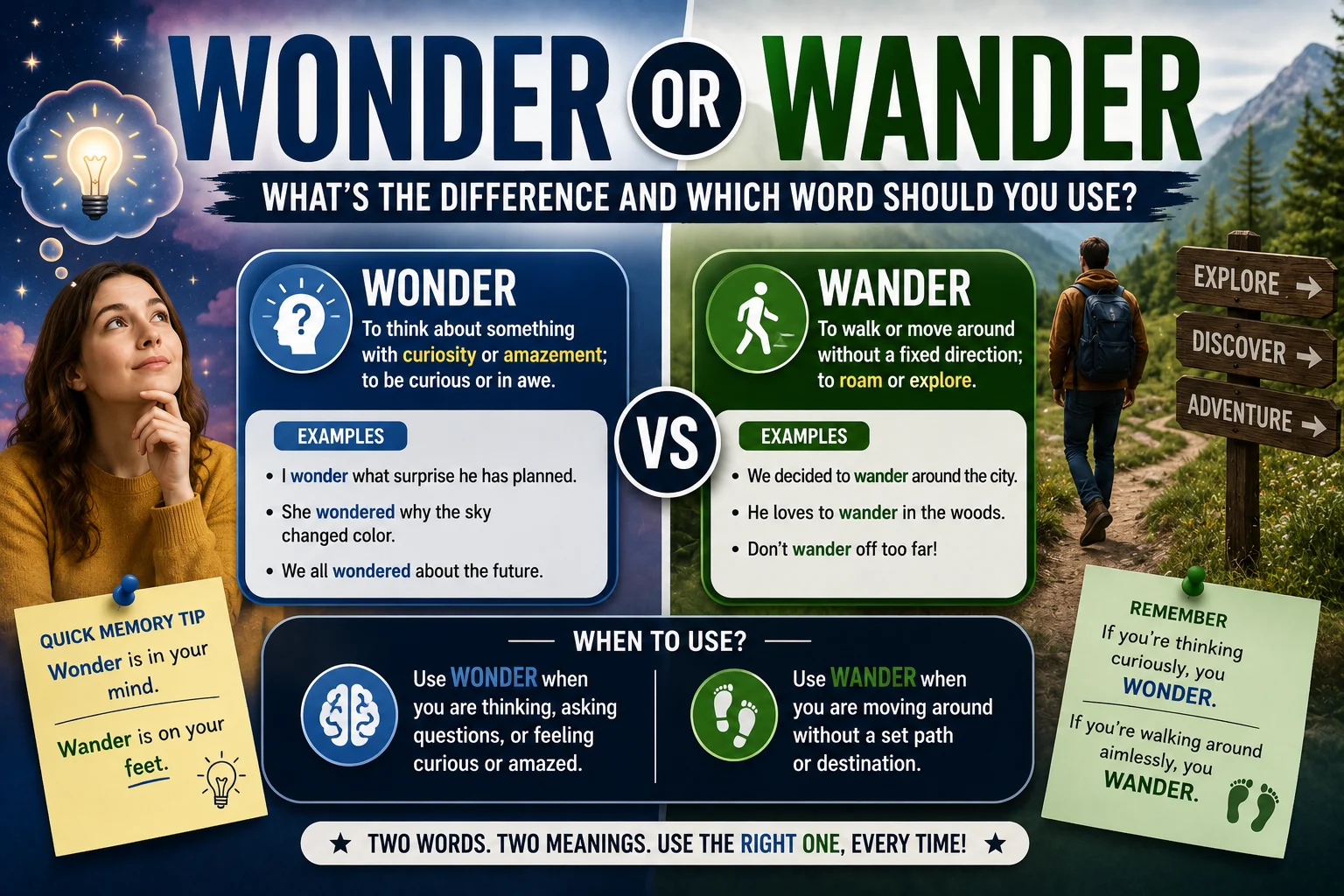
Have you ever paused while writing because you were unsure whether to use wonder or wander? You are not alone. Thousands of people search for “wonder or wander” because these two words look and sound similar but have very different meanings. One is about thinking or feeling curious, while the other is about moving from place to place without a clear direction.
This confusion is common among students, English learners, writers, and even native speakers. Choosing the wrong word can change the meaning of a sentence and make your writing less clear. Whether you are writing an email, a school assignment, a blog post, or a social media caption, using the correct word helps you communicate better.
In this guide, you’ll learn the difference between wonder and wander, where each word comes from, whether British and American English use them differently, common mistakes to avoid, and real-life examples. By the end, you’ll know exactly when to use each word with confidence.
Wonder and wander are both correct English words, but they have different meanings.
- Wonder means to think, question, or feel curiosity.
- Wander means to walk, travel, or move without a fixed direction.
Correct Examples
Wonder
- I wonder where she is.
- They wondered if it would rain.
- Children wonder about space.
Wander
- We wandered through the forest.
- Don’t wander away from the group.
- She likes to wander around the city.
Quick Tip
- Wonder = Think
- Wander = Walk
The Origin of Wonder or Wander
Although wonder and wander look alike, they come from different Old English words.
Wonder comes from the Old English word wundor, meaning surprise, amazement, or curiosity. Over time, it came to mean thinking deeply or asking questions.
Wander comes from the Old English word wandrian, meaning to roam or move without a fixed path.
Their similar spelling causes confusion, but they have different histories and meanings.
Easy Way to Remember
- Wonder is about your mind.
- Wander is about your feet.
British English vs American English Spelling
There is no spelling difference between British English and American English for wonder and wander.
Both countries use the same spellings and meanings.
Comparison Table
| English Version | Wonder | Wander |
|---|---|---|
| British English | ✅ wonder | ✅ wander |
| American English | ✅ wonder | ✅ wander |
| Canadian English | ✅ wonder | ✅ wander |
| Australian English | ✅ wonder | ✅ wander |
Examples
British English:
- I wonder what happened.
- They wandered through the countryside.
American English:
- I wonder if he is coming.
- Tourists wandered around the park.
Which Spelling Should You Use?
The correct word depends on your meaning.
| Audience | Use Wonder | Use Wander |
|---|---|---|
| United States | Thinking or curiosity | Walking or roaming |
| United Kingdom | Thinking or curiosity | Walking or roaming |
| Canada | Thinking or curiosity | Walking or roaming |
| Australia | Thinking or curiosity | Walking or roaming |
| Global Audience | Same rule | Same rule |
Choose wonder when talking about thoughts or questions.
Choose wander when talking about movement or travel.
Common Mistakes with Wonder or Wander
These words are often mixed up because they sound similar.
| Incorrect Sentence | Correct Sentence |
|---|---|
| I wander why she left. | I wonder why she left. |
| We wondered around town. | We wandered around town. |
| Don’t wonder too far away. | Don’t wander too far away. |
| I like to wander about life. | I like to wonder about life. |
Why People Get Confused
- The words have similar pronunciation.
- Only one letter is different.
- Both are common in everyday English.
Memory Trick
- Wonder begins with Won, like thinking you want to know.
- Wander contains and, reminding you to move from one place and another.
Wonder or Wander in Everyday Examples
“I wonder if we can meet tomorrow.”
News
“Hikers wandered off the marked trail.”
Social Media
“I wonder what next year will bring.”
Formal Writing
“Researchers wonder whether climate patterns are changing.”
Travel Blog
“We wandered through the old streets for hours.”
Daily Conversation
“I wonder where my keys are.”
“Let’s wander around before dinner.”
Wonder or Wander – Google Trends & Usage Data
Searches for “wonder or wander” are common because people want to understand the difference between these similar-looking words.
Generally:
- Wonder appears more often in daily conversation, books, and online searches because it expresses curiosity.
- Wander is common in travel writing, storytelling, and outdoor topics.
- English learners frequently search for this keyword to avoid using the wrong word.
- Search interest is high in countries where English is widely learned, including India, Pakistan, the Philippines, Canada, Australia, the United Kingdom, and the United States.
Grammar websites and dictionaries consistently explain that both words are correct but should be used in different contexts.
Comparison Table: Keyword Variations
| Word | Part of Speech | Meaning | Correct? |
|---|---|---|---|
| wonder | Verb/Noun | Curiosity or amazement | ✅ Yes |
| wondered | Verb | Past tense of wonder | ✅ Yes |
| wondering | Verb | Present participle | ✅ Yes |
| wander | Verb | Move without direction | ✅ Yes |
| wandered | Verb | Past tense of wander | ✅ Yes |
| wandering | Verb | Present participle | ✅ Yes |
Frequently Asked Questions
1. Is it “wonder” or “wander why”?
The correct phrase is wonder why because it refers to thinking or asking a question.
2. Is “wander” ever used to mean thinking?
No. Wander means to move or travel without a clear direction.
3. Are “wonder” and “wander” interchangeable?
No. They have different meanings and cannot replace each other.
4. Is the spelling different in British and American English?
No. Both varieties use wonder and wander with the same spelling and meaning.
5. How can I remember the difference?
Remember:
- Wonder = Think
- Wander = Walk
6. Which word is more common?
Wonder is generally more common because people often express curiosity in everyday speech and writing.
7. Can “wander” be used figuratively?
Yes. It can describe thoughts moving without focus.
Example:
“My mind began to wander during the meeting.”
Conclusion
Understanding the difference between wonder or wander is easier than it first seems. Although the words look alike and sound similar, they have completely different meanings. Wonder is connected to curiosity, questions, and thinking. Wander is about moving from place to place without a fixed direction. Choosing the correct word helps your writing stay clear and accurate.
The good news is that there is no difference between British and American English for these words. The spelling remains the same across all major English-speaking countries. A simple way to remember them is this: wonder happens in your mind, while wander happens with your feet. Whenever you write, think about whether you are describing a thought or a movement. Following this easy rule will help you avoid one of the most common vocabulary mistakes in English and make your communication more natural, professional, and easy to understand.
Blink or Ring: Which Word Should You Use? Meaning, Differences, Examples & Usage Guide





5 thoughts on “Wonder or Wander: What’s the Difference and Which Word Should You Use?”