Have you ever wondered whether you should write passtime or pastime? You are not alone. Many people search for this keyword because the two words look similar, but only one is correct in standard English. This common spelling mistake appears in school assignments, blog posts, emails, and even social media. Knowing the right spelling helps you write with confidence and avoid simple errors.
The confusion usually comes from how the word sounds. Some people hear “past time” and assume the spelling should be passtime. Others think it may be a compound word formed from “pass” and “time.” In reality, English has a different history for this word. Understanding its origin makes the correct spelling much easier to remember.
In this guide, you’ll learn the quick answer, the history of the word, British and American spelling differences, common mistakes, real-life examples, and usage trends. By the end, you’ll know exactly when and why to use pastime.
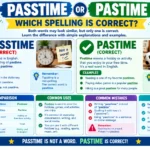
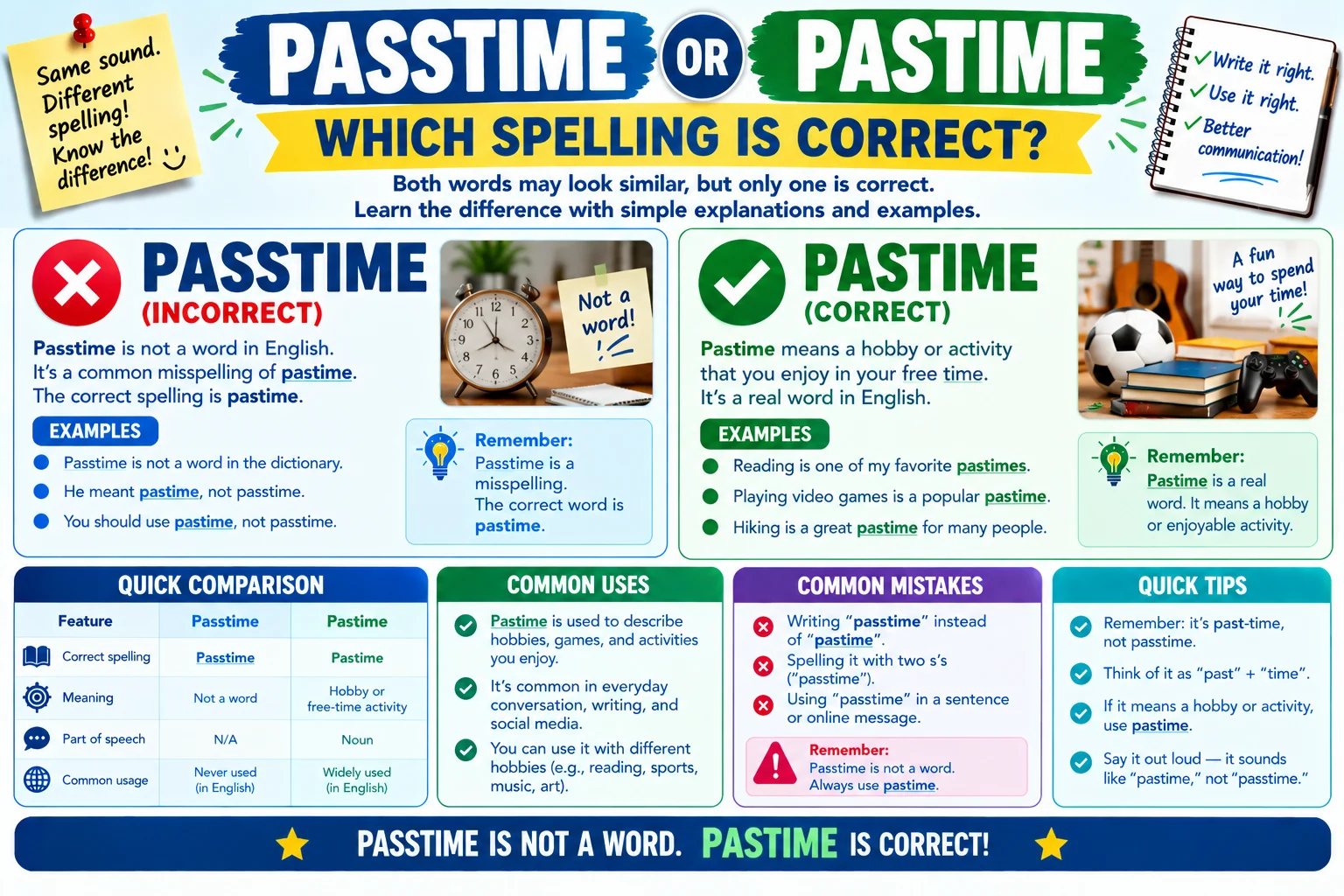
The correct spelling is pastime.
Passtime is not a standard English word.
Pastime means an activity that someone enjoys doing for fun during free time.
Examples
- Reading is my favorite pastime.
- Gardening is a relaxing pastime.
- Watching movies is a popular pastime.
Incorrect:
- ❌ Reading is my favorite passtime.
Correct:
- ✅ Reading is my favorite pastime.
The Origin of Passtime or Pastime
The word pastime comes from the phrase “pass time.” Hundreds of years ago, people used the expression to describe spending or passing time in an enjoyable way.
Over time, the phrase became one word: pastime.
The spelling changed naturally as English developed. Today, dictionaries recognize only pastime as the correct noun.
The confusion happens because people still connect the word with the verb pass. This leads many writers to mistakenly spell it as passtime.
British English vs American English Spelling
Unlike many English words, pastime has the same spelling in both British English and American English.
There is no regional spelling difference.
| English Version | Correct Spelling | Example |
| British English | Pastime | Cricket is a popular pastime. |
| American English | Pastime | Baseball is America’s favorite pastime. |
| Australian English | Pastime | Surfing is a common pastime. |
| Canadian English | Pastime | Hiking is a healthy pastime. |
Key Point
Whether you write for the UK, the US, Canada, Australia, or anywhere else, pastime is always the correct spelling.
Which Spelling Should You Use?
The answer is simple.
If your audience is in the United States
Use pastime.
If your audience is in the United Kingdom
Use pastime.
If your audience is in Australia, Canada, New Zealand, or other Commonwealth countries
Use pastime.
If your audience is global
Use pastime because it is the accepted spelling worldwide.
There is never a situation where passtime is considered standard English.
Common Mistakes with Passtime or Pastime
Here are mistakes people often make.
| Incorrect | Correct |
| Passtime | Pastime |
| My passtime is painting. | My pastime is painting. |
| Favorite passtime | Favorite pastime |
| Outdoor passtime | Outdoor pastime |
Why People Make This Mistake
- They confuse pass with past.
- They spell the word the way it sounds.
- They assume it comes directly from “pass” and “time.”
Easy Trick to Remember
Think of pastime as an activity from your free time.
Remember:
Pastime = hobby.
Passtime or Pastime in Everyday Examples
“My favorite pastime is reading before bed.”
News
“Photography has become a popular pastime among young people.”
Social Media
“My weekend pastime is trying new coffee shops.”
Formal Writing
“Birdwatching is a relaxing pastime enjoyed by people of all ages.”
Conversation
“My favorite pastime is playing chess.”
Passtime or Pastime – Google Trends & Usage Data
Search data shows that pastime is overwhelmingly more common than passtime.
People usually search passtime because they want to know whether it is correct. Search engines and dictionaries consistently recognize pastime as the standard spelling.
Popular Usage by Country
| Country | Common Form |
| United States | Pastime |
| United Kingdom | Pastime |
| Canada | Pastime |
| Australia | Pastime |
| New Zealand | Pastime |
Common Search Intent
- Is it pastime or passtime?
- Correct spelling of pastime
- Meaning of pastime
- Pastime examples
- Pastime definition
Comparison Table
| Keyword Variation | Correct? | Meaning |
| Pastime | ✅ Yes | A hobby or enjoyable activity |
| Passtime | ❌ No | Misspelling |
| Pass time | ✅ Yes (verb phrase) | To spend time |
| Passing time | ✅ Yes | The act of spending time |
Frequently Asked Questions
1. Is passtime a real word?
No. Passtime is not recognized as a standard English word.
2. What is the correct spelling?
The correct spelling is pastime.
3. What does pastime mean?
A pastime is a hobby or activity done for enjoyment during free time.
4. Is there a British spelling of pastime?
No. British and American English both use pastime.
5. Can I write “pass time” instead?
Yes, but only when it is used as a verb phrase.
Example:
“We played cards to pass time.”
As a noun, use pastime.
6. Why do people spell it as passtime?
People often confuse the word with the verb pass, leading to the incorrect spelling passtime.
7. Is pastime one word or two?
As a noun meaning hobby, it is always one word: pastime.
Conclusion
The choice between passtime and pastime is actually very simple. Pastime is the only correct spelling when referring to a hobby or an enjoyable activity. Although many people mistakenly write passtime, dictionaries, style guides, and English language experts do not accept it as a standard word.
The confusion comes from the phrase pass time, which means to spend time. Over the years, that expression developed into the noun pastime, creating a spelling that no longer matches the original verb. Once you understand this history, the difference becomes much easier to remember.
No matter whether you write for readers in the United States, the United Kingdom, Canada, Australia, or anywhere else, pastime is always the correct choice. If you mean an enjoyable hobby, use pastime. If you mean spending time, use the verb phrase pass time. Following this simple rule will make your writing clearer, more professional, and free from one of the most common English spelling mistakes.
Loss or Lost: Difference, Meaning, and Correct Usage Explained

I am an English Literature expert and professional content writer with a passion for language, grammar, and effective communication. I specialize in creating well-researched, reader-friendly articles on English usage, spelling, vocabulary, writing techniques, and literary topics. My goal is to simplify complex concepts and provide accurate, engaging content that helps readers strengthen their language skills and communicate with confidence.