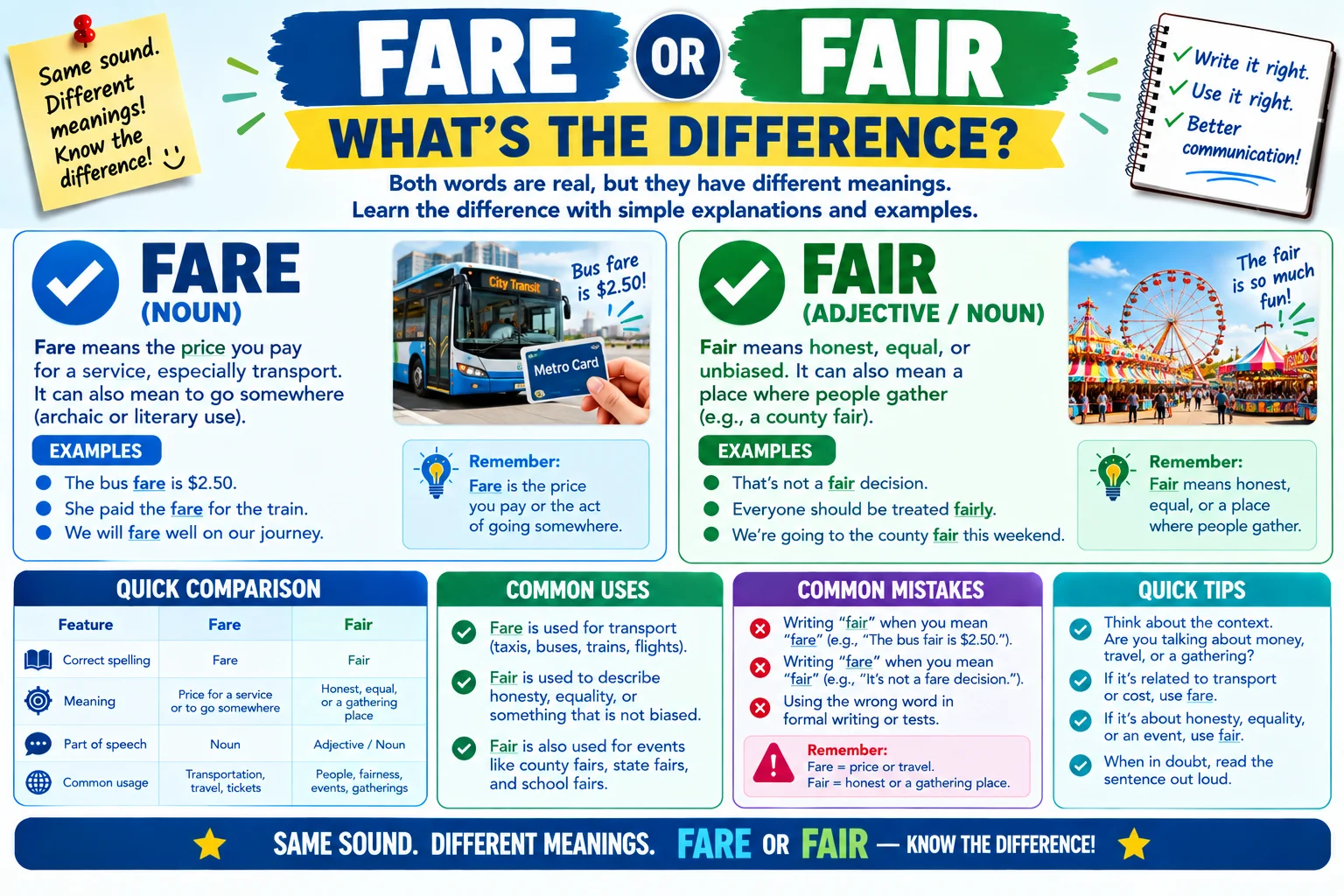
Have you ever stopped while writing and wondered whether to use fare or fair? You are not alone. These two words sound exactly the same, but they have very different meanings. Because they are homophones, many people mix them up in emails, school work, social media posts, and even business writing.
People search for “fare or fair” because they want a quick answer that helps them avoid spelling mistakes. Some want to know the correct word for bus tickets or airline prices. Others wonder whether fair means equal, honest, or a public event. Understanding the difference helps you write with confidence and avoid common grammar errors.
In this guide, you will learn the meaning of fare and fair, where each word comes from, how they are used in British and American English, and which one you should choose in different situations. You will also find easy examples, comparison tables, common mistakes, FAQs, and practical writing tips.
Fare usually means the price you pay for travel or how someone performs or succeeds.
Examples:
- The bus fare is $3.
- She fared well in the interview.
Fair usually means just, honest, reasonable, or light in color. It can also mean a public event.
Examples:
- The teacher made a fair decision.
- We visited the county fair.
Quick Comparison
| Word | Meaning | Example |
| Fare | Cost of travel | The train fare is expensive. |
| Fare | To perform or succeed | He fared better this year. |
| Fair | Just or honest | That was a fair decision. |
| Fair | Public event | The book fair starts tomorrow. |
| Fair | Light-colored | She has fair hair. |
The Origin of Fare or Fair
The words fare and fair have different histories, even though they sound the same today.
Fare comes from Old English faran, which means “to travel” or “to go on a journey.” Over time, it also became the word for the money paid for transportation.
Fair comes from Old English fæger, meaning “beautiful,” “pleasant,” or “just.” As the language developed, it gained meanings related to honesty, equality, and public gatherings where people bought and sold goods.
Because English spelling kept older forms while pronunciation changed, these two words became homophones. They sound alike but have different spellings and meanings.
British English vs American English Spelling
There is no spelling difference between British English and American English for fare and fair. Both countries spell and use these words the same way.
The only difference is how often certain meanings appear in everyday language.
For example, British English often uses bus fare and rail fare, while American English commonly uses airfare and cab fare.
British vs American Usage
| Context | British English | American English |
| Bus ticket cost | Bus fare | Bus fare |
| Train ticket cost | Rail fare | Train fare |
| Honest decision | Fair decision | Fair decision |
| Public event | Village fair | County fair |
Which Spelling Should You Use?
Choose the word based on its meaning.
Use Fare when:
- Talking about travel costs.
- Talking about someone’s performance.
- Writing about transportation.
Examples:
- Taxi fare
- Airfare
- How did you fare?
Use Fair when:
- Talking about justice or equality.
- Describing something reasonable.
- Referring to festivals or exhibitions.
- Describing light-colored skin or hair.
Audience-Based Advice
| Audience | Best Choice |
| United States | Use fare for travel costs and fair for justice or events. |
| United Kingdom | Same spelling and usage. |
| Australia, Canada, New Zealand | Same spelling and usage. |
| Global audience | Follow the meaning, not the pronunciation. |
Common Mistakes with Fare or Fair
These words are often confused because they sound the same.
Incorrect:
The taxi fair was expensive.
Correct:
The taxi fare was expensive.
Incorrect:
The judge gave everyone a fare chance.
Correct:
The judge gave everyone a fair chance.
Incorrect:
We went to the science fare.
Correct:
We went to the science fair.
Incorrect:
She paid the train fair.
Correct:
She paid the train fare.
Fare or Fair in Everyday Examples
Emails
Correct:
“The travel fare will be reimbursed after your trip.”
News
“The city increased bus fares by five percent.”
“The judge promised a fair trial.”
Social Media
“Can’t believe the airfare doubled overnight!”
“Everyone deserves a fair chance.”
Formal Writing
“The organization follows fair hiring practices.”
“Employees receive reimbursement for transportation fares.”
Fare or Fair – Google Trends & Usage Data
Search interest for fare and fair depends on context.
- Fare is popular in countries where people frequently search for travel prices, airline tickets, train fares, and public transportation.
- Fair appears more often because it has several meanings, including justice, equality, weather, appearance, and public events.
- Countries such as the United States, the United Kingdom, Canada, Australia, and India regularly search for both words because learners often confuse them.
- Searches for fare usually increase during holiday travel seasons, while fair remains popular throughout the year because it is used in many different situations.
Keyword Comparison Table
| Keyword Variation | Meaning | Common Search Intent |
| fare or fair | Difference between the words | Grammar help |
| fare vs fair | Word comparison | English learning |
| fare meaning | Travel cost or performance | Definition |
| fair meaning | Honest, equal, event | Definition |
| bus fare | Transportation cost | Travel |
| county fair | Public event | Entertainment |
| fair chance | Equal opportunity | Writing |
| airfare | Cost of flying | Travel planning |
Frequently Asked Questions (FAQs)
1. Is it fare or fair for bus tickets?
Use fare because it means the price of transportation.
2. Is it fair or fare chance?
Use fair chance because it means equal or reasonable opportunity.
3. Is airfare spelled with fare or fair?
It is spelled airfare because it refers to the cost of flying.
4. Why do fare and fair sound the same?
They are homophones. They have different meanings but the same pronunciation.
5. Can fair mean an event?
Yes. A fair can be a festival, exhibition, or public event where people gather.
6. What does “fare well” mean?
It means to perform successfully or do well in a situation.
7. How can I remember the difference?
Think of fare as the price of travel and fair as justice, honesty, or an event.
Conclusion
Understanding the difference between fare and fair is simple once you know what each word means. Although they sound the same, they serve completely different purposes in English. Fare is mainly used for transportation costs or to describe how someone performs. Fair refers to honesty, equality, reasonable treatment, public events, or even light coloring.
The good news is that British English and American English use the same spelling for both words, so you only need to focus on choosing the correct meaning. If you are talking about buses, trains, taxis, or flights, use fare. If you are discussing justice, equal treatment, or a festival, use fair.
A simple way to remember is this: fare is for travel, while fair is for fairness and festivals. By following this rule and practicing with real examples, you can avoid common spelling mistakes and write more clearly in every situation, whether you are sending an email, writing an article, or posting on social media.
Loss or Lost: Difference, Meaning, and Correct Usage Explained

I am an English Literature expert and professional content writer with a passion for language, grammar, and effective communication. I specialize in creating well-researched, reader-friendly articles on English usage, spelling, vocabulary, writing techniques, and literary topics. My goal is to simplify complex concepts and provide accurate, engaging content that helps readers strengthen their language skills and communicate with confidence.