Many people search for “diagnoses or diagnosis” because these two words look almost the same, but they have different meanings. The confusion often happens because both words come from the same medical term, and many writers are unsure when to use each one. Choosing the wrong form can make sentences sound incorrect in emails, reports, articles, and professional documents.
The simple answer is that “diagnosis” is usually singular, while “diagnoses” is plural. However, the difference is not only about adding a letter. The spelling changes because English follows different rules for words borrowed from other languages. Understanding these forms helps writers communicate clearly and avoid common grammar mistakes.
This guide explains the meaning, history, spelling rules, and everyday use of “diagnoses or diagnosis.” It also compares British and American English usage, shows examples, and provides practical advice for students, professionals, and global English users.
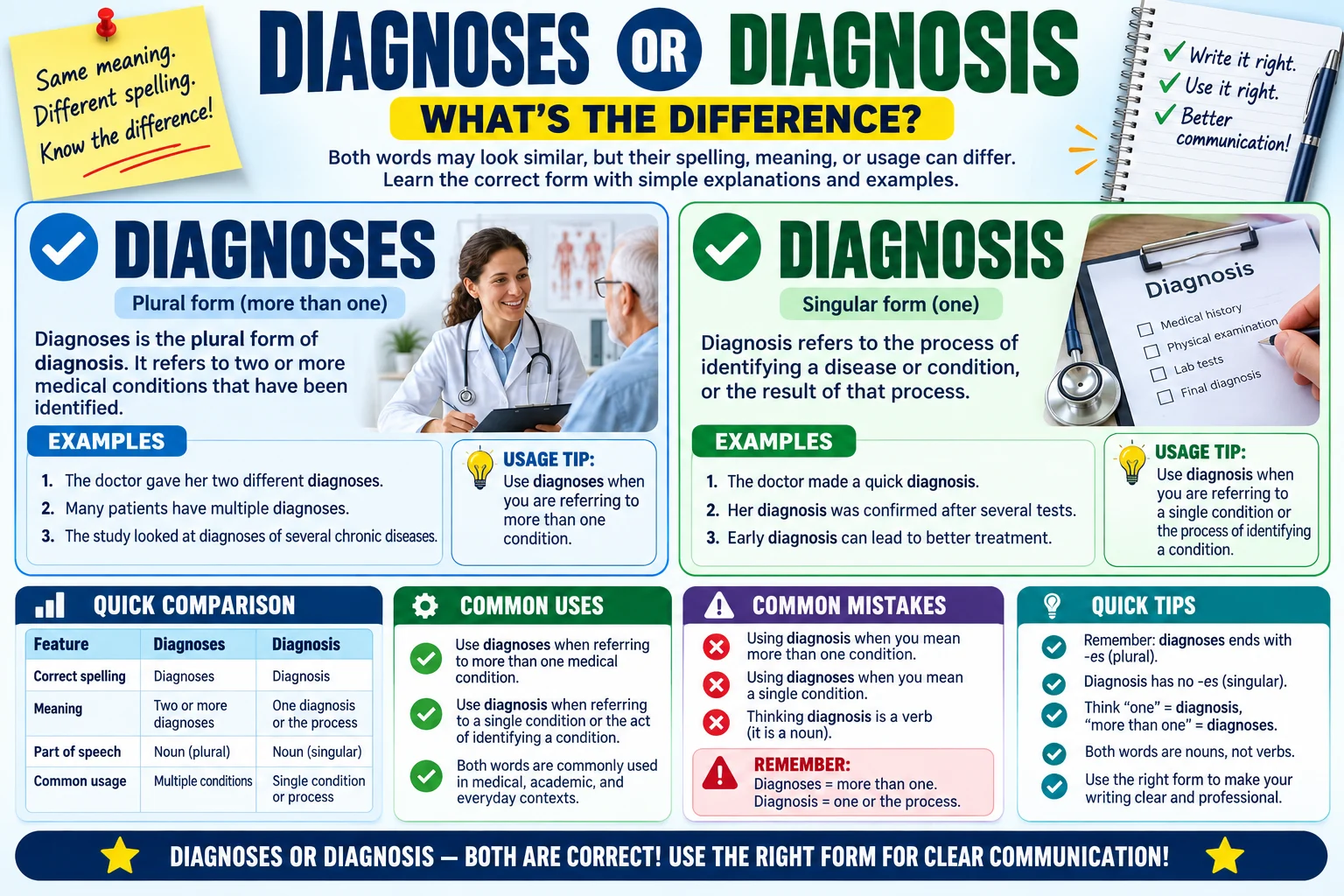
Diagnosis means one medical finding or conclusion about a condition.
Diagnoses means more than one medical finding or conclusion.
Examples:
- The doctor made a diagnosis after the test.
- The hospital recorded several diagnoses from different patients.
| Word | Meaning | Example |
|---|---|---|
| Diagnosis | One identified condition or conclusion | The diagnosis was confirmed today. |
| Diagnoses | Multiple identified conditions or conclusions | The study included many diagnoses. |
The main difference is number:
- Diagnosis = singular
- Diagnoses = plural
The Origin of Diagnoses or Diagnosis
The word diagnosis comes from the Greek word diagnōsis, meaning “knowing apart” or “recognition.” It entered English through Latin and later became common in medical language.
The plural form diagnoses follows the original Greek-style ending. Many English words that come from Greek keep unusual plural forms instead of adding a simple “-s.”
Examples:
- Analysis → Analyses
- Crisis → Crises
- Thesis → Theses
- Diagnosis → Diagnoses
The spelling difference exists because English has borrowed words from many languages. Some words keep older patterns, while others follow modern English rules.
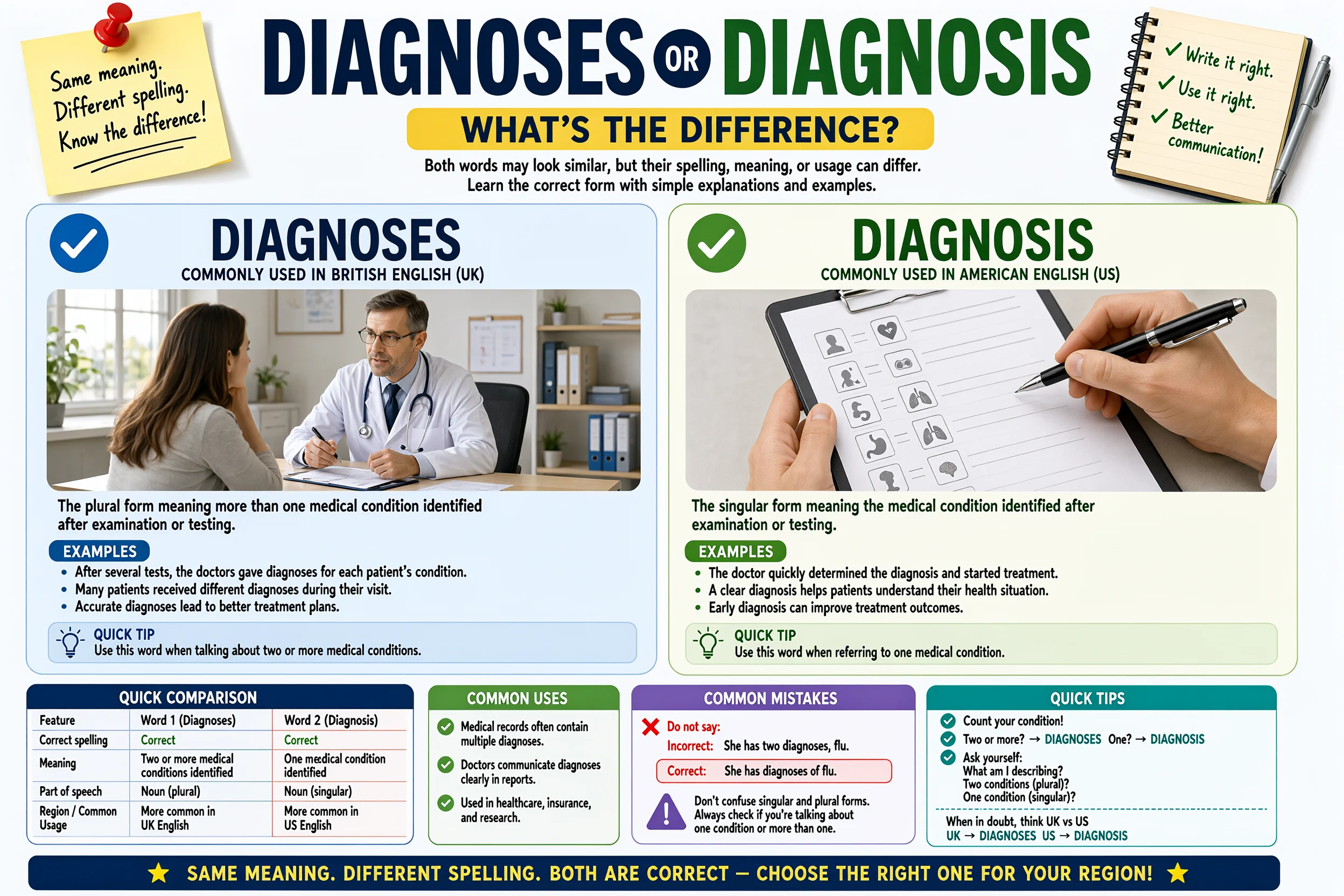
British English vs American English Spelling
British English and American English use the same spellings for diagnosis and diagnoses. Unlike some words that change between regions, this medical term does not have a UK or US spelling difference.
The difference people notice is usually pronunciation, writing style, or confusion about singular and plural forms.
| Variation | British English | American English |
|---|---|---|
| Singular | Diagnosis | Diagnosis |
| Plural | Diagnoses | Diagnoses |
| Meaning | One medical conclusion | One medical conclusion |
| Plural meaning | Multiple medical conclusions | Multiple medical conclusions |
Examples:
British English:
- The patient received a diagnosis from the specialist.
- Researchers compared several diagnoses.
American English:
- The doctor provided a diagnosis.
- The report listed multiple diagnoses.
Which Spelling Should You Use?
The correct choice depends on meaning, not location.
For US readers:
Use diagnosis for one condition and diagnoses for more than one condition.
For UK and Commonwealth readers:
Use the same rule. The spelling does not change.
For global English users:
Both forms are internationally accepted. Focus on whether you mean one condition or several conditions.
Professional writing should always match the number of subjects being discussed.
Common Mistakes with Diagnoses or Diagnosis
Many writers make mistakes because the two words look similar.
Common errors and corrections:
Incorrect:
- The doctor gave three diagnosis.
Correct:
- The doctor gave three diagnoses.
Incorrect:
- The diagnoses was unclear.
Correct:
- The diagnosis was unclear.
Incorrect:
- Several diagnosis were reviewed.
Correct:
- Several diagnoses were reviewed.
Another common mistake is using diagnose instead of diagnosis.
- Diagnose = a verb (the doctor will diagnose the illness)
- Diagnosis = a noun (the doctor made a diagnosis)
Diagnoses or Diagnosis in Everyday Examples
Emails
Incorrect:
“Please review the patient diagnosis listed below.”
Correct:
“Please review the patient’s diagnosis listed below.”
News Writing
Example:
“Doctors confirmed a diagnosis after several medical tests.”
Example:
“Researchers studied multiple diagnoses among older adults.”
Social Media
Example:
“My diagnosis helped me understand my health condition.”
Example:
“The article discusses different diagnoses related to this disease.”
Formal Writing
Example:
“The research examined how accurate diagnoses improve treatment decisions.”
Example:
“The final diagnosis was recorded after laboratory testing.”
Diagnoses or Diagnosis – Google Trends & Usage Data
Search interest for “diagnoses or diagnosis” is usually highest among people studying English, writing professionally, or working in healthcare fields.
The word diagnosis receives more searches because it is the common everyday form. People often search “diagnoses” when they need help understanding the plural spelling.
Usage patterns:
| Term | Common Search Intent | Typical Users |
|---|---|---|
| Diagnosis | Meaning, definition, medical information | General readers, patients, students |
| Diagnoses | Grammar help, plural form, writing checks | Writers, editors, professionals |
Countries with strong English-language education systems often show searches for spelling explanations, especially among students and professional writers.
Diagnoses or Diagnosis – Comparison Table
| Feature | Diagnosis | Diagnoses |
|---|---|---|
| Number | Singular | Plural |
| Word type | Noun | Noun |
| Meaning | One identified condition | More than one identified condition |
| Correct example | The diagnosis was correct. | The diagnoses were correct. |
| Common use | Everyday medical discussions | Reports, research, multiple cases |
FAQs About Diagnoses or Diagnosis
1. Is “diagnoses” the plural of “diagnosis”?
Yes. “Diagnoses” is the plural form of “diagnosis.”
2. How do you pronounce diagnosis and diagnoses?
“Diagnosis” is commonly pronounced with a “sis” sound at the end. “Diagnoses” has a “seez” sound at the end.
3. Can I use “diagnosis” for multiple conditions?
No. Use “diagnoses” when talking about more than one condition.
4. Is “diagnoses” a verb?
Yes, “diagnoses” can also be a verb form. Example: “The doctor diagnoses rare conditions.”
5. Do British and American English spell these words differently?
No. Both use “diagnosis” and “diagnoses.”
6. Which word should I use in a medical report?
Use “diagnosis” for one condition and “diagnoses” for multiple conditions.
7. Why is the plural not “diagnosises”?
Because the word follows its Greek origin pattern, creating “diagnoses” instead.
Conclusion
Understanding “diagnoses or diagnosis” is simple once you remember the basic rule: diagnosis means one, and diagnoses means more than one. The spelling difference comes from the word’s Greek origin, which gives it a special plural form instead of the usual English “-s” ending.
Both British and American English use the same spellings, so writers around the world can follow the same rule. The key is to match the word with the number of conditions or findings being discussed.
Using the correct form improves clarity in medical writing, workplace communication, academic papers, and online content. Whether you are writing a report, email, article, or social media post, choosing between diagnosis and diagnoses helps your message sound accurate and professional.
Remember: one condition equals diagnosis; multiple conditions equal diagnoses.
Throught or Through: Which Spelling Is Correct?

I am an English Literature expert and professional content writer with a passion for language, grammar, and effective communication. I specialize in creating well-researched, reader-friendly articles on English usage, spelling, vocabulary, writing techniques, and literary topics. My goal is to simplify complex concepts and provide accurate, engaging content that helps readers strengthen their language skills and communicate with confidence.