Have you ever stopped while writing and wondered whether you should use “throught” or “through”? You are not alone. Thousands of people search for this question because the two words look very similar. One appears in typing mistakes, while the other is the correct English word.
This confusion often happens when people write emails, school assignments, blog posts, or social media updates. Since English spelling can be tricky, it is easy to add an extra “t” at the end by accident. Many writers want to know which spelling is correct before they publish or send their work.
This guide gives you a quick answer first, then explains the history of the word, spelling rules, common mistakes, and real-life examples. You will also learn whether British English and American English use different spellings and see how the word is used around the world. By the end, you will know exactly when to use through and why throught should almost never appear in your writing.
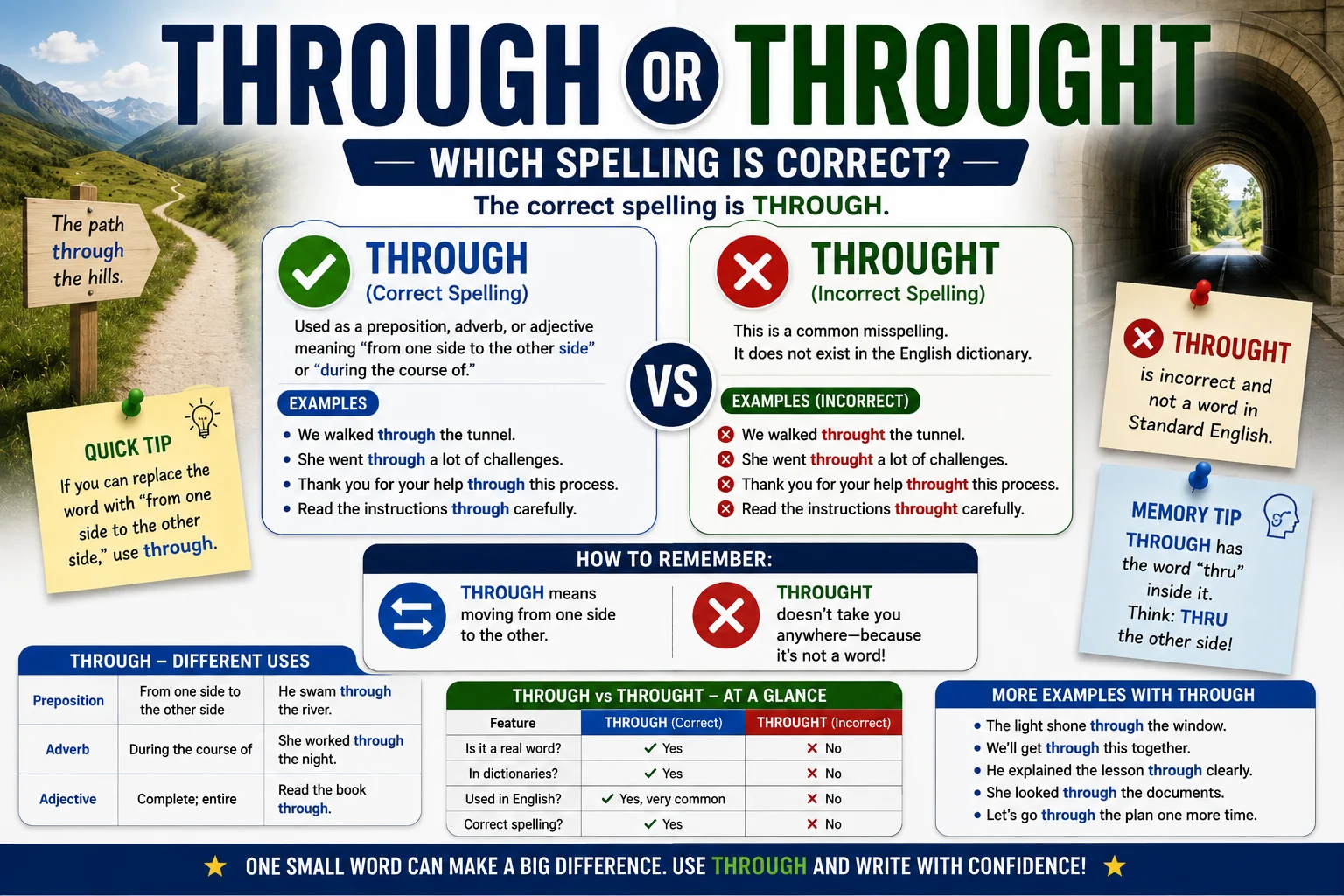
The correct spelling is through.
Throught is a spelling mistake. It is not an accepted English word.
Correct Examples
- We walked through the park.
- She looked through the window.
- Please read through the report before sending it.
Incorrect Examples
- ❌ We walked throught the park.
- ❌ She looked throught the window.
Quick Tip: If you see throught, remove the final “t.”
The Origin of Throught or Through
The word through comes from Old English þurh and þuruh, which meant “from one side to another” or “by means of.”
Over hundreds of years, English spelling changed. The pronunciation became simpler, but many old letters stayed in the spelling. That is why through has several silent letters.
The spelling throught did not develop from English history. It is simply a typing or spelling error. People often add the extra “t” because many English words end with -ght, such as:
- thought
- brought
- fought
- sought
Since these words are common, writers sometimes mistakenly type throught instead of through.
British English vs American English Spelling
Unlike many English words, through has the same spelling in both British English and American English.
There is no spelling difference between the two varieties.
| Feature | British English | American English |
|---|---|---|
| Correct spelling | Through | Through |
| “Throught” accepted? | No | No |
| Pronunciation | Similar | Similar |
| Formal writing | Through | Through |
Examples
British English:
- The train passed through the tunnel.
American English:
- We drove through the city.
Both are correct because the spelling never changes.
Which Spelling Should You Use?
The answer is simple.
If your audience is in the United States
Use through.
If your audience is in the United Kingdom
Use through.
If your audience is in Canada, Australia, New Zealand, or other Commonwealth countries
Use through.
If your audience is global
Use through because it is the only correct spelling everywhere.
No matter where your readers live, through is always the right choice.
Common Mistakes with Throught or Through
Here are mistakes people often make.
| Incorrect | Correct |
|---|---|
| Throught | Through |
| Go throught the door | Go through the door |
| Read throught the document | Read through the document |
| Walk throught the park | Walk through the park |
Why These Mistakes Happen
- Confusing through with thought
- Typing too quickly
- Auto-correct not catching the error
- Mixing up words ending in -ght
Always proofread your writing before sending it.
Throught or Through in Everyday Examples
Please read through the attached report before tomorrow’s meeting.
News
The storm moved through the coastal area overnight.
Social Media
We finally made it through the week!
Formal Writing
Researchers collected data through several field studies.
Conversation
Let’s walk through the plan together.
Throught or Through – Google Trends & Usage Data
Search interest in through is high because it is one of the most common English words.
Searches for throught mostly come from people checking whether they spelled the word correctly.
General Usage
| Variation | Status | Usage |
|---|---|---|
| Through | Correct | Very common |
| Throught | Incorrect | Typing mistake |
Popular Search Contexts
| Country | Common Search |
|---|---|
| United States | Through meaning |
| United Kingdom | Through spelling |
| Canada | Through examples |
| Australia | Through grammar |
| India | Through vs throught |
People usually search for this keyword while writing school work, business emails, articles, or exams.
Comparison Table
| Word | Correct? | Meaning | Should You Use It? |
|---|---|---|---|
| Through | ✅ Yes | From one side to another, by means of | Yes |
| Throught | ❌ No | None | No |
Frequently Asked Questions
Is “throught” a real English word?
No. It is a spelling mistake.
Which is correct, throught or through?
Through is the correct spelling.
Do British people write “throught”?
No. British English also uses through.
Why do people type “throught”?
Many people confuse it with words like thought or brought, which end in -ght.
Can I use “throught” in formal writing?
No. It should never appear in formal or academic writing.
Does Microsoft Word or Grammarly correct “throught”?
Most spelling tools recognize throught as an error and suggest through.
Is “through” used in business writing?
Yes. It is commonly used in emails, reports, contracts, and professional documents.
Conclusion
Choosing between throught and through is easier than it first appears. The only correct spelling is through, and it is accepted in every major variety of English, including American, British, Canadian, Australian, and other Commonwealth English. The spelling throught is simply a typing or spelling mistake that often happens because many English words end in -ght, such as thought and brought.
Whenever you write an email, report, blog post, school assignment, or social media update, always use through. If you accidentally type throught, correct it before publishing your work. A quick proofread or spell check can help you catch the mistake and make your writing look more professional.
Remember this simple rule: through is the only correct word, while throught should never be used. Keeping this difference in mind will improve your spelling, make your writing clearer, and help you communicate with confidence in every situation.
Favor or Favour: Which Spelling Should You Use? Complete English Guide

I am an English Literature expert and professional content writer with a passion for language, grammar, and effective communication. I specialize in creating well-researched, reader-friendly articles on English usage, spelling, vocabulary, writing techniques, and literary topics. My goal is to simplify complex concepts and provide accurate, engaging content that helps readers strengthen their language skills and communicate with confidence.


5 thoughts on “Throught or Through: Which Spelling Is Correct?”