Have you ever written a sentence and wondered whether favor or favour is the correct spelling? This is a common question for English writers around the world. Both spellings look right, and both appear in books, websites, emails, and professional documents. The confusion happens because English has different spelling rules in different countries.
People often search for this keyword when writing for an international audience, applying for jobs, creating content, or checking grammar. They want to know if one spelling is wrong or if both are accepted. The answer depends on where your readers are located.
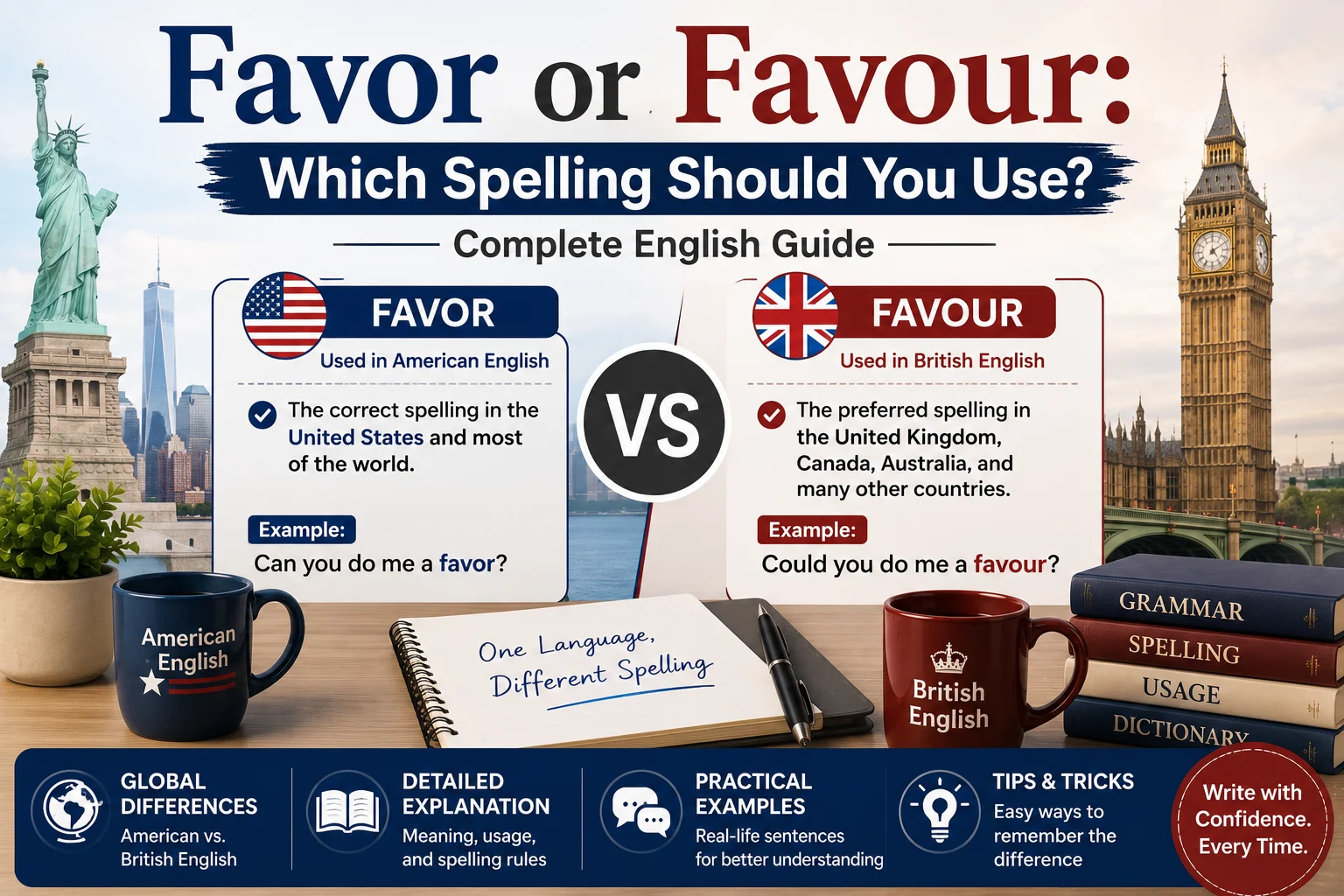
Favor and favour have the same meaning. They both refer to kindness, support, approval, or a helpful action. The main difference is regional spelling. American English usually removes the letter “u,” while British English keeps it.
This guide explains the difference between favor or favour, their history, correct usage, common mistakes, and which spelling you should choose for your audience.
Both favor and favour are correct spellings.
The difference is based on English style:
- Favor = American English spelling
- Favour = British English spelling
Examples
American English:
- Could you do me a favor?
- The judge showed favor toward the new policy.
British English:
- Could you do me a favour?
- The judge showed favour toward the new policy.
Both words have the same meaning.
The Origin of Favor or Favour
The word favor/favour comes from the Latin word favor, meaning kindness, goodwill, or support. It entered English through Old French after the Norman influence on the English language.
For many centuries, English writers used different spellings. The version with “u” became common in British English because of French spelling influence.
During the 18th and 19th centuries, American English spelling began changing. Writers such as Noah Webster supported simpler spellings in American dictionaries. This helped popularize shorter forms like favor instead of favour.
The spelling difference is not about meaning. It is a result of different language traditions.
British English vs American English Spelling
The main spelling difference is the missing letter “u.”
British English often keeps -our endings, while American English usually uses -or endings.
| Meaning | American English | British English |
|---|---|---|
| Kindness or support | Favor | Favour |
| Showing kindness | Favorable | Favourable |
| Preferred choice | Favorite | Favourite |
| A special event | Favor | Favour |
More Examples
American English:
- My favorite book is a mystery novel.
- Please do me a favor.
British English:
- My favourite book is a mystery novel.
- Please do me a favour.
Which Spelling Should You Use?
Choose the spelling based on your readers.
For a US Audience
Use favor.
Examples:
- American websites
- US business emails
- School papers in the United States
For UK and Commonwealth Audiences
Use favour.
Examples:
- United Kingdom
- Australia
- Canada (often uses British spelling traditions)
- New Zealand
For a Global Audience
Choose one style and use it consistently.
If your content targets international readers, check your main audience. Mixing favor and favour in the same document may look unprofessional.
Common Mistakes with Favor or Favour
Mistake 1: Mixing spelling styles
❌ My favourite book is my favorite.
✅ My favourite book is my favourite. (British style)
✅ My favorite book is my favorite. (American style)
Mistake 2: Thinking one spelling is incorrect
❌ Favour is wrong.
✅ Favour is correct in British English.
❌ Favor is wrong.
✅ Favor is correct in American English.
Mistake 3: Changing spelling without checking the audience
❌ Using British spelling in a US business document.
✅ Match your spelling to your readers.
Favor or Favour in Everyday Examples
American English:
- “Could you please do me a favor and review this file?”
British English:
- “Could you please do me a favour and review this file?”
News
American:
- “The candidate received public favor after the announcement.”
British:
- “The candidate received public favour after the announcement.”
Social Media
American:
- “Do me a favor and share this post!”
British:
- “Do me a favour and share this post!”
Formal Writing
American:
- “The company received public favor because of its new policy.”
British:
- “The company received public favour because of its new policy.”
Favor or Favour – Google Trends & Usage Data
Search interest for favor and favour depends strongly on location.
The spelling favor is more common in countries where American English dominates, including:
- United States
- Philippines
- Some online global communities
The spelling favour is more common in countries that follow British English, including:
- United Kingdom
- Australia
- New Zealand
- India
- South Africa
Online content often shows more results for favor because American English is widely used in technology, entertainment, and global platforms.
Keyword Comparison Table
| Keyword Variation | Region | Meaning | Usage |
|---|---|---|---|
| Favor | US English | Kindness or support | Very common |
| Favour | UK English | Kindness or support | Very common |
| Favorite | US English | Preferred choice | Very common |
| Favourite | UK English | Preferred choice | Very common |
| Favorable | US English | Positive | Common |
| Favourable | UK English | Positive | Common |
Frequently Asked Questions
1. Is favor or favour correct?
Both are correct. Favor is American English, and favour is British English.
2. Is favour used in the United States?
No. Most US writers use favor.
3. Is favor used in the UK?
Some people understand it, but favour is the standard British spelling.
4. Why does British English use favour?
British spelling kept the “u” because of French and traditional spelling influences.
5. Which spelling should I use in an essay?
Use the spelling style required by your school, country, or audience.
6. Are favorite and favourite the same?
Yes. They have the same meaning. The spelling depends on English variety.
7. Do search engines treat favor and favour differently?
Search engines usually understand both spellings, but using the spelling preferred by your audience improves clarity.
Conclusion
The choice between favor or favour depends on your audience, not on correctness. Both spellings are accepted English words with the same meaning. The only difference is regional spelling style.
Use favor when writing for American readers. Use favour when writing for British, Australian, New Zealand, or other Commonwealth audiences that follow British spelling rules. For international writing, choose one style and keep it consistent throughout your content.
Understanding this small spelling difference can make your writing look more professional. It also helps avoid confusion when creating emails, articles, reports, or business documents. Remember the simple rule: American English usually removes the “u,” while British English keeps it.
Whether you write favor or favour, the important thing is consistency. Matching your spelling to your audience shows attention to detail and creates a better reading experience.
Blink or Ring: Which Word Should You Use? Meaning, Differences, Examples & Usage Guide

I am an English Literature expert and professional content writer with a passion for language, grammar, and effective communication. I specialize in creating well-researched, reader-friendly articles on English usage, spelling, vocabulary, writing techniques, and literary topics. My goal is to simplify complex concepts and provide accurate, engaging content that helps readers strengthen their language skills and communicate with confidence.