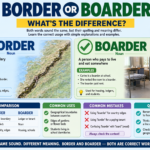
Have you ever typed “border or boarder” and stopped to ask which word is right? You are not alone. These two words look almost the same and often sound the same, but they have very different meanings.
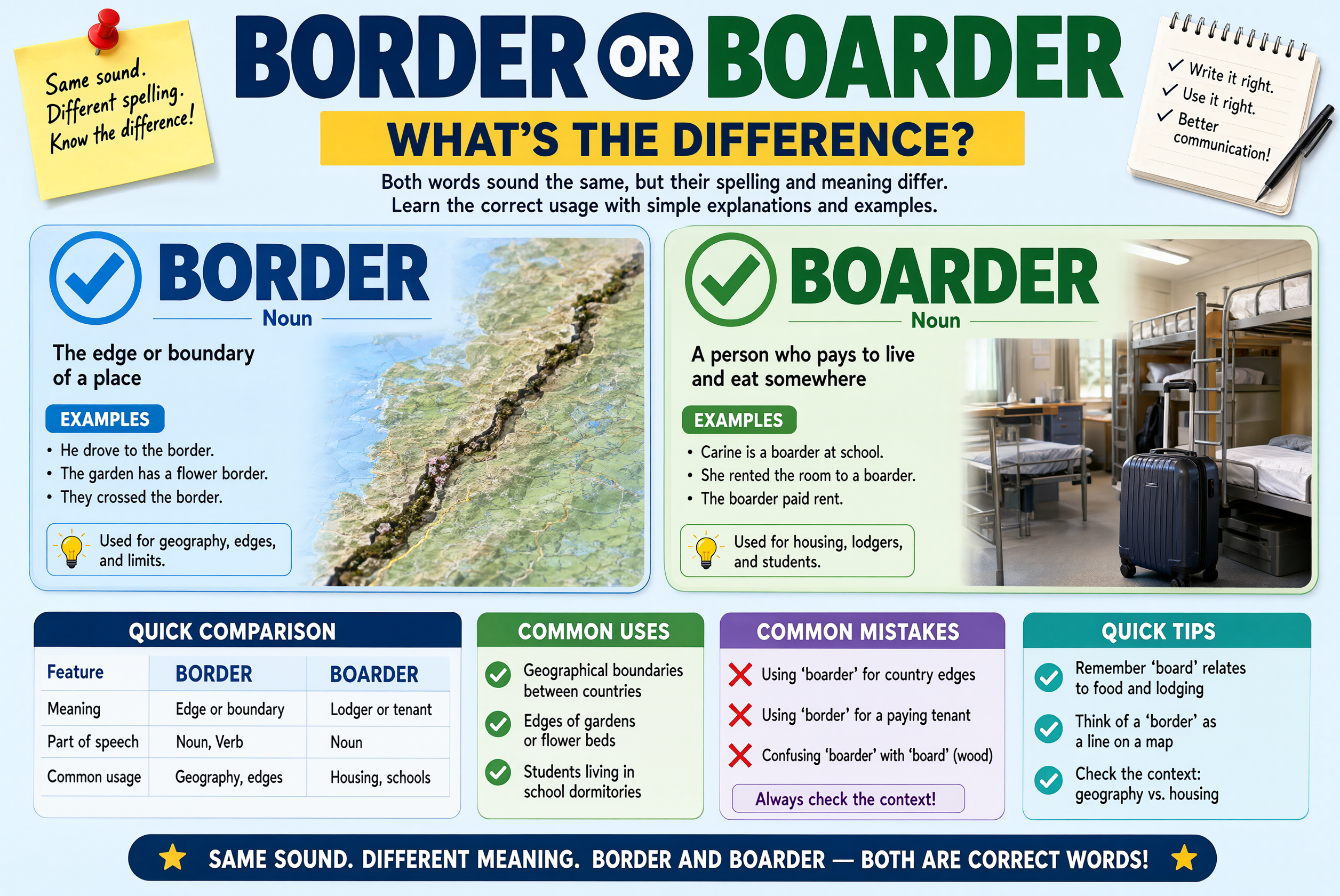
Border usually means an edge, limit, or boundary. It can describe the line between two countries, the edge of a garden, or a decorative edge around a picture. Boarder, however, usually means a person who lives somewhere and receives food and lodging. It can also describe a student at a boarding school or, in informal use, a person who takes part in a board sport.
People search for “border or boarder” because one extra letter changes the meaning. A spelling checker may not catch the mistake because both words are valid English words. This guide explains the difference, the history of both words, correct usage, common errors, and which spelling to choose in professional writing.
The quick answer is simple:
- Border = an edge, boundary, or dividing line.
- Boarder = a person who pays for lodging and meals, or someone who boards in certain contexts.
Examples
Border:
- The two countries share a long border.
- Add a blue border around the image.
- Canada borders the United States.
Boarder:
- The house has one boarder.
- She was a boarder at a private school.
- The hostel welcomed several new boarders.
A useful memory trick is this:
Border = boundary.
Boarder = board + person.
The extra a in boarder connects it to board, as in “room and board.”
The Origin of Border or Boarder
The two words have related-looking histories, which helps explain why they are easy to confuse.
Origin of “border”
Border entered English through French. Merriam-Webster traces it to Middle English bordure, from Anglo-French and Old French bort, meaning a border. Its roots are Germanic and are probably related to Old English bord, meaning a board or side. The English noun is recorded from the 14th century.
At first, border referred more broadly to an edge or decorative band. Its meaning later developed into the idea of a dividing line between places. The country or state meaning came later than the basic meaning of an edge or boundary.
Origin of “boarder”
Boarder comes from board + -er. The word board once referred to a flat piece of wood. Its meaning later expanded to mean a table and then the food served at a table. From this came the idea of providing food and lodging. Boarder, meaning someone who receives food and lodging, dates to the 1520s.
So the words developed from different paths:
- Border → edge, boundary, dividing line
- Boarder → board → food/lodging → person receiving lodging
The spelling difference is therefore meaningful. It is not a British-versus-American spelling change.
British English vs American English Spelling
There is no major British English vs American English spelling difference between border and boarder.
Both varieties normally use:
| Meaning | British English | American English |
|---|---|---|
| Boundary or edge | border | border |
| Person receiving lodging and meals | boarder | boarder |
| Student living at school | boarder | boarder |
| Person taking part in a board sport | boarder | boarder |
This is important because some English words do change spelling between the UK and US, such as colour/color and centre/center. Border and boarder do not work that way.
The difference is about meaning, not regional spelling rules.
Border vs Boarder: Side-by-Side Comparison
| Word | Part of speech | Main meaning | Example |
|---|---|---|---|
| border | Noun | Edge or boundary | The river forms the border. |
| border | Verb | To share a boundary | France borders Spain. |
| boarder | Noun | Person receiving food and lodging | The family has a boarder. |
| boarder | Noun | Student living at school | He is a boarder at the school. |
| boarder | Noun | Board-sport participant | The competition attracted skilled boarders. |
Cambridge confirms that boarder can refer to a student who lives and eats at school, a person paying for accommodation and meals, and, informally, someone who practices sports such as snowboarding or skateboarding.
Which Spelling Should You Use?
Choose the word based on what you mean, not where your reader lives.
Use “border” when you mean:
- a country boundary
- a state or regional boundary
- the edge of an object
- a decorative edge
- something that is next to or surrounds another thing
Example:
“The company operates near the border.”
Use “boarder” when you mean:
- a person receiving lodging and meals
- a student living at a boarding school
- a person who boards in a home
- informally, a board-sport participant
Example:
“The school has 300 boarders.”
Advice for global writers
If you write for an international audience, do not change border to boarder because you think one is American or British. Both forms are standard in both major varieties of English.
Instead, check the meaning of the sentence.
Common Mistakes with Border or Boarder
Mistake 1: “The boarder between two countries”
Incorrect:
The boarder between India and Pakistan is busy.
Correct:
The border between India and Pakistan is busy.
A country has a border, not a boarder.
Mistake 2: “A border at the boarding school”
Incorrect:
The school has 200 borders.
Correct:
The school has 200 boarders.
Students who live at the school are boarders.
Mistake 3: “Border” for a person
Incorrect:
The family rented a room to a border.
Correct:
The family rented a room to a boarder.
The person is a boarder because the word comes from board in the food-and-lodging sense.
Mistake 4: Thinking “boarder” is a spelling error
Boarder is a real English word. It is not an incorrect version of border.
Both are correct:
- The garden has a stone border.
- The house has a student boarder.
Border or Boarder in Everyday Examples
In emails
Border:
Please confirm the location of the border crossing.
Boarder:
We have one new boarder arriving on Monday.
In news writing
Border:
Officials announced new measures at the border.
Boarder:
The school welcomed several new boarders this term.
News writing often uses border because countries, migration, travel, and regional boundaries are common news topics.
On social media
Border:
Beautiful sunset near the border!
Boarder:
Our newest boarder just joined the school team.
In formal writing
Border:
The study examines trade across the international border.
Boarder:
Each boarder must follow the school’s residential rules.
In everyday speech
- “The village is close to the border.”
- “She was a boarder at school.”
- “The picture needs a wider border.”
- “The house takes in one boarder.”
Context makes the meaning clear.
Border or Boarder – Google Trends & Usage Data
Search interest for these words is not evenly distributed because border and boarder serve very different topics.
Google Trends measures relative search interest, not the exact number of searches. This means a trend score should not be treated as a raw search-volume figure.
For this topic, the strongest distinction is usually search intent:
- Border is connected with countries, immigration, travel, geography, politics, maps, and physical edges.
- Boarder is connected with boarding schools, lodging, housing, and board sports.
- Searches such as “border or boarder” and “border vs boarder” are mainly language-learning and spelling queries.
Because border has many common meanings and appears in major news topics, its overall search presence is much broader than that of boarder. That does not make boarder incorrect. It simply has a narrower meaning.
You can compare current interest by country and search term using Google Trends. Results can change over time, especially when major border, travel, political, or sports events attract public attention.
Border vs Boarder: Quick Comparison Table
| Feature | Border | Boarder |
|---|---|---|
| Correct English word? | Yes | Yes |
| Main meaning | Boundary or edge | Person receiving lodging/food |
| Can be a verb? | Yes | Usually no |
| Used for countries? | Yes | No |
| Used for boarding schools? | No | Yes |
| Used for lodging? | No | Yes |
| Related word | Boundary | Board |
| Extra letter | No “a” | Has “a” |
| UK spelling | Border | Boarder |
| US spelling | Border | Boarder |
FAQs About Border or Boarder
1. Is “border” or “boarder” correct?
Both are correct. Border means a boundary or edge. Boarder usually means a person who receives lodging and meals.
2. What is the difference between border and boarder?
The main difference is meaning. A border is a boundary or edge. A boarder is a person who stays somewhere and receives food or lodging.
3. Is “boarder” a real word?
Yes. Boarder is a standard English noun. It can mean a person who pays for lodging and meals or a student who lives at a boarding school.
4. Is “border” British or American English?
Border is standard in both British and American English.
5. Is “boarder” British or American English?
Boarder is also standard in both British and American English.
6. How can I remember the difference?
Think of border = boundary. For boarder, think of board, as in room and board or boarding school.
7. Which word should I use for a country boundary?
Use border.
Correct:
The two countries share a long border.
Do not use boarder for a country boundary.
Conclusion
The difference between border and boarder is simple once you connect each word with its meaning.
Use border for an edge, limit, or boundary. You can talk about a country border, a garden border, or the border of a picture. Border can also be a verb, as in “Canada borders the United States.”
Use boarder for a person who receives lodging and meals. It can describe someone living in a boarding house or a student living at a boarding school. In informal use, it can also describe someone who takes part in a board sport.
The key point is that border and boarder are not British and American spelling variants. Both spellings are correct in both forms of English. The right choice depends on your meaning.
For professional writing, always check the sentence before choosing the word. If you mean a boundary, choose border. If you mean a person who boards, choose boarder. Remember that one extra letter can completely change the meaning.
Yall or Y’all: Which Spelling Is Correct? Complete Grammar Guide

I am an English Literature expert and professional content writer with a passion for language, grammar, and effective communication. I specialize in creating well-researched, reader-friendly articles on English usage, spelling, vocabulary, writing techniques, and literary topics. My goal is to simplify complex concepts and provide accurate, engaging content that helps readers strengthen their language skills and communicate with confidence.