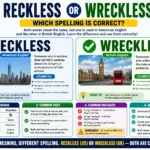
Have you ever typed “wreckless” and wondered if it is correct, or should it be “reckless”? This small spelling choice causes confusion for many English learners, writers, and professionals. People often search for “reckless or wreckless” because both words look logical. The word “wreckless” seems like it should mean “without wrecks,” while “reckless” has a meaning connected to danger and careless actions.
The correct spelling in standard English is reckless. It means showing little care, caution, or concern about danger or consequences. The incorrect spelling wreckless is a common mistake caused by the familiar word “wreck,” which means damage or destruction.
Understanding the difference helps you write clearly in emails, school work, reports, articles, and everyday conversations. This guide explains the meaning, history, spelling rules, common mistakes, and examples of “reckless or wreckless” so you can choose the right word with confidence.
The correct spelling is reckless.
Reckless means acting without thinking about safety, risks, or results.
Examples:
- The driver made a reckless decision on the road.
- His reckless spending caused financial problems.
- The company avoided reckless choices during the project.
Wreckless is usually considered incorrect in standard English. Many people use it by mistake because it looks like it means “without wrecks.” However, English does not form this word from “wreck.”
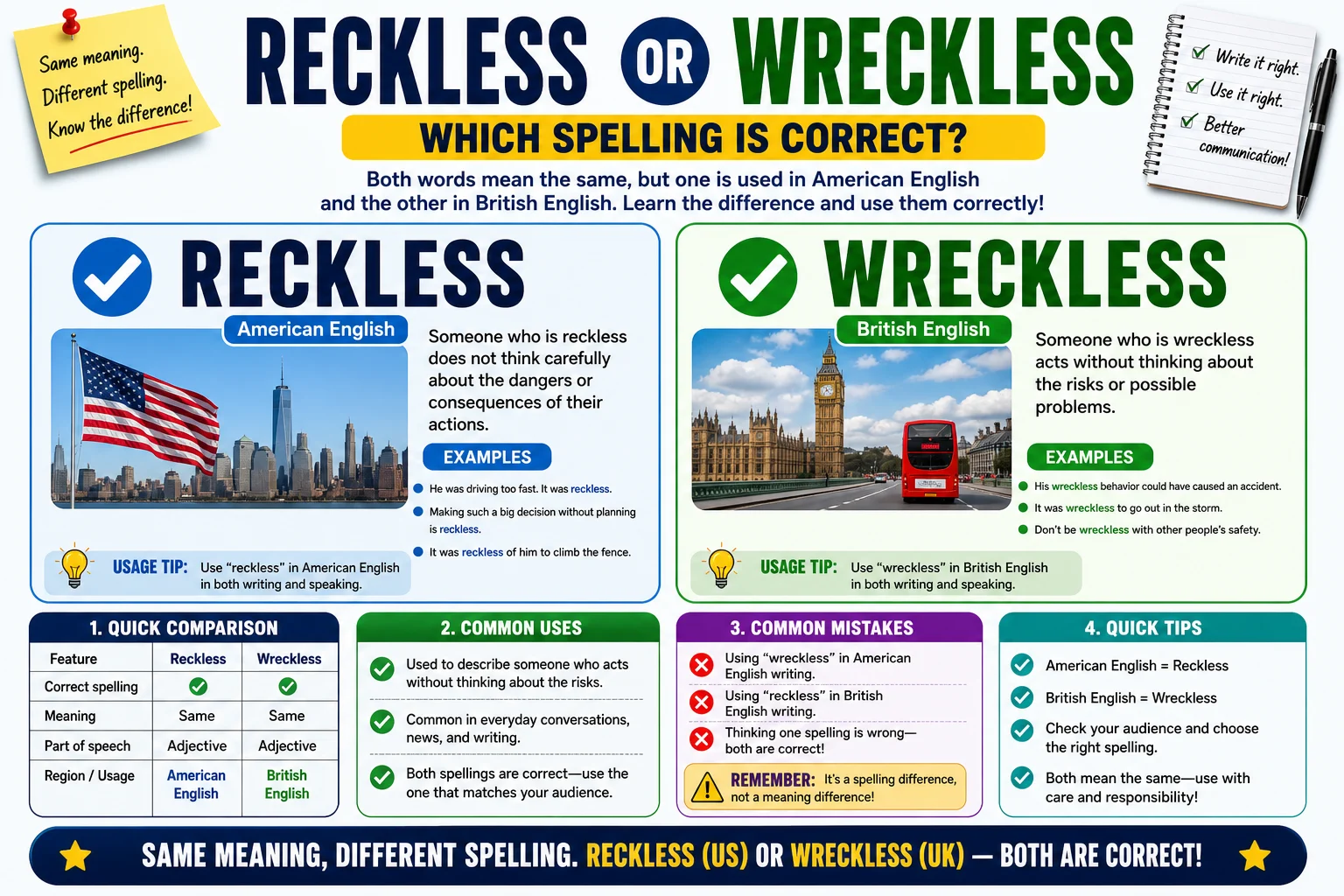
Comparison Table: Reckless vs Wreckless
| Spelling | Correct? | Meaning | Example |
|---|---|---|---|
| Reckless | Yes | Careless or dangerous behavior | He was reckless with his safety. |
| Wreckless | No (in standard English) | Not a standard word | Avoid using this spelling. |
| Careless | Yes | Not paying enough attention | A careless mistake was made. |
| Cautious | Yes | Careful and aware of risks | She made a cautious choice. |
The Origin of Reckless
The word reckless comes from the Old English word receleas, which meant “careless” or “without concern.” It developed from the word reck, meaning “to care” or “to pay attention.”
Over time, English added the ending -less to show the absence of something. Therefore:
- Reck + less = reckless
- Meaning: without care or concern
The spelling difference exists because modern speakers sometimes connect the word with wreck, a word related to accidents and destruction. This creates the false idea that “wreckless” should mean “without wrecks.” However, the history of the word is connected to “reck,” not “wreck.”
British English vs American English Spelling
British English and American English both use the spelling reckless. There is no regional spelling difference for this word.
Some English words change spelling between countries, such as:
- colour (British) vs color (American)
- centre (British) vs center (American)
However, reckless remains the same in both forms.
| Feature | British English | American English |
|---|---|---|
| Correct spelling | Reckless | Reckless |
| Incorrect form | Wreckless | Wreckless |
| Meaning | Careless or dangerous | Careless or dangerous |
| Example | A reckless action | A reckless action |
Which Spelling Should You Use?
Use reckless in all types of English writing.
For US English
Use reckless in school, work, business, and online writing.
Example:
- The athlete took a reckless risk.
For UK and Commonwealth English
Use reckless because the spelling is the same.
Example:
- The report described the decision as reckless.
For Global English
International readers will recognize reckless as the correct spelling. Using “wreckless” may make your writing appear less professional.
Common Mistakes with Reckless
Many spelling errors happen because people connect words by meaning instead of history.
Common mistakes:
Incorrect: The driver was wreckless.
Correct: The driver was reckless.
Incorrect: His wreckless behavior caused problems.
Correct: His reckless behavior caused problems.
Incorrect: The company made a wreckless investment.
Correct: The company made a reckless investment.
A useful memory tip:
- Reckless = without care
- Think: “reck” means care, and “-less” means without.
Reckless in Everyday Examples
In Emails
Incorrect:
- Your reckless approach to the project created delays.
Correct:
- Your reckless approach to the project created delays.
In News Writing
- Officials criticized the reckless actions that caused public safety concerns.
In Social Media
- “That was a reckless move. Think before you act.”
In Formal Writing
- “The report identified reckless financial decisions as a major risk factor.”
The word is common in discussions about:
- driving
- money
- business decisions
- safety
- behavior
- leadership
Reckless or Wreckless – Google Trends & Usage Data
Search interest for “reckless or wreckless” appears because many people are unsure about the spelling. The confusion is common in English-speaking countries because “wreckless” looks like a logical combination of “wreck” and “-less.”
The word reckless is widely used in countries such as the United States, United Kingdom, Canada, Australia, and other English-speaking regions. Searches for the spelling question often increase when people write essays, professional documents, or online content.
Usage context also affects searches:
- Students check the spelling for assignments.
- Writers verify the word before publishing.
- Professionals confirm correct usage in reports and emails.
Although “wreckless” may appear online, standard dictionaries and professional writing use reckless.
Frequently Asked Questions (FAQs)
1. Is reckless or wreckless correct?
Reckless is the correct spelling. “Wreckless” is a common spelling mistake.
2. What does reckless mean?
Reckless means acting without enough care, caution, or concern about possible harm.
3. Why do people spell reckless as wreckless?
People often connect the word with “wreck,” which means damage or destruction. This makes “wreckless” look logical, but it is not the correct spelling.
4. Is wreckless a real word?
“Wreckless” is not accepted as a standard English word. It may appear as an informal mistake or in creative names.
5. Is reckless spelled the same in British and American English?
Yes. Both British English and American English use reckless.
6. What is the opposite of reckless?
The opposite words include:
- careful
- cautious
- responsible
- thoughtful
7. Can I use reckless in formal writing?
Yes. “Reckless” is appropriate for formal writing, including reports, essays, and professional documents.
Conclusion
The correct spelling is simple: use reckless, not wreckless. The word reckless has a long history connected to the idea of being without care or concern. It does not come from the word “wreck,” even though that spelling connection seems natural.
Both British English and American English use the same spelling, making it easy to remember. Whether you are writing an email, article, report, or social media post, choosing “reckless” will make your writing clearer and more professional.
If you are unsure, remember the basic rule: reckless describes a person, action, or decision that ignores risks. “Wreckless” may look meaningful, but it is not the standard spelling. Using the correct form helps readers understand your message and improves the quality of your English writing.
Throught or Through: Which Spelling Is Correct?

I am an English Literature expert and professional content writer with a passion for language, grammar, and effective communication. I specialize in creating well-researched, reader-friendly articles on English usage, spelling, vocabulary, writing techniques, and literary topics. My goal is to simplify complex concepts and provide accurate, engaging content that helps readers strengthen their language skills and communicate with confidence.