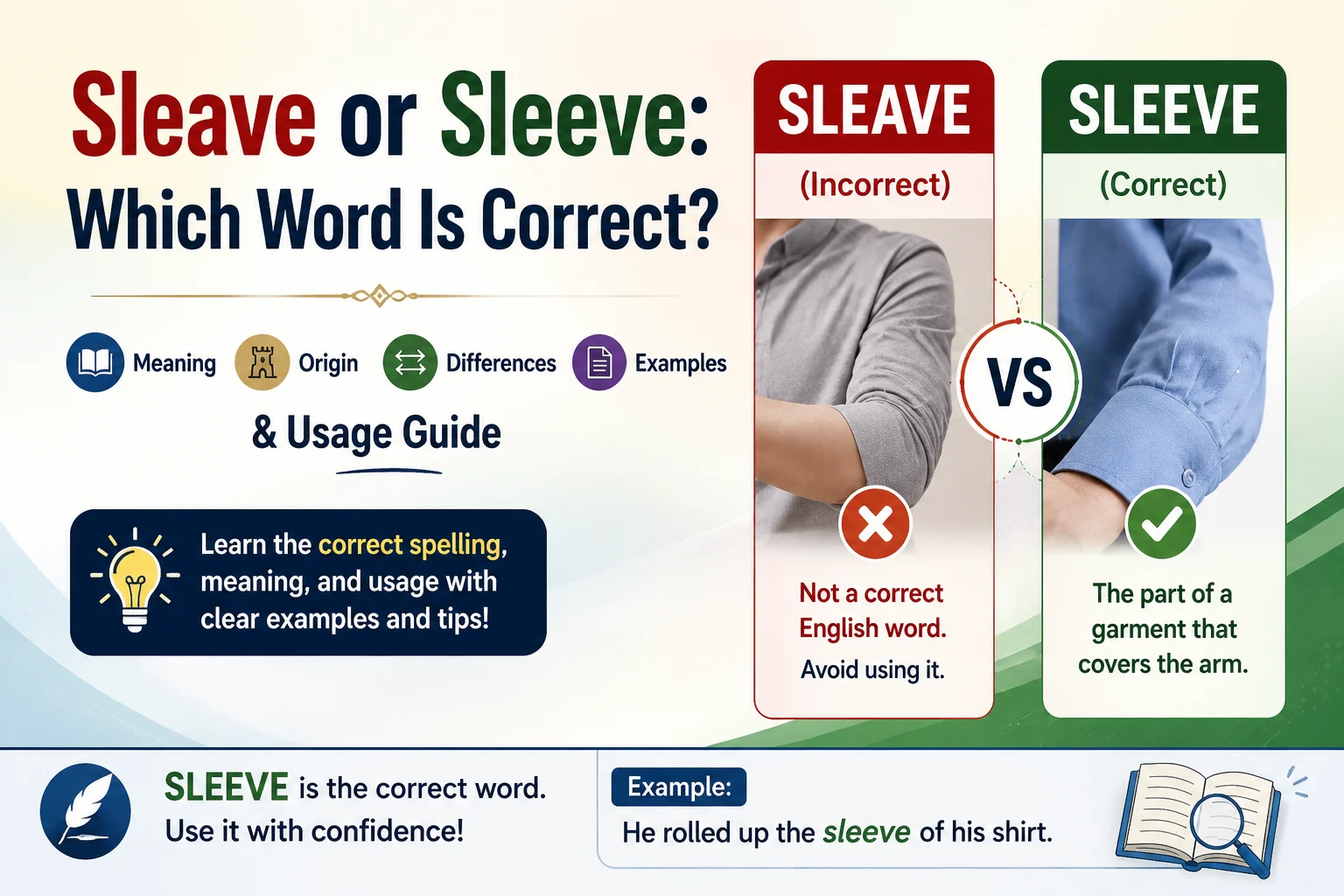
Have you come across the words “sleave” and “sleeve” and wondered which one is correct? This question is common because the two words look almost identical, yet they have very different meanings and levels of use. Most people know sleeve as the part of a shirt or jacket that covers the arm. However, sleave is a rare English word that appears mainly in old literature, especially in William Shakespeare’s works. Because of this, many readers believe sleave is simply a misspelling of sleeve, while others are unsure whether both words are correct.
The truth is that both words are valid, but they are used in very different situations. Sleeve is the standard word in modern English, while sleave is an old and uncommon term that usually refers to fine silk thread or something delicate. This guide explains the meaning of sleave or sleeve, their history, spelling, usage, common mistakes, examples, and popularity. By the end, you’ll know exactly which word to choose and when to use it.
Both sleave and sleeve are correct English words, but they do not have the same meaning.
- Sleeve is the common modern word for the part of a garment that covers the arm.
- Sleave is an old and rare word meaning fine silk thread, untwisted silk, or something delicate. It is mainly found in historical literature.
Examples
- She rolled up her sleeves before washing the dishes.
- The tailor shortened the sleeves of the jacket.
- Shakespeare used the word sleave in Macbeth.
- The old text described delicate sleave of silk.
Quick tip: For modern writing, you almost always need sleeve.
The Origin of Sleave or Sleeve
The word sleeve comes from the Old English word slēfe, meaning the part of a garment that covers the arm. It has been used for over a thousand years and remains common today.
The word sleave comes from an older form of English and was used to describe untwisted silk or fine thread. It became well known because William Shakespeare used it in Macbeth in the phrase “the sleave of care.” In that context, it symbolized the delicate threads of worry that sleep could untangle.
Although the words look similar, sleave is not an alternative spelling of sleeve. They are separate words with different meanings.
British English vs American English Spelling
There is no spelling difference between British English and American English.
Both countries use:
- Sleeve for clothing.
- Sleave only in historical or literary contexts.
| Feature | British English | American English |
|---|---|---|
| Modern clothing term | Sleeve | Sleeve |
| Literary word | Sleave | Sleave |
| Everyday usage | Sleeve | Sleeve |
| Common spelling | Sleeve | Sleeve |
Examples
| British English | American English |
|---|---|
| Roll up your sleeves. | Roll up your sleeves. |
| The shirt has long sleeves. | The shirt has long sleeves. |
There is no regional spelling variation.
Which Spelling Should You Use?
Your choice depends on what you want to say.
For US Audiences
Use sleeve in almost every situation.
Use sleave only when discussing literature or historical language.
For UK and Commonwealth Audiences
The same advice applies.
For Global Audiences
Choose sleeve unless you are quoting Shakespeare or discussing historical English.
This ensures your writing is clear and easy to understand.
Common Mistakes with Sleave or Sleeve
Many writers confuse these two words.
| Incorrect | Correct |
|---|---|
| Roll up your sleaves. | Roll up your sleeves. |
| The jacket has long sleaves. | The jacket has long sleeves. |
| Sleave is the modern spelling. | Sleeve is the modern spelling. |
| Sleeve means fine silk thread. | Sleave means fine silk thread. |
Tips
- Clothing uses sleeve.
- Literature may use sleave.
- Do not replace sleeve with sleave in everyday writing.
- Check spelling carefully when typing.
Sleave or Sleeve in Everyday Examples
Emails
“Please wear a long-sleeve shirt for the meeting.”
News
“The designer introduced jackets with wider sleeves.”
Social Media
“I love this sweater with oversized sleeves!”
Formal Writing
“The uniform includes long sleeves for additional protection.”
Literary Discussion
“Shakespeare’s phrase ‘the sleave of care’ remains one of his most famous poetic expressions.”
Sleave or Sleeve – Google Trends & Usage Data
Search interest shows a huge difference between these two words.
- Sleeve is searched millions of times because it is used in clothing, fashion, sewing, and everyday conversation.
- Sleave receives very little search traffic and is mostly searched by students, literature readers, and Shakespeare fans.
Popular Usage by Country
| Country | Sleeve | Sleave |
|---|---|---|
| United States | Very High | Very Low |
| United Kingdom | Very High | Low |
| Canada | High | Very Low |
| Australia | High | Very Low |
| India | High | Low |
Overall, sleeve is the standard modern English word worldwide.
Sleave or Sleeve Comparison Table
| Feature | Sleave | Sleeve |
|---|---|---|
| Meaning | Fine silk thread | Part of a garment |
| Modern Usage | Rare | Very Common |
| Literary Usage | Common | Common |
| Everyday Writing | No | Yes |
| British English | Same spelling | Same spelling |
| American English | Same spelling | Same spelling |
| Best Choice for Most Writing | No | Yes |
Frequently Asked Questions (FAQs)
1. Is it “sleave” or “sleeve”?
For modern English, sleeve is almost always the correct choice.
2. Is “sleave” a real word?
Yes. It is an old English word, mainly used in literature and historical texts.
3. What does “sleave” mean?
It refers to fine silk thread or untwisted silk.
4. Why did Shakespeare use “sleave”?
He used it poetically in Macbeth to describe the delicate threads of worry or care.
5. Is “sleave” used today?
Very rarely. Most people only encounter it in literary studies.
6. Are “sleave” and “sleeve” different spellings of the same word?
No. They are different words with different meanings.
7. Which word should I use in everyday writing?
Use sleeve for clothing and modern communication.
Conclusion
Understanding the difference between sleave and sleeve is easier once you know their meanings and history. Sleeve is the standard modern English word that refers to the part of a shirt, jacket, or dress that covers the arm. It is the correct choice for everyday conversations, professional writing, fashion, and education. Sleave, on the other hand, is a rare historical word that refers to fine silk thread and is mainly found in older literature, especially the works of William Shakespeare. It is not a regional spelling variation of sleeve, and it should not replace sleeve in modern writing.
If your goal is clear communication, sleeve is almost always the right option. Use sleave only when discussing classic literature or quoting historical texts. Knowing the difference will help you avoid spelling mistakes, improve your writing, and better understand older English works. By choosing the correct word for your audience and purpose, your writing will remain accurate, professional, and easy to understand.
Bologna or Baloney: Which Spelling Is Correct? Meaning, Differences, and When to Use Each

I am an English Literature expert and professional content writer with a passion for language, grammar, and effective communication. I specialize in creating well-researched, reader-friendly articles on English usage, spelling, vocabulary, writing techniques, and literary topics. My goal is to simplify complex concepts and provide accurate, engaging content that helps readers strengthen their language skills and communicate with confidence.