Have you ever seen someone write op or opp and wondered which spelling is correct? You are not the only one. Many people search for “op or opp” because both versions appear online, in text messages, music, gaming, and social media. The confusion grows because the two spellings can have different meanings depending on the situation.
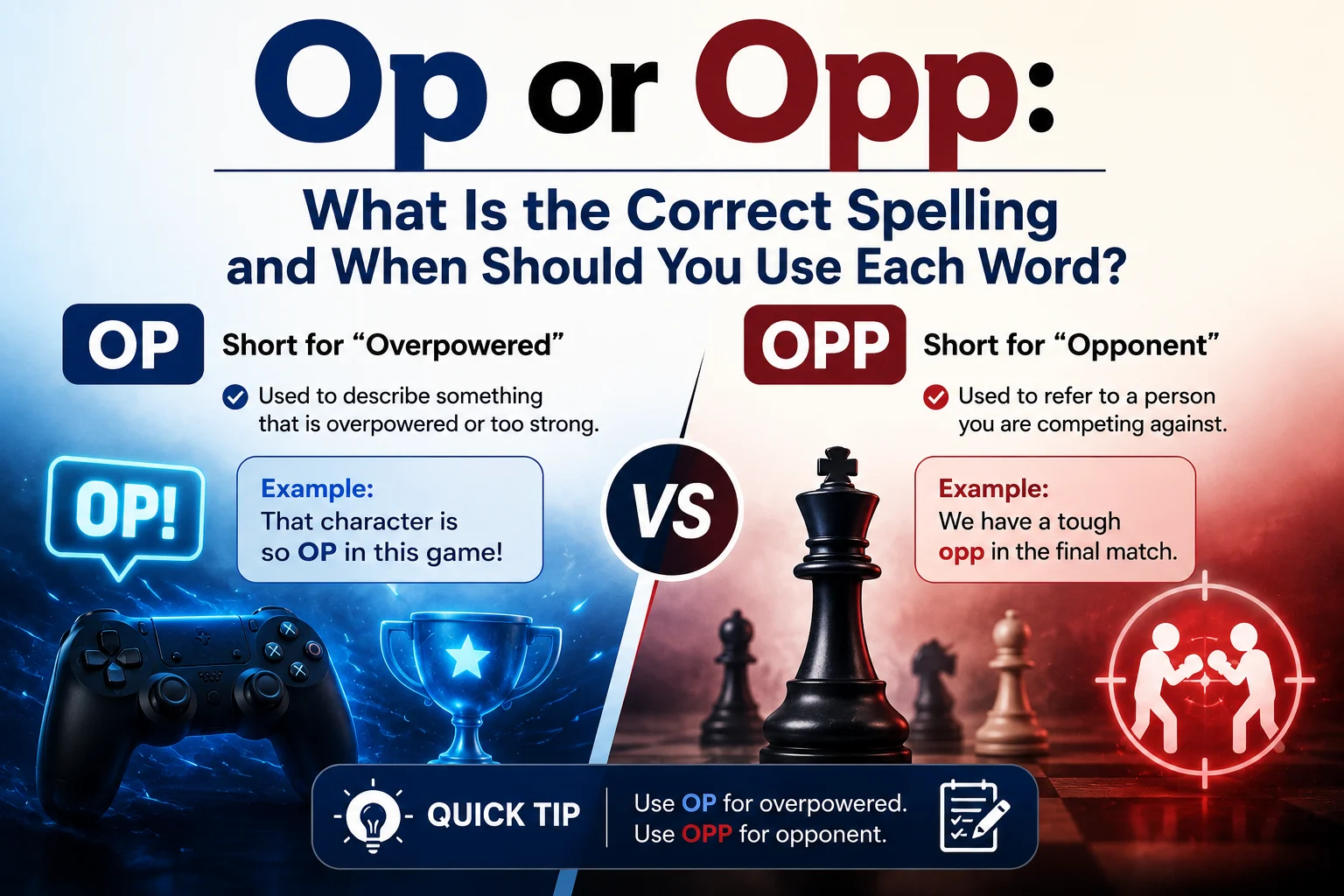
In most cases, op and opp are not standard spelling variations like British and American English differences. Instead, they are short forms, slang terms, or abbreviations used in different communities. For example, OP can mean “original poster” online, while opp is often short for “opponent” or “opposition” in slang.
Understanding the difference helps you avoid mistakes in conversations, professional writing, and online communication. This guide explains op or opp, their meanings, origins, usage, common errors, and the best choice for different audiences. Whether you saw the word in a comment, a game, a message, or a formal document, you will know what it means and when to use it.
The short answer:
- Op usually means original poster, operation, or a short form of other words depending on context.
- Opp usually means opponent, opposition, or an enemy/rival in slang.
Examples
Op
- The OP updated the post with new information. (Original Poster)
- The special op was completed successfully. (Operation)
Opp
- The player defeated his opp in the final round. (Opponent)
- He does not trust his opps. (Opposition/enemies in slang)
Quick Comparison
| Word | Meaning | Example |
|---|---|---|
| Op | Original poster, operation, other abbreviations | The OP replied to comments. |
| Opp | Opponent or opposition | My opp is waiting for the match. |
The Origin of Op or Opp
The words op and opp come from different shortened forms.
Origin of Op
The abbreviation OP became popular on internet forums and social media. It originally meant “original poster”—the person who created a discussion or shared content.
Over time, OP gained more meanings, including:
- Operation
- Overpowered (gaming slang)
- Operator (in some technical settings)
The meaning depends on the community and context.
Origin of Opp
The word opp comes mainly from slang. It is often a shortened form of opponent or opposition.
It became popular through:
- Gaming communities
- Hip-hop culture
- Online conversations
The spelling with two “p” letters helps separate it from other meanings of “op.”
Why Do Spelling Differences Exist?
The difference exists because these words are abbreviations and slang terms. They are created by communities for quick communication, so spelling can change based on usage and trends.
British English vs American English Spelling
Op and opp are not British vs American spelling differences. Both forms can appear in English-speaking countries, but their meanings depend on context.
Examples
American English:
- The OP created the online discussion.
- My opp is playing against me.
British English:
- The OP shared the original post.
- The team defeated their opp.
Comparison Table
| Feature | Op | Opp |
|---|---|---|
| Meaning | Original poster, operation, abbreviation | Opponent or opposition slang |
| British English | Used in online slang | Used in slang |
| American English | Used widely online | Used widely in slang |
| Formal writing | Rare | Rare |
| Standard dictionary word | Usually abbreviation | Usually slang abbreviation |
Which Spelling Should You Use?
The correct choice depends on your audience and purpose.
For US Audiences
Use:
- OP for online discussions and forums.
- opp for gaming or slang conversations.
Avoid both in formal business writing unless the meaning is explained.
For UK/Commonwealth Audiences
The same rule applies:
- Use OP when referring to an original poster.
- Use opp only in informal slang settings.
For Global Audiences
Because these terms are informal, always consider your readers. If the audience may not understand the abbreviation, write the full word instead.
Examples:
- Write “original poster” instead of OP.
- Write “opponent” instead of opp.
Common Mistakes with Op or Opp
Many mistakes happen because people use these terms without considering context.
Incorrect
- The opp wrote this article online.
Correct
- The OP wrote this article online.
Incorrect
- My gaming op defeated me.
Correct
- My gaming opp defeated me.
Incorrect
- The company launched a new opp.
Correct
- The company launched a new operation.
Incorrect
- Please explain this OP in a formal business report.
Correct
- Please explain the original poster’s statement in a formal business report.
Op or Opp in Everyday Examples
Emails
Informal:
- The OP added more details to the discussion.
Professional:
- The original poster provided additional information.
News
Informal online reports may say:
- The OP shared the video first.
Formal news writing usually says:
- The person who posted the video first shared additional details.
Social Media
- OP, can you explain your point?
- My opp keeps challenging me in the game.
Formal Writing
Avoid slang:
- Use “opponent” instead of opp.
- Use “original poster” instead of OP when clarity matters.
Op or Opp – Google Trends & Usage Data
Search interest for op and opp changes depending on the online community.
OP is more common in:
- United States
- Online forums
- Reddit-style discussions
- Gaming communities
Common searches include:
- OP meaning
- What does OP mean?
- OP slang
Opp is more common in:
- Gaming communities
- Music discussions
- Youth slang
- Social media platforms
Common searches include:
- Opp meaning slang
- What does opp mean?
- My opp meaning
Keyword Comparison Table
| Keyword Variation | Meaning | Common Context |
|---|---|---|
| op | Original poster | Forums and social media |
| OP meaning | Definition search | Education |
| opp | Opponent/opposition | Gaming and slang |
| opp meaning slang | Slang definition | Social media |
| my opp | Rival/enemy | Informal conversations |
| OP vs opp | Word comparison | Language learning |
Frequently Asked Questions
Is op or opp the correct spelling?
Both can be correct, but they have different meanings. OP usually means original poster, while opp usually means opponent or opposition.
Is opp a real English word?
Opp is mainly slang or an abbreviation. It is not commonly used in formal English.
What does OP mean on social media?
OP usually means “original poster,” the person who created a post or discussion.
What does opp mean in slang?
Opp means an opponent, rival, or someone considered opposition.
Should I use OP in professional writing?
Usually no. Write “original poster” or explain the abbreviation for clarity.
Do British people use OP and opp?
Yes, both may appear online, but they are informal abbreviations rather than standard spelling differences.
Why does opp have two letters p?
The double “p” helps distinguish it from other meanings of “op” and follows slang spelling patterns.
Conclusion
The difference between op or opp depends on meaning and context. These words are not spelling variations from different countries. Instead, they are short forms created through online communication, gaming, and modern slang.
OP is most often used for “original poster” on websites, forums, and social media. It can also mean other things, such as operation, depending on the situation. Opp is mainly used as slang for opponent, rival, or opposition. It appears often in gaming, music, and casual conversations.
For professional writing, emails, reports, and formal communication, it is usually better to use the full words instead of abbreviations. Write “original poster,” “opponent,” or “operation” when clarity matters. For online conversations, understanding the difference between op or opp helps you communicate better and avoid confusion. Remember the simple rule: OP creates the post, while an opp is usually the person you compete against.
Blink or Ring: Which Word Should You Use? Meaning, Differences, Examples & Usage Guide

I am an English Literature expert and professional content writer with a passion for language, grammar, and effective communication. I specialize in creating well-researched, reader-friendly articles on English usage, spelling, vocabulary, writing techniques, and literary topics. My goal is to simplify complex concepts and provide accurate, engaging content that helps readers strengthen their language skills and communicate with confidence.