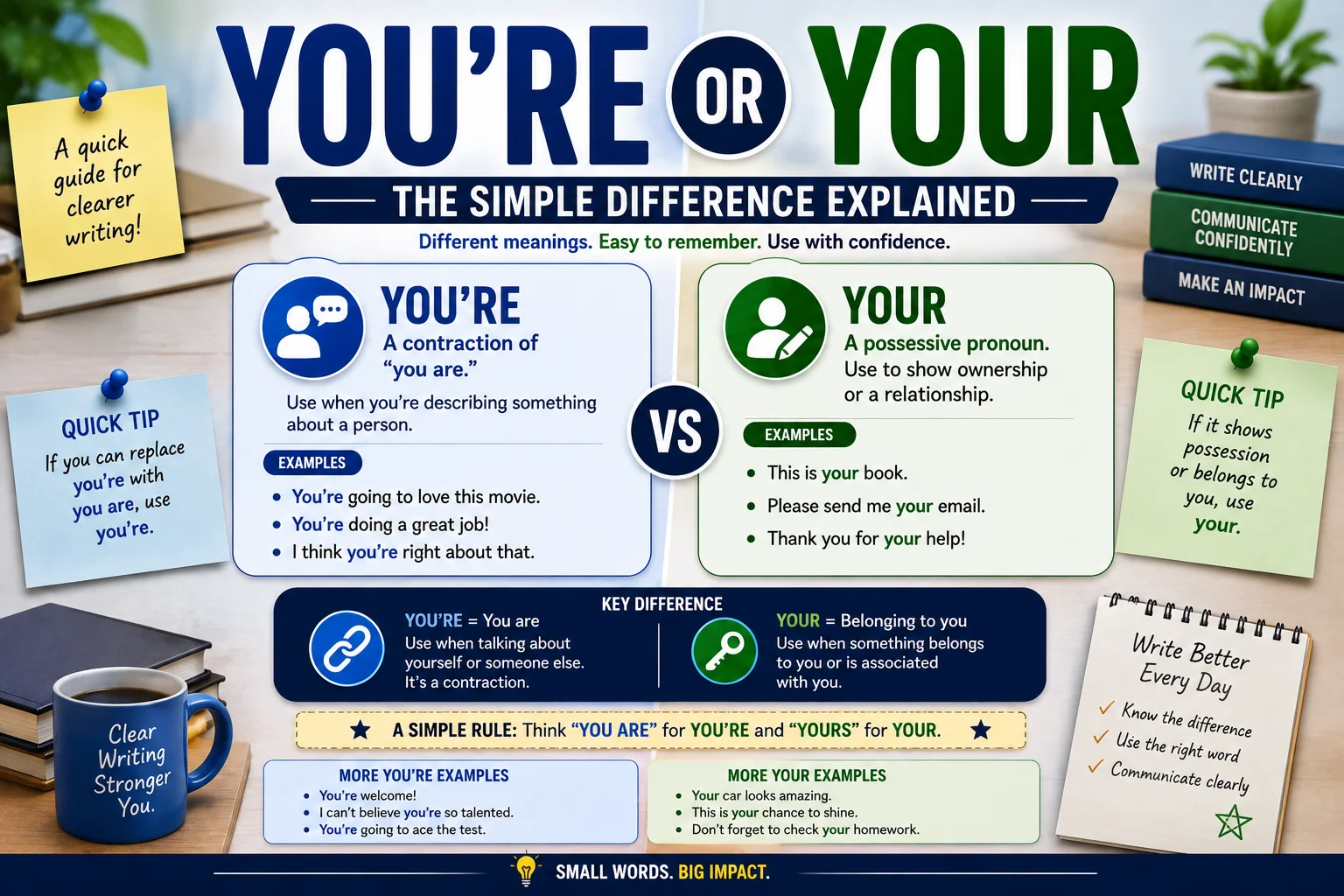
Have you ever stopped while typing and wondered, “Should I use you’re or your?” You are not alone. This is one of the most searched grammar questions online because the two words sound the same but have different meanings.
Many people mix them up in emails, social media posts, school assignments, and work documents. A small mistake can change the meaning of a sentence and make your writing look less professional. The good news is that the difference is easy to learn.
This guide explains you’re or your in simple words. You will get a quick answer, learn where the words came from, understand how they are used in British and American English, see common mistakes, and read real-life examples. You will also find comparison tables, FAQs, and usage tips to help you choose the correct word every time.
By the end of this article, you will never have to guess whether to write you’re or your again.
The difference is simple:
- You’re = You are
- Your = Shows ownership or possession.
Examples
| Word | Meaning | Example |
|---|---|---|
| You’re | Short for you are | You’re very kind. |
| Your | Something belongs to you | Your book is on the table. |
Easy Trick
Replace you’re with you are.
If the sentence still makes sense, use you’re.
Correct:
- You’re my best friend.
- You are my best friend. ✔
Incorrect:
- You’re phone is ringing.
- You are phone is ringing. ✘
The correct sentence is:
- Your phone is ringing.
The Origin of You’re or Your
The word your comes from Old English ēower, which meant “belonging to you.”
The word you’re is much newer. It is a contraction of you are. English speakers started using contractions to make speaking and writing faster and more natural.
The spelling difference exists because the two words have different jobs.
- Your is a possessive adjective.
- You’re is a contraction.
Although they sound exactly the same, they have different meanings and grammar rules.
British English vs American English Spelling
Unlike many English words, you’re and your are spelled the same in both British and American English.
There is no spelling difference between the two varieties.
The only difference you may notice is writing style. British writing may use slightly more formal wording, while American writing often sounds more direct.
Examples
British English
- You’re invited to the meeting.
- Please bring your passport.
American English
- You’re doing a great job.
- Don’t forget your keys.
Comparison Table
| Feature | British English | American English |
|---|---|---|
| You’re | You’re | You’re |
| Your | Your | Your |
| Meaning | Same | Same |
| Grammar | Same | Same |
| Pronunciation | Nearly identical | Nearly identical |
Which Spelling Should You Use?
The answer depends on what you want to say—not where your readers live.
If your audience is in the United States
Use:
- You’re when you mean you are.
- Your when showing ownership.
If your audience is in the United Kingdom
Use exactly the same rule.
If your audience is global
The rule never changes.
Remember this simple guide:
| Meaning | Correct Word |
|---|---|
| You are | You’re |
| Belongs to you | Your |
Common Mistakes with You’re or Your
Many writers confuse these words because they sound alike.
Mistake 1
❌ Your amazing.
✔ You’re amazing.
Mistake 2
❌ I like you’re idea.
✔ I like your idea.
Mistake 3
❌ Is this you’re car?
✔ Is this your car?
Mistake 4
❌ Your welcome.
✔ You’re welcome.
Mistake 5
❌ You’re dog is cute.
✔ Your dog is cute.
You’re or Your in Everyday Examples
Here is how these words appear in daily writing.
- You’re scheduled for tomorrow’s meeting.
- Please check your inbox.
News
- You’re reading today’s top stories.
- Your local weather forecast is available.
Social Media
- You’re awesome!
- Your photo looks amazing.
Formal Writing
- You’re eligible for the program.
- Your application has been approved.
School Writing
- You’re expected to finish the assignment.
- Your homework is due Friday.
You’re or Your – Google Trends & Usage Data
The search term “you’re or your” stays popular because many English learners and native speakers want a quick grammar answer.
People often search for this keyword before writing:
- Emails
- School assignments
- Blog posts
- Social media updates
- Business documents
The keyword receives strong interest in countries where English is the main language or widely taught, including:
- United States
- United Kingdom
- Canada
- Australia
- New Zealand
- India
- Pakistan
- Philippines
Searches usually increase during school terms and exam seasons, when students and professionals focus more on grammar and writing accuracy.
You’re or Your Comparison Table
| Feature | You’re | Your |
|---|---|---|
| Word Type | Contraction | Possessive adjective |
| Full Form | You are | Not a contraction |
| Meaning | Describes someone | Shows ownership |
| Example | You’re funny. | Your joke is funny. |
| Replace with “You are”? | Yes | No |
| Common Mistake | Used instead of “your” | Used instead of “you’re” |
FAQs
1. What is the difference between you’re and your?
You’re means you are. Your shows that something belongs to you.
2. Is “you’re” always short for “you are”?
Yes. Every time you use you’re, it should be possible to replace it with you are.
3. When should I use “your”?
Use your before a noun to show ownership.
Example:
- Your laptop
- Your family
4. Is “your welcome” correct?
No.
The correct phrase is:
You’re welcome.
5. Why do people confuse you’re and your?
They sound exactly alike, making them homophones. Their meanings and grammar are different.
6. Do British and American English use different spellings?
No.
Both use you’re and your the same way.
7. How can I remember the difference?
Replace you’re with you are.
If the sentence still makes sense, you’re is correct.
If not, use your.
Conclusion
Knowing the difference between you’re and your is one of the easiest ways to improve your English writing. Even though the two words sound the same, they have different meanings and different grammar roles. You’re is simply a shorter form of you are, while your shows that something belongs to someone. A quick substitution test can help you choose the correct word every time. If you can replace the word with you are, then you’re is the right choice. If you are talking about ownership, use your instead.
These rules are the same in American English, British English, and other English-speaking countries, so you never need to change your spelling based on your audience. Whether you are writing an email, posting on social media, creating school assignments, or preparing professional documents, using you’re and your correctly makes your writing clearer and more trustworthy. Keep practicing with real examples, and soon choosing between you’re and your will become a natural habit.
Favor or Favour: Which Spelling Should You Use? Complete English Guide

I am an English Literature expert and professional content writer with a passion for language, grammar, and effective communication. I specialize in creating well-researched, reader-friendly articles on English usage, spelling, vocabulary, writing techniques, and literary topics. My goal is to simplify complex concepts and provide accurate, engaging content that helps readers strengthen their language skills and communicate with confidence.