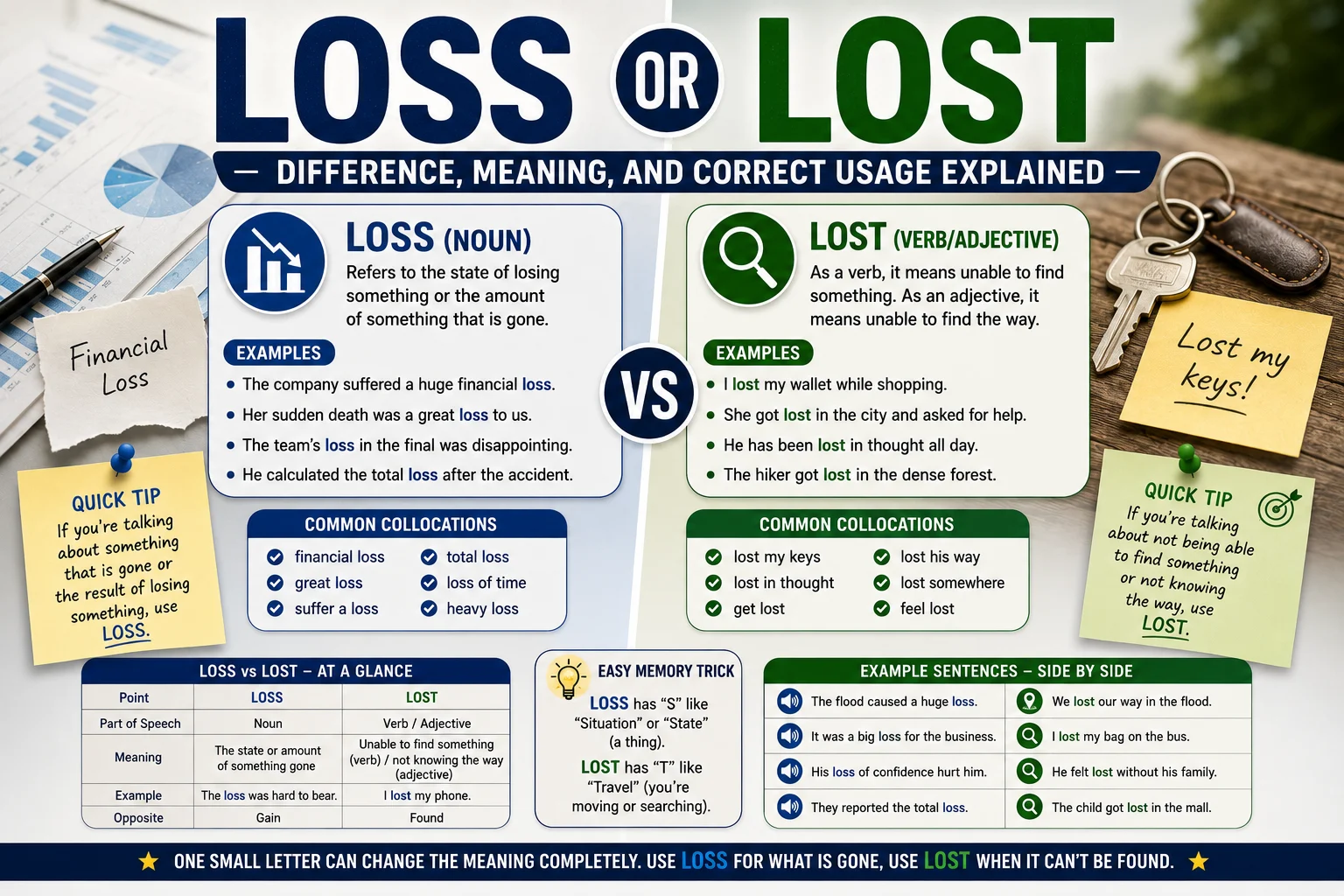
Have you ever stopped while writing and wondered, “Should I use loss or lost?” You are not alone. These two words look similar and are connected to the same idea, but they have different meanings and uses. Many people search for loss or lost because they want to write correctly in emails, school work, business documents, or everyday conversations.
The confusion happens because both words come from the verb lose. However, one is usually a noun, while the other is a verb form. Using the wrong word can change the meaning of a sentence. For example, saying “I loss my keys” is incorrect, while “I lost my keys” is correct.
This guide explains the difference between loss and lost in simple language. You will learn their meanings, origins, spelling rules, examples, common mistakes, and how people use them in different types of writing. Whether you use American English, British English, or global English, this article will help you choose the correct word with confidence.
The quick answer:
- Loss is a noun. It means the act of losing something or the result of losing something.
- Lost is the past tense and past participle of the verb lose.
Examples
✅ The company suffered a financial loss.
✅ She felt great loss after her pet died.
✅ I lost my wallet yesterday.
✅ He has lost his phone.
Easy Rule
Use loss when you are talking about a thing, event, or result.
Use lost when you are talking about an action that happened.
The Origin of Loss or Lost
Both loss and lost come from the Old English word losian, which meant “to perish” or “to be destroyed.”
Over time, English developed different forms of the word:
- Lose became the verb meaning to fail to keep something.
- Lost became the past form of lose.
- Loss became the noun describing the experience or result of losing.
The spelling differences exist because English uses different word endings to show grammar roles.
Examples:
- Lose → Lost (verb change for past action)
- Lose → Loss (noun form)
Although these words share the same history, they are not interchangeable.
British English vs American English Spelling
The spelling of loss and lost is the same in both British English and American English.
There is no regional spelling difference.
| Feature | British English | American English |
|---|---|---|
| Noun form | Loss | Loss |
| Past tense verb | Lost | Lost |
| Present verb | Lose | Lose |
| Meaning | Same | Same |
Examples in Both English Styles
British English
- The team suffered a heavy loss.
- I lost my ticket.
American English
- The business reported a major loss.
- She lost her keys.
The spelling remains identical, but pronunciation and sentence style may vary slightly.
Which Spelling Should You Use?
The correct choice depends on the meaning, not the country.
For US Readers
Use:
- Loss for an event, problem, or result.
- Lost for an action completed in the past.
Examples:
- The company reported a loss.
- I lost my job.
For UK and Commonwealth Readers
The same rule applies.
Examples:
- The family experienced a great loss.
- He lost his passport.
For Global Audiences
Both words are widely understood. The main goal is choosing the correct grammar form.
Remember:
- A person can lose something.
- Something can become a loss.
- Something was lost in the past.
Common Mistakes with Loss or Lost
Many writers confuse these words because they describe similar ideas.
| Incorrect | Correct | Explanation |
|---|---|---|
| I loss my phone. | I lost my phone. | Lost describes a past action. |
| The team lost a big. | The team had a big loss. | Loss is the noun. |
| We are sorry for your lost. | We are sorry for your loss. | Loss is used for sympathy. |
| He loss his opportunity. | He lost his opportunity. | Lost is the verb form. |
| The lost was unexpected. | The loss was unexpected. | Loss names an event. |
Simple Memory Trick
Ask:
Can I replace the word with “a thing” or “an event”?
If yes, use loss.
Is someone doing an action?
Use lost.
Loss or Lost in Everyday Examples
In Emails
Correct:
- We apologize for the loss of your account information.
- I lost the document you sent me.
In News
- The company reported a financial loss this year.
- Thousands of people lost their homes after the storm.
On Social Media
- Feeling the loss of a loved one today.
- I lost my favorite jacket!
In Formal Writing
- The economic loss affected many industries.
- The research team lost valuable data.
In Personal Messages
- I am sorry for your loss.
- I lost my way but found the right path.
Loss or Lost – Google Trends & Usage Data
Search interest for loss or lost remains high because both words are common in daily English.
Why People Search These Words
People often search for:
- Grammar explanations
- Correct spelling
- Sentence examples
- Writing help
Usage by Context
| Context | More Common Word |
|---|---|
| Business reports | Loss |
| Personal experiences | Lost |
| Sympathy messages | Loss |
| Travel problems | Lost |
| Sports results | Loss |
| Technology problems | Lost |
Popularity by Country
| Country | Common Usage |
|---|---|
| United States | Both widely used |
| United Kingdom | Both widely used |
| Canada | Both widely used |
| Australia | Both widely used |
| India | Both widely used |
Because these words are basic English vocabulary, they are common worldwide.
Keyword Comparison Table
| Word | Grammar Type | Meaning | Example |
|---|---|---|---|
| Lose | Verb | To fail to keep something | I might lose my keys. |
| Lost | Verb (past) | Something was no longer kept | I lost my keys. |
| Loss | Noun | The result of losing | The loss was painful. |
| Losing | Verb form | The act of losing | He is losing confidence. |
| Loser | Noun | A person who loses | The loser left the game. |
Frequently Asked Questions
1. Is loss or lost correct?
Both are correct words, but they have different meanings. Loss is a noun, and lost is a verb form.
2. Should I say “sorry for your loss” or “sorry for your lost”?
The correct phrase is “sorry for your loss.”
3. Is “I loss my phone” correct?
No. The correct sentence is “I lost my phone.”
4. Why do people confuse loss and lost?
They come from the same word, lose, and have similar meanings.
5. Is loss a verb?
No. Loss is usually a noun. The verb is lose.
6. Is lost always the past tense of lose?
Yes. Lost is the past tense and past participle of lose.
7. Do British and American English spell loss differently?
No. Both use the same spelling: loss and lost.
Conclusion
Understanding loss or lost becomes easy when you remember their grammar roles. Loss is a noun that describes the result, experience, or event of losing something. Lost is the past form of the verb lose and describes an action that already happened.
Both words are used in British English, American English, and global English with the same spelling and meaning. The key difference is not pronunciation or location but how the word functions in a sentence.
Use loss when you are naming something, such as a financial loss, personal loss, or loss of opportunity. Use lost when you are describing something that someone no longer has, such as lost keys, lost time, or lost information.
Choosing the correct word makes your writing clearer and more professional. Whether you are writing an email, report, social media post, or personal message, knowing the difference between loss and lost will help you communicate your ideas accurately.
Blink or Ring: Which Word Should You Use? Meaning, Differences, Examples & Usage Guide






5 thoughts on “Loss or Lost: Difference, Meaning, and Correct Usage Explained”