Have you ever stopped while writing and wondered whether you should write “sank” or “sunk”? You are not alone. Many English learners, students, writers, and even native speakers mix up these two words. Since both come from the same verb, they look similar, but they are not used the same way.
People often search for “sank or sunk” because they want a quick answer before sending an email, writing a report, completing homework, or publishing online content. Using the wrong word can make your writing sound awkward or incorrect. The good news is that the rule is simple once you understand it.
This guide explains the difference between sank and sunk in easy language. You will learn when to use each word, where they came from, how British and American English treat them, common mistakes to avoid, and real-life examples. By the end of this article, you will know exactly which word fits every situation.
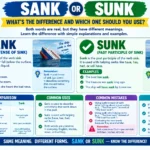
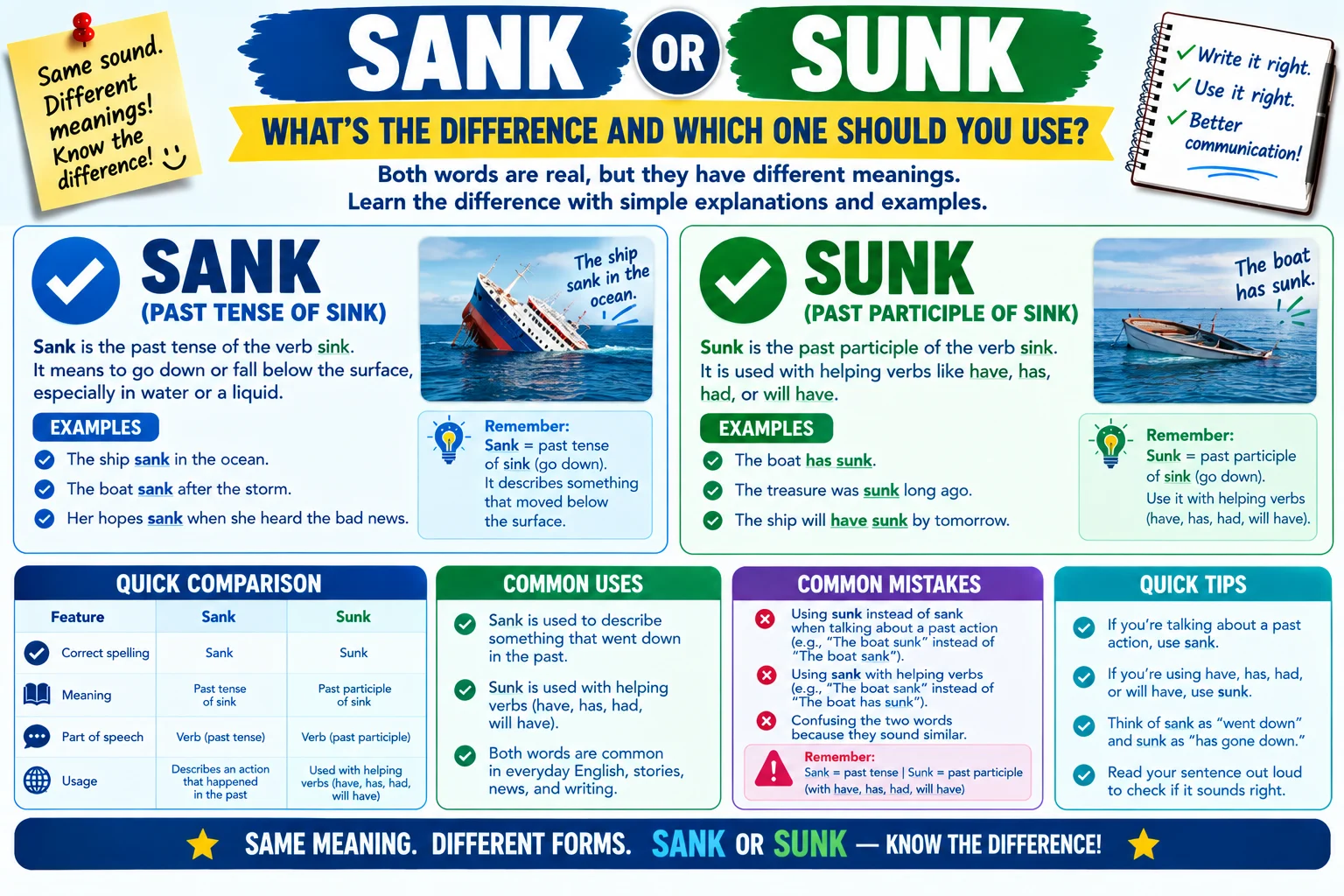
- Sank is the simple past tense of sink.
- Sunk is the past participle of sink.
Examples
✅ The ship sank during the storm.
✅ The ship has sunk to the bottom of the ocean.
✅ My phone sank into the mud.
✅ My phone had sunk before I found it.
Simple Rule
| Word | Use | Example |
| Sank | Simple past | The boat sank yesterday. |
| Sunk | Past participle | The boat has sunk. |
The Origin of Sank or Sunk
The words sank and sunk both come from the Old English verb sincan, which meant “to go down” or “to descend.”
Over hundreds of years, English grammar developed different forms of many irregular verbs. The verb sink became:
- Present: sink
- Past: sank
- Past participle: sunk
Unlike many English words, the difference is not caused by spelling changes between countries. Instead, it is part of the normal grammar of an irregular verb.
Today, dictionaries around the world follow the same standard forms.
British English vs American English Spelling
Unlike words such as colour/color or organise/organize, sank and sunk are not British and American spelling variations.
Both British English and American English use exactly the same forms.
Comparison
| Feature | British English | American English |
| Past tense | Sank | Sank |
| Past participle | Sunk | Sunk |
| Standard spelling | Same | Same |
| Meaning | Same | Same |
Examples
British English:
- The fishing boat sank overnight.
- The boat has sunk.
American English:
- The ship sank near the coast.
- The ship has sunk.
There is no spelling difference between the two varieties.
Which Spelling Should You Use?
The answer depends on the grammar, not your country.
If your audience is in the United States
Use:
- Sank for the simple past.
- Sunk after has, have, or had.
If your audience is in the United Kingdom or Commonwealth countries
Use exactly the same rule.
If you write for a global audience
Follow standard English grammar:
- Yesterday, the ship sank.
- The ship has sunk.
This works everywhere.
Common Mistakes with Sank or Sunk
Many writers use these words incorrectly.
Mistake 1
❌ The ship sunk yesterday.
✅ The ship sank yesterday.
Mistake 2
❌ The ship has sank.
✅ The ship has sunk.
Mistake 3
❌ My keys have sank.
✅ My keys have sunk.
Mistake 4
❌ The stone has sank.
✅ The stone has sunk.
Easy Memory Tip
Think of this pattern:
- Yesterday = sank
- Has/Have/Had = sunk
Sank or Sunk in Everyday Examples
“The package sank into the water during delivery.”
News
“The cargo ship sank after hitting rocks.”
Social Media
“My phone sank into the sand at the beach!”
Formal Writing
“The vessel has sunk, according to the official report.”
Conversation
“We watched the boat as it sank.”
“The old bridge has sunk into the riverbed.”
Sank or Sunk – Google Trends & Usage Data
Search interest for “sank or sunk” stays steady because people regularly check the correct grammar before writing.
The keyword is especially popular in:
- United States
- United Kingdom
- Canada
- Australia
- India
Most searches come from:
- Students
- English learners
- Teachers
- Content writers
- Editors
People usually search this phrase before writing essays, emails, news stories, or business documents.
Comparison Table
| Variation | Correct? | Use | Example |
| Sink | Yes | Present tense | Ships sometimes sink. |
| Sank | Yes | Simple past | The ship sank yesterday. |
| Sunk | Yes | Past participle | The ship has sunk. |
| Has sank | No | Incorrect | ❌ Has sank |
| Has sunk | Yes | Correct | ✅ Has sunk |
FAQs
1. Is it sank or sunk?
Both are correct, but they are used differently. Sank is the past tense, while sunk is the past participle.
2. Can I say “the ship sunk yesterday”?
No. The correct sentence is “The ship sank yesterday.”
3. Is “has sank” correct?
No. The correct phrase is “has sunk.”
4. Why are people confused about sank or sunk?
Both words come from the same verb and describe something going underwater, but they have different grammar roles.
5. Is sunk ever used by itself?
Yes. It can be used as an adjective.
Example:
“The treasure is in a sunk ship.”
More commonly, it appears after has, have, or had.
6. Do British and American English use different spellings?
No. Both use sank and sunk in exactly the same way.
7. How can I remember the difference?
Remember this simple rule:
- Yesterday = sank
- Has, have, or had = sunk
Conclusion
Understanding the difference between sank or sunk is easier than it first appears. The key is knowing that sank is the simple past tense and sunk is the past participle. You use sank when talking about an action that happened in the past, such as “The boat sank yesterday.” You use sunk after helping verbs like has, have, and had, as in “The boat has sunk.”
Unlike many English words, there is no British or American spelling difference between these forms. Both varieties of English follow the same grammar rules, making them easy to use once you remember the pattern. Whether you are writing emails, news articles, social media posts, school assignments, or professional reports, choosing the correct form improves clarity and credibility.
Whenever you feel unsure, remember one simple tip: Yesterday means sank. Has, have, or had means sunk. Following this rule will help you use these words correctly every time.
Loss or Lost: Difference, Meaning, and Correct Usage Explained

I am an English Literature expert and professional content writer with a passion for language, grammar, and effective communication. I specialize in creating well-researched, reader-friendly articles on English usage, spelling, vocabulary, writing techniques, and literary topics. My goal is to simplify complex concepts and provide accurate, engaging content that helps readers strengthen their language skills and communicate with confidence.