Have you ever stopped while writing and wondered whether you should use specialty or speciality? You are not alone. Many students, writers, business owners, and professionals search for this keyword because both spellings appear online, in books, and in everyday writing.
The confusion comes from the difference between American English and British English. In some countries, specialty is the standard spelling. In others, speciality is more common. Both words have the same meaning, but using the wrong spelling for your audience can make your writing look less natural.
This guide explains everything you need to know about specialty or speciality. You will learn the difference, where each spelling comes from, which countries use each version, and how to choose the right one. You will also see simple examples, common mistakes, comparison tables, FAQs, and practical writing tips. By the end, you will know exactly which spelling fits your audience and writing style.
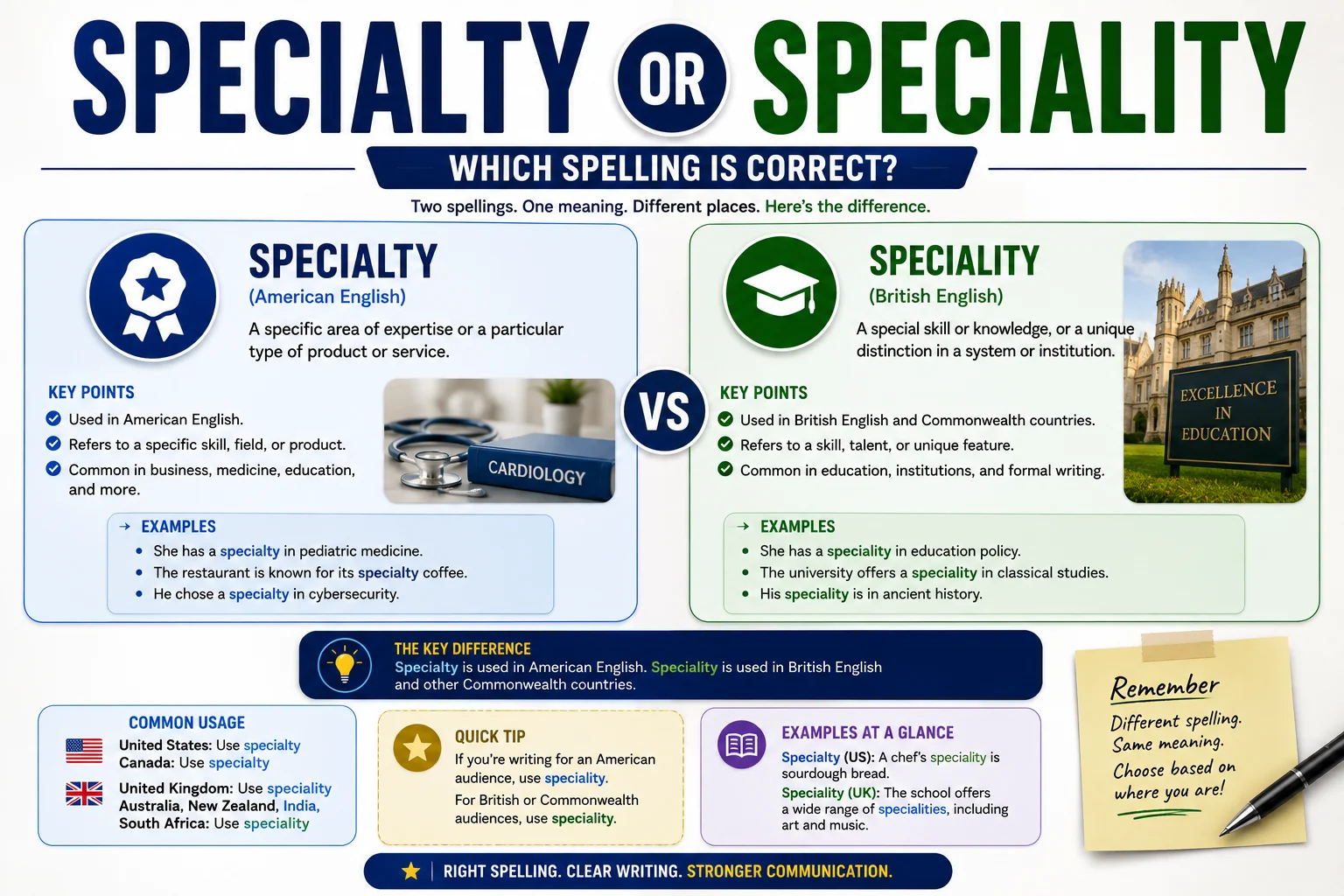
Both “specialty” and “speciality” are correct. The only difference is the spelling preference.
- Specialty = Preferred in American English.
- Speciality = Preferred in British English and many Commonwealth countries.
Examples
American English
- Cardiology is her medical specialty.
- The restaurant’s specialty is homemade pizza.
British English
- Cardiology is her medical speciality.
- The chef’s speciality is seafood dishes.
Both words mean:
- A person’s area of expertise.
- A product, food, or service someone is known for.
The Origin of Specialty or Speciality
The word comes from the Latin word specialis, meaning “particular” or “specific.”
It later entered Old French before becoming part of English. Over time, English developed different spelling styles in different countries.
British English often kept spellings ending in -ity, creating speciality.
American English gradually favored the shorter form specialty, which became the standard in the United States.
Today, both spellings have the same meaning. The difference is only regional.
British English vs American English Spelling
Many English words have different spellings depending on the country.
| American English | British English |
|---|---|
| Specialty | Speciality |
| Color | Colour |
| Favorite | Favourite |
| Center | Centre |
| Organize | Organise |
Key Difference
| Feature | Specialty | Speciality |
|---|---|---|
| Preferred in | United States | United Kingdom |
| Also common in | American businesses | UK, Australia, New Zealand |
| Meaning | Area of expertise | Area of expertise |
| Correct? | Yes | Yes |
The meaning never changes. Only the preferred spelling changes.
Which Spelling Should You Use?
Choose your spelling based on your audience.
Use Specialty if your readers are:
- In the United States
- Reading American websites
- Buying American products
- Using American English
Use Speciality if your readers are:
- In the United Kingdom
- In Australia
- In New Zealand
- In South Africa
- In other Commonwealth countries
For Global Audiences
Pick one spelling and use it throughout your document.
Do not switch between specialty and speciality in the same article unless you are explaining the difference.
Consistency makes your writing look professional.
Common Mistakes with Specialty or Speciality
Here are mistakes people often make.
| Incorrect | Correct |
|---|---|
| Using both spellings in one article | Choose one spelling style |
| Thinking one spelling is wrong | Both are correct |
| Using American spelling for UK clients | Use speciality |
| Using British spelling for US clients | Use specialty |
| Changing spelling randomly | Stay consistent |
Example
❌ Our company’s specialty products are our best speciality items.
✅ Our company’s specialty products are our best sellers.
OR
✅ Our company’s speciality products are our best sellers.
Specialty or Speciality in Everyday Examples
“Our team’s specialty is website design.”
“Our team’s speciality is website design.”
News
“The hospital announced a new heart specialty clinic.”
“The hospital announced a new heart speciality clinic.”
Social Media
“My specialty is baking chocolate cakes.”
“My speciality is baking chocolate cakes.”
Formal Writing
“Her research specialty focuses on climate science.”
“Her research speciality focuses on climate science.”
Specialty or Speciality – Google Trends & Usage Data
Search interest depends largely on location.
- Specialty is much more popular in the United States.
- Speciality appears more often in the United Kingdom.
- Australia, New Zealand, and other Commonwealth countries commonly use speciality, although specialty also appears in international brands.
- Global companies often choose the spelling that matches the target market.
- Search engines understand both spellings and usually recognize them as closely related terms.
Keyword Comparison
| Keyword Variation | Primary Region | Common Use |
|---|---|---|
| Specialty | United States | General writing |
| Speciality | United Kingdom | General writing |
| Medical specialty | United States | Healthcare |
| Medical speciality | United Kingdom | Healthcare |
| Restaurant specialty | United States | Food industry |
| Restaurant speciality | United Kingdom | Food industry |
Frequently Asked Questions
Is specialty or speciality correct?
Yes. Both spellings are correct. The preferred version depends on whether you use American or British English.
Which spelling is used in the United States?
Americans almost always use specialty.
Which spelling is used in the United Kingdom?
British English usually uses speciality.
Do both words have the same meaning?
Yes. Both refer to a person’s area of expertise or something unique that someone is known for.
Which spelling is better for SEO?
Use the spelling your audience searches for most. For US readers, use specialty. For UK readers, use speciality.
Can I use both spellings in one article?
Only if you are explaining the difference. Otherwise, choose one spelling and keep it consistent.
Which spelling should international companies use?
Use the version that matches your main audience or the English style used across your website.
Conclusion
Choosing between specialty or speciality is easier once you know the audience you are writing for. Both spellings are correct, and both carry the same meaning. The only real difference is regional preference. Specialty is the standard choice in American English, while speciality is preferred in British English and many Commonwealth countries.
When writing for a business, website, school, or publication, always follow the style guide your audience expects. If your readers are mainly in the United States, use specialty throughout your content. If your audience is in the United Kingdom or another Commonwealth country, use speciality instead. For international websites, choose one version and stay consistent across every page.
Remember that consistency is more important than the spelling itself. Search engines recognize both forms, and readers understand both. By matching your audience’s language style and keeping your writing consistent, your content will appear more natural, professional, and trustworthy.
Favor or Favour: Which Spelling Should You Use? Complete English Guide

I am an English Literature expert and professional content writer with a passion for language, grammar, and effective communication. I specialize in creating well-researched, reader-friendly articles on English usage, spelling, vocabulary, writing techniques, and literary topics. My goal is to simplify complex concepts and provide accurate, engaging content that helps readers strengthen their language skills and communicate with confidence.