Have you ever stopped while writing and wondered whether you should use sheers or shears? You are not alone. Many people search for this keyword because the two words look almost the same, but they have very different meanings. One is a common noun for a cutting tool, while the other is usually a verb or an adjective. This small spelling difference can completely change the meaning of a sentence.
People often see these words in gardening, sewing, hairdressing, construction, and everyday writing. Search engines also show both spellings, making the confusion even greater. If you choose the wrong word, your writing may sound incorrect or unclear.
This guide explains the difference between sheers and shears in simple language. You will learn what each word means, where it came from, when to use it, and which spelling fits different audiences. By the end of this article, you will know exactly which word belongs in every situation.
Sheers or Shears – Quick Answer
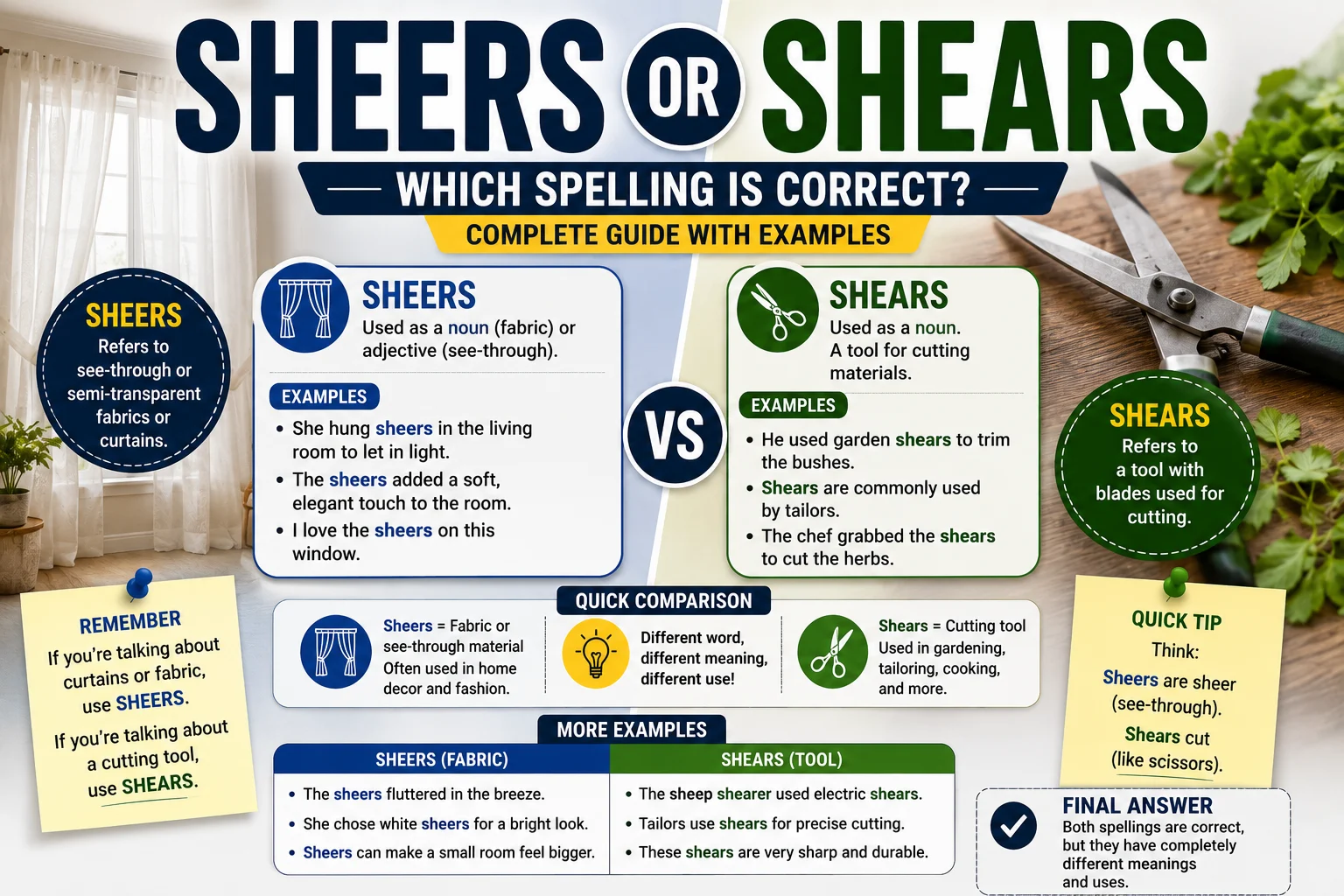
Shears is the correct word when talking about a large cutting tool.
Sheers is usually not the correct spelling if you mean the tool. Instead, sheers is the third-person form of the verb sheer, which means to turn sharply, move suddenly, or cut something off. It can also relate to the adjective sheer, meaning complete or very steep.
Examples
✅ I bought new garden shears.
✅ The barber used hair shears.
✅ The ship sheers away from the rocks.
❌ I bought new garden sheers.
The Origin of Sheers or Shears
The word shears comes from Old English sceara, meaning a cutting instrument. For hundreds of years, people have used the word for tools that cut cloth, plants, wool, or hair.
The word sheer has a different history. It comes from Old English and later Dutch influences. Over time, it developed several meanings, including:
- To turn suddenly
- To move away quickly
- Complete or absolute
- Very steep
Because sheers is simply a verb form of sheer, it is not another spelling of the cutting tool.
The similar pronunciation causes many spelling mistakes, but the words have different origins and meanings.
British English vs American English Spelling
Unlike many English words, shears does not change spelling between British English and American English.
People in both countries write shears when referring to cutting tools.
The difference is not regional. It is grammatical.
| Meaning | Correct Word | British English | American English |
|---|---|---|---|
| Cutting tool | Shears | ✅ Shears | ✅ Shears |
| Verb meaning turns away | Sheers | ✅ Sheers | ✅ Sheers |
| Garden tool | Shears | ✅ Shears | ✅ Shears |
| Hair cutting tool | Shears | ✅ Shears | ✅ Shears |
Example
British English:
- Please sharpen the garden shears.
American English:
- He bought professional hair shears.
Both are correct.
Which Spelling Should You Use?
Choose your spelling based on what you want to say.
If your audience is in the United States
Use shears for cutting tools.
If your audience is in the United Kingdom or Commonwealth countries
Use shears for cutting tools.
If you write for a global audience
Use shears whenever you mean scissors designed for heavy cutting.
Only use sheers if you are talking about the verb sheer, such as a ship changing direction.
Common Mistakes with Sheers or Shears
Many writers accidentally replace shears with sheers because the words sound alike.
Mistake 1
❌ Garden sheers
✅ Garden shears
Mistake 2
❌ Hair sheers
✅ Hair shears
Mistake 3
❌ Hedge sheers
✅ Hedge shears
Mistake 4
❌ Fabric sheers
✅ Fabric shears
Mistake 5
❌ The barber sharpened his sheers.
✅ The barber sharpened his shears.
Remember:
- Shears = cutting tool
- Sheers = verb form of sheer
Sheers or Shears in Everyday Examples
Here are common situations where these words appear.
“I ordered new garden shears for the landscaping project.”
News
“Firefighters used heavy-duty shears to rescue passengers.”
Social Media
“My new pruning shears work perfectly!”
Formal Writing
“The technician used industrial shears to cut the metal sheets.”
Verb Example
“The boat sheers to the left during strong winds.”
Sheers or Shears – Google Trends & Usage Data
Search data shows that shears is searched far more often than sheers because people usually look for cutting tools.
The keyword shears is especially popular in countries where gardening, farming, tailoring, and hairdressing are common industries.
Countries with strong interest include:
- United States
- United Kingdom
- Canada
- Australia
- New Zealand
The word sheers appears much less often and usually relates to nautical writing or grammar searches rather than tools.
Keyword Comparison Table
| Keyword Variation | Meaning | Correct for Cutting Tool? | Common Usage |
|---|---|---|---|
| Shears | Cutting tool | ✅ Yes | Very Common |
| Sheers | Verb form of sheer | ❌ No | Uncommon |
| Garden shears | Gardening tool | ✅ Yes | Very Common |
| Hair shears | Hair-cutting tool | ✅ Yes | Very Common |
| Pruning shears | Plant trimming tool | ✅ Yes | Common |
| Hedge shears | Hedge trimming tool | ✅ Yes | Common |
Frequently Asked Questions
1. Is it sheers or shears?
Shears is correct when talking about cutting tools.
2. Why do people write sheers?
Many people confuse the words because they sound similar.
3. Are sheers and shears the same?
No. Shears is a tool. Sheers is usually a verb form of sheer.
4. Is garden sheers correct?
No. The correct phrase is garden shears.
5. Is hair sheers correct?
No. The correct term is hair shears.
6. Do British and American English spell shears differently?
No. Both use shears.
7. When should I use sheers?
Use sheers only when writing about the verb sheer, such as a vehicle or ship changing direction sharply.
Conclusion
The difference between sheers and shears is simple once you know their meanings. If you are talking about a cutting tool used for gardening, sewing, hairdressing, farming, or construction, shears is always the correct word. This spelling is accepted in both British English and American English, so you do not need to change it based on your audience.
The word sheers, however, belongs to the verb sheer. It describes actions such as turning suddenly or moving away sharply, and it is much less common in everyday writing. Because the words sound alike, many writers accidentally use the wrong spelling. Remember that pronunciation does not always match meaning.
When in doubt, think about the context. If something is cutting, trimming, or pruning, choose shears. If something suddenly changes direction, sheers may be correct. Following this simple rule will help your writing stay accurate, professional, and easy for readers to understand.
Oriented or Orientated: Which Spelling Is Correct? Meaning, Differences, Examples & Usage Guide