Have you ever wondered whether you should write “oriented” or “orientated”? You’re not alone. Many English learners, students, writers, and professionals search for this question because both words appear in books, websites, and everyday conversations. At first glance, they seem to mean exactly the same thing, yet one is more common in some countries than others.
The good news is that both “oriented” and “orientated” are correct. The difference is not about grammar or meaning. Instead, it comes down to regional English preferences. American English strongly prefers oriented, while British English accepts both forms, with orientated appearing more often than it does in the United States. This can make choosing the right word confusing, especially when writing for an international audience.
This guide explains the meaning, history, spelling differences, usage examples, common mistakes, and popularity of oriented or orientated. By the end, you’ll know which spelling fits your audience and how to use each word with confidence.
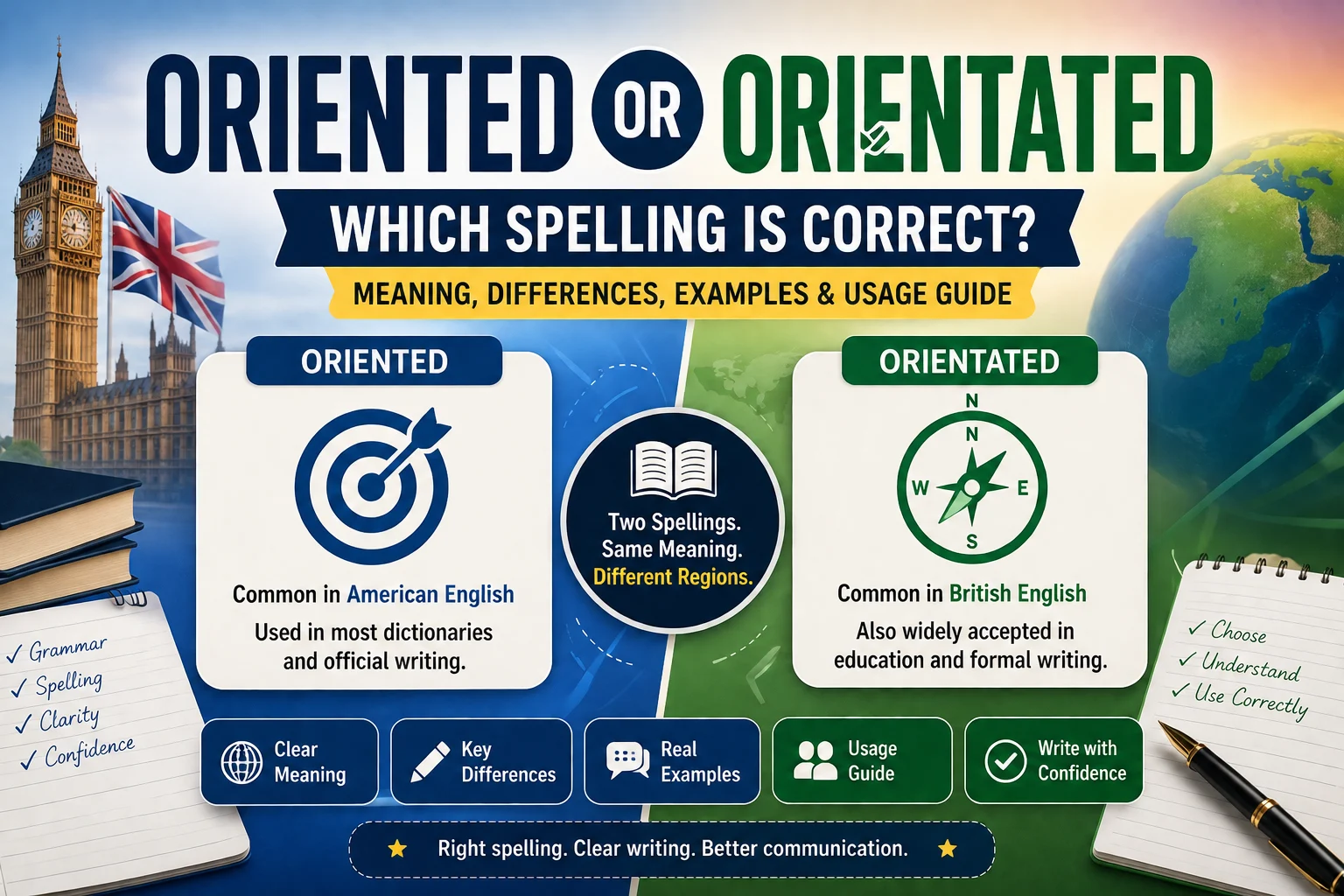
Both oriented and orientated are correct English words.
They both mean:
- Directed toward something.
- Positioned correctly.
- Focused on a goal or purpose.
The main difference is regional preference.
- Oriented is preferred in American English.
- Orientated is more common in British English, although oriented is also widely accepted.
Examples
- She is career-oriented.
- He is career-orientated.
- The map is correctly oriented.
- The building is orientated toward the sea.
All four sentences are correct.
The Origin of Oriented or Orientated
The word orient comes from the Latin word oriens, meaning “east” or “rising.” It originally described facing toward the east. Over time, the meaning expanded to include finding direction or becoming familiar with a place or situation.
Oriented developed directly from the verb orient.
Later, orientated appeared as an alternative form by adding the ending -ate, following patterns found in other English verbs.
Today, both words share the same meaning. The main reason for the difference is regional language preference rather than grammar.
British English vs American English Spelling
The biggest difference between these words is where they are commonly used.
| Feature | American English | British English |
|---|---|---|
| Preferred spelling | Oriented | Orientated or Oriented |
| Most common in business writing | Oriented | Both accepted |
| Academic writing | Oriented | Both accepted |
| Everyday writing | Oriented | Often Orientated |
Examples
| American English | British English |
|---|---|
| Customer-oriented service | Customer-orientated service |
| Goal-oriented employee | Goal-orientated employee |
| Market-oriented strategy | Market-orientated strategy |
Both versions are grammatically correct.
Which Spelling Should You Use?
Your audience should guide your choice.
For US Audiences
Use oriented.
Examples:
- Customer-oriented business
- Career-oriented student
- Results-oriented team
This is the standard choice in American English.
For UK and Commonwealth Audiences
Both spellings are correct.
Many British writers use orientated, but oriented is also widely accepted.
For Global Audiences
Use oriented if you want one spelling that is familiar to readers around the world.
It is the more common choice in international business and academic writing.
Common Mistakes with Oriented or Orientated
Here are mistakes people often make.
| Incorrect | Correct |
|---|---|
| Career orientated person (US writing) | Career-oriented person |
| Customer oriented service | Customer-oriented service |
| Goal orientated team (US style guide) | Goal-oriented team |
| Mixing both spellings in one article | Use one spelling consistently |
Tips
- Choose one spelling.
- Stay consistent throughout your document.
- Match the spelling to your audience.
Oriented or Orientated in Everyday Examples
Emails
“Our company is customer-oriented.”
“Our company is customer-orientated.”
News
“The government announced a growth-oriented policy.”
“The council introduced a community-orientated program.”
Social Media
“I’m goal-oriented this year.”
“Our team is people-orientated.”
Formal Writing
“The organization follows a research-oriented approach.”
“The school has a student-orientated learning system.”
Oriented or Orientated – Google Trends & Usage Data
Search data shows that both spellings are widely used, but popularity varies by region.
- Oriented is much more popular in the United States.
- Orientated appears more often in the United Kingdom, Australia, New Zealand, and some Commonwealth countries.
- International companies often prefer oriented because it reaches a wider audience.
Popular Usage by Country
| Country | Oriented | Orientated |
|---|---|---|
| United States | Very High | Low |
| United Kingdom | High | High |
| Canada | High | Medium |
| Australia | Medium | High |
| New Zealand | Medium | High |
| India | High | Medium |
Overall, oriented has greater global search volume.
Oriented or Orientated Comparison Table
| Feature | Oriented | Orientated |
|---|---|---|
| Meaning | Directed or focused | Directed or focused |
| Grammar | Correct | Correct |
| American English | Preferred | Rare |
| British English | Accepted | Common |
| Business Writing | Very Common | Less Common |
| Academic Writing | Common | Accepted |
| Global Audience | Best Choice | Less Common |
Frequently Asked Questions (FAQs)
1. Is “oriented” or “orientated” correct?
Both are correct English words.
2. Which spelling is used in American English?
American English strongly prefers oriented.
3. Is “orientated” wrong?
No. It is a correct word and is widely used in British English.
4. Which spelling is better for business writing?
Oriented is usually the safest choice, especially for international readers.
5. Do both words have the same meaning?
Yes. They both mean directed toward, focused on, or positioned correctly.
6. Can I use both spellings in one article?
It is better to choose one spelling and use it consistently.
7. Which spelling is more common worldwide?
Oriented is generally more common, especially in American English and global business communication.
Conclusion
The choice between oriented and orientated is mainly a matter of regional preference rather than correctness. Both words have the same meaning and are accepted in standard English. If you write for readers in the United States, oriented is the preferred spelling and appears in most business, academic, and professional writing. In the United Kingdom and many Commonwealth countries, orientated is also common, although oriented remains widely understood and accepted.
For international audiences, oriented is usually the safest option because it is more familiar to readers across different countries. Whatever spelling you choose, the most important rule is consistency. Avoid switching between oriented and orientated within the same document. By matching your spelling to your audience and keeping your usage consistent, you can create writing that is clear, professional, and easy to understand. With these simple guidelines, you’ll always know when to use oriented or orientated with confidence.
Bologna or Baloney: Which Spelling Is Correct? Meaning, Differences, and When to Use Each