Have you ever seen a meeting scheduled for PDT or PST and wondered which one is correct? Many people search for “PDT or PST” because they are confused about time zones, especially when planning meetings, online events, travel, or business calls. Using the wrong abbreviation can cause people to join an hour early or an hour late.
The confusion comes from daylight saving time. Some places change their clocks during part of the year, while others do not. Because of this, PDT and PST are not the same, even though both refer to the Pacific Time Zone in North America. Knowing when to use each abbreviation helps you avoid scheduling mistakes and communicate clearly.
In this guide, you’ll learn the difference between PDT and PST, where these terms came from, how they are used, common mistakes to avoid, and which one is right for your audience. By the end, you’ll know exactly when to use PDT and when PST is the correct choice.
PDT or PST – Quick Answer
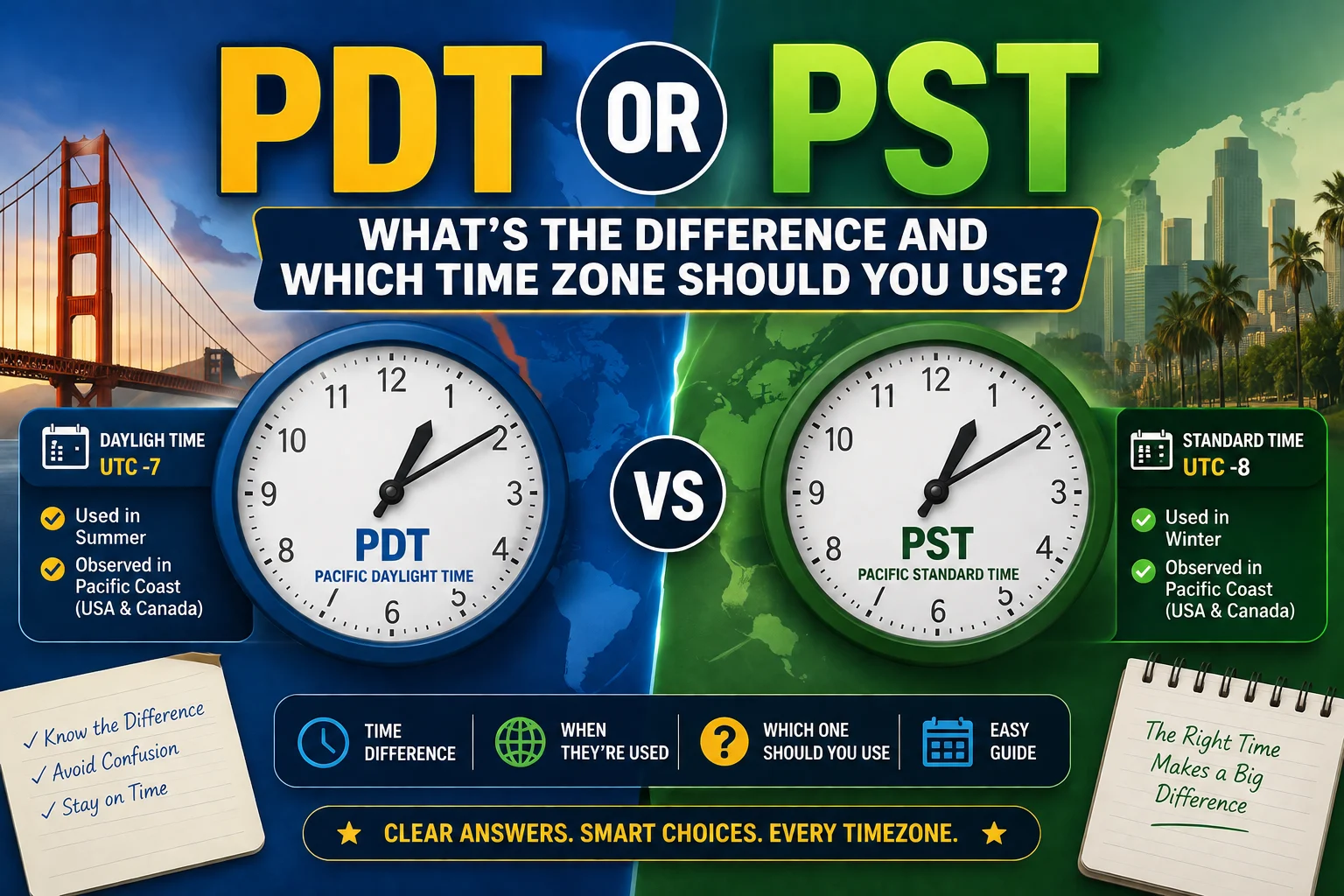
Quick answer: Use PDT (Pacific Daylight Time) during daylight saving time and PST (Pacific Standard Time) during standard time.
- PDT = UTC−7
- PST = UTC−8
Examples
- Meeting at 3:00 PM PDT (summer)
- Meeting at 3:00 PM PST (winter)
If daylight saving time is active, use PDT. If it is not, use PST.
The Origin of PDT or PST
The Pacific Time Zone was created so people in the western part of North America could use the same standard time.
- PST stands for Pacific Standard Time.
- PDT stands for Pacific Daylight Time.
The word Standard means the normal time used during the colder months.
The word Daylight refers to daylight saving time, when clocks move forward by one hour to make better use of evening daylight.
There is no spelling difference between PDT and PST. They are different abbreviations because they represent different times of the year.
British English vs American English Spelling
There is no British or American spelling difference between PDT and PST.
Both countries use these abbreviations exactly the same way when referring to the Pacific Time Zone.
| Feature | British English | American English |
|---|---|---|
| Pacific Standard Time | PST | PST |
| Pacific Daylight Time | PDT | PDT |
| Meaning | Same | Same |
| Usage | Same abbreviations | Same abbreviations |
Key Point
The difference is based on time of year, not on British or American spelling.
Which Spelling Should You Use?
Since PDT and PST are official time zone abbreviations, there is no regional spelling choice.
Instead, choose the abbreviation based on the date.
For US Audiences
Use:
- PDT during daylight saving time.
- PST during standard time.
For UK and Commonwealth Audiences
Use the same abbreviations when referring to Pacific Time.
Many international businesses also include the UTC offset to avoid confusion.
For Global Audiences
When communicating worldwide, include both the abbreviation and the UTC offset.
Example:
- 10:00 AM PDT (UTC−7)
- 10:00 AM PST (UTC−8)
This makes scheduling easier for everyone.
Common Mistakes with PDT or PST
Many people accidentally use the wrong abbreviation.
| Mistake | Correct Version |
|---|---|
| Using PST in July | Use PDT. |
| Using PDT in January | Use PST. |
| Assuming they mean the same thing | They differ by one hour. |
| Leaving out the time zone | Always include PDT or PST when needed. |
| Forgetting daylight saving time | Check whether daylight saving time is active. |
Helpful Tip
If clocks have moved forward for daylight saving time, use PDT.
If clocks are on standard time, use PST.
PDT or PST in Everyday Examples
“Our meeting starts at 2:00 PM PDT on Tuesday.”
News
“The announcement will be released at 9:00 AM PST.”
Social Media
“Live stream starts tonight at 7 PM PDT. Don’t miss it!”
Formal Writing
“Applications must be submitted before 5:00 PM PST on the closing date.”
PDT or PST – Google Trends & Usage Data
Searches for “PDT or PST” increase during daylight saving time changes because people want to know which abbreviation is correct.
Common reasons people search include:
- Scheduling virtual meetings
- Online classes
- Gaming events
- Live streams
- Flight schedules
- Business deadlines
- International communication
Interest is highest in countries that work with North American businesses or audiences, including the United States, Canada, the United Kingdom, Australia, and India.
Many people search for the phrase because they want to avoid missing important events by one hour.
Comparison Table
| Term | Full Name | UTC Offset | When to Use |
|---|---|---|---|
| PDT | Pacific Daylight Time | UTC−7 | During daylight saving time |
| PST | Pacific Standard Time | UTC−8 | During standard time |
Frequently Asked Questions
1. What is the difference between PDT and PST?
PDT is used during daylight saving time, while PST is used during standard time.
2. Is PDT one hour ahead of PST?
Yes. PDT is one hour ahead because clocks move forward during daylight saving time.
3. Which is used in summer?
PDT is used during the summer months when daylight saving time is active.
4. Which is used in winter?
PST is used during the winter when daylight saving time ends.
5. Are PDT and PST the same time zone?
Yes. Both belong to the Pacific Time Zone, but they represent different parts of the year.
6. Should I write PDT or PST in business emails?
Use the abbreviation that matches the date of the meeting or event.
7. How can I avoid confusion?
Include both the abbreviation and the UTC offset when communicating with an international audience.
Conclusion
Understanding the difference between PDT and PST is important for anyone who schedules meetings, attends online events, travels, or works with people in different time zones. Although both abbreviations refer to the Pacific Time Zone, they are not interchangeable. PDT (Pacific Daylight Time) is used when daylight saving time is in effect, while PST (Pacific Standard Time) is used during the standard time period. The difference is one hour, which can make a big impact on appointments and deadlines.
There is no British or American spelling difference between PDT and PST. The correct choice depends only on the date and whether daylight saving time is active. For international communication, adding the UTC offset can make your message even clearer. By using the right abbreviation and checking the current time period, you can avoid confusion, keep your schedule accurate, and communicate professionally with people around the world.
Bologna or Baloney: Which Spelling Is Correct? Meaning, Differences, and When to Use Each