Have you seen fibre in one article and fiber in another? You may wonder which spelling is correct. The simple answer is that both are correct, but they are used in different parts of the world.
Many people search for “fibre or fiber” because they want to write correctly for school, work, websites, or business. They also want to know which spelling Google prefers, whether the words have different meanings, and which version is better for SEO. This confusion is common because English has different spelling rules in different countries.
The good news is that fibre and fiber mean the same thing. They both refer to dietary fiber in food, natural or synthetic threads in materials, and communication technology such as fiber-optic cables. The only real difference is the spelling.
This guide explains the origin of the words, the differences between British and American English, when to use each spelling, common mistakes, real-life examples, and usage trends. By the end, you will know exactly which spelling is right for your audience.
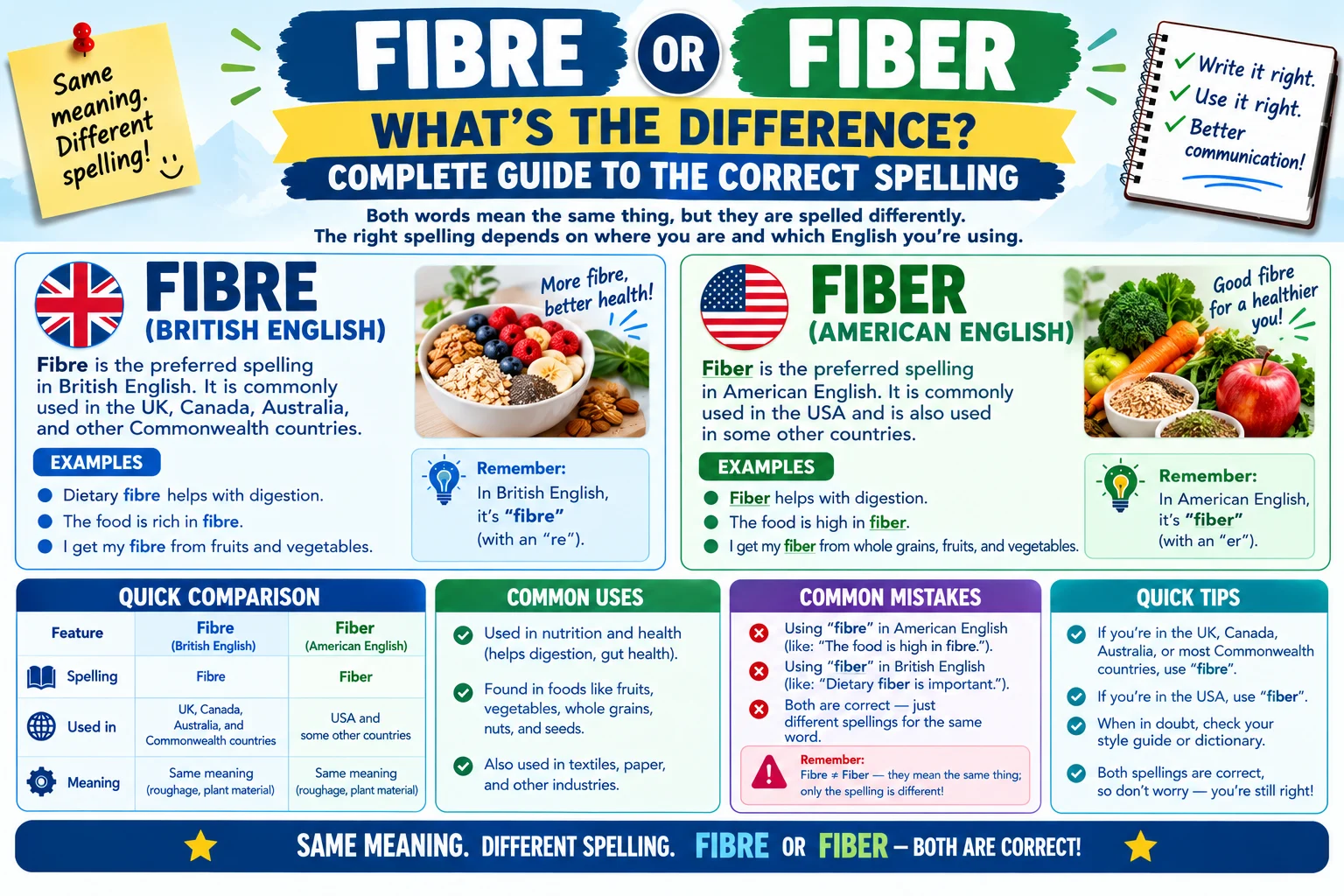
Both fibre and fiber are correct spellings of the same word.
- Fiber is the standard spelling in American English.
- Fibre is the standard spelling in British English and most Commonwealth countries.
Examples
- American English: Eating enough fiber supports healthy digestion.
- British English: Eating enough fibre supports healthy digestion.
Another example:
- US: The internet provider installed a fiber connection.
- UK: The internet provider installed a fibre connection.
The meaning stays exactly the same. Only the spelling changes.
The Origin of Fibre or Fiber
The word comes from the Latin word fibra, meaning a thread, strand, or filament.
For many centuries, English borrowed words from Latin and French. Over time, spelling changed in different countries.
When American English became more standardized, many words were simplified. This included changing -re endings to -er in words such as:
- Fibre → Fiber
- Centre → Center
- Theatre → Theater
British English kept the older -re spelling, while American English adopted -er for many words.
Today, both spellings are accepted because they follow different English language standards.
British English vs American English Spelling
The biggest difference is where each spelling is used.
| British English | American English |
|---|---|
| Fibre | Fiber |
| Centre | Center |
| Theatre | Theater |
| Metre | Meter |
| Litre | Liter |
Where each spelling is used
| Country or Region | Preferred Spelling |
|---|---|
| United States | Fiber |
| United Kingdom | Fibre |
| Canada | Fibre (most common) |
| Australia | Fibre |
| New Zealand | Fibre |
| Ireland | Fibre |
Examples
British English:
- Foods high in fibre improve digestion.
- The company installed fibre broadband.
American English:
- Foods high in fiber improve digestion.
- The company installed fiber internet.
Which Spelling Should You Use?
The best spelling depends on your audience.
Use Fiber if your readers are:
- In the United States
- Reading American publications
- Buying products made for the US market
- Visiting a US-focused website
Use Fibre if your readers are:
- In the United Kingdom
- Australia
- New Zealand
- Ireland
- Most Commonwealth countries
For global websites
Choose one spelling and use it consistently.
If most of your visitors come from the United States, use fiber.
If your audience is international or mainly British, use fibre.
Consistency helps readers and creates a more professional website.
Common Mistakes with Fibre or Fiber
Many writers make simple spelling mistakes.
Mistake 1: Mixing spellings
❌ Our food contains fibre and lots of fiber.
✅ Choose one spelling style and keep it throughout the document.
Mistake 2: Using the wrong spelling for your audience
US website:
❌ Best foods with fibre.
✅ Best foods with fiber.
UK website:
❌ Foods rich in fiber.
✅ Foods rich in fibre.
Mistake 3: Thinking the meanings are different
Many people believe fiber means internet cables while fibre means food.
This is incorrect.
Both spellings can describe:
- Dietary fiber/fibre
- Textile fibers/fibres
- Fiber-optic or fibre-optic technology
Only the spelling changes.
Fibre or Fiber in Everyday Examples
US:
“Please choose foods with more fiber.”
UK:
“Please choose foods with more fibre.”
News
US:
“The city expanded its fiber internet network.”
UK:
“The city expanded its fibre broadband network.”
Social Media
US:
“More fiber, better digestion!”
UK:
“Eat more fibre every day!”
Formal Writing
US:
“Patients should increase their daily fiber intake.”
UK:
“Patients should increase their daily fibre intake.”
Fibre or Fiber – Google Trends & Usage Data
Search interest depends largely on the country.
- Fiber is much more popular in the United States.
- Fibre is more common in the United Kingdom, Australia, New Zealand, and many Commonwealth countries.
- Health websites, internet providers, and textile industries all follow the spelling used in their target market.
For SEO, it is best to match the spelling that your audience expects. A US audience is more likely to search for fiber, while a UK audience typically searches for fibre. If your website serves readers from multiple regions, consider naturally mentioning both spellings so users can find the content regardless of their preferred form.
Comparison Table
| Feature | Fibre | Fiber |
|---|---|---|
| Meaning | Same | Same |
| British English | ✅ Yes | ❌ No |
| American English | ❌ No | ✅ Yes |
| Dietary health | ✅ Yes | ✅ Yes |
| Internet cables | ✅ Yes | ✅ Yes |
| Textile materials | ✅ Yes | ✅ Yes |
| Best for UK SEO | ✅ Yes | ❌ No |
| Best for US SEO | ❌ No | ✅ Yes |
Frequently Asked Questions
1. Is fibre or fiber correct?
Both are correct. The choice depends on whether you are using British or American English.
2. Is there any difference in meaning?
No. They have exactly the same meaning.
3. Which spelling is used in the United States?
American English uses fiber.
4. Which spelling is used in the United Kingdom?
British English uses fibre.
5. Which spelling is better for SEO?
Use the spelling that matches your target audience. US websites should use fiber, while UK websites should use fibre.
6. Can I use both spellings on one website?
Yes, but only if your content targets international readers. Otherwise, using one spelling consistently is usually better for readability and branding.
7. Do fibre and fiber both refer to food and internet cables?
Yes. Both spellings are used for dietary fiber/fibre, textile fibers/fibres, and fiber-optic or fibre-optic communication.
Conclusion
The difference between fibre and fiber is simple: the spelling changes, but the meaning does not. Fiber is the standard form in American English, while fibre is preferred in British English and most Commonwealth countries. Whether you are writing about healthy food, textile materials, or high-speed internet, both words describe the same thing.
When choosing which spelling to use, always think about your readers. A US audience expects fiber, while readers in the UK, Australia, and many other countries expect fibre. If your website serves a global audience, pick one style and stay consistent, or mention both spellings naturally when appropriate. Consistent language improves readability, builds trust, and supports SEO by matching the search habits of your audience.
By understanding the origin, spelling rules, common mistakes, and real-world examples, you can confidently choose the correct version every time. The right spelling is simply the one that fits your audience and keeps your writing clear, accurate, and professional.
Wonder or Wander: What’s the Difference and Which Word Should You Use?

I am an English Literature expert and professional content writer with a passion for language, grammar, and effective communication. I specialize in creating well-researched, reader-friendly articles on English usage, spelling, vocabulary, writing techniques, and literary topics. My goal is to simplify complex concepts and provide accurate, engaging content that helps readers strengthen their language skills and communicate with confidence.