Have you ever stopped while writing and wondered, “Should I write master or masters?” You are not alone. This is a common question because both words are correct, but they have different meanings and uses. Many people search for this keyword when filling out job applications, writing resumes, talking about university degrees, or creating professional documents.
The confusion usually comes from grammar. Sometimes master is singular. Sometimes masters is plural. In education, people also wonder whether to write master’s degree, masters degree, or simply master. Small spelling differences can change the meaning of a sentence or make your writing look less professional.
This guide explains everything in simple language. You will learn when to use master and masters, how British and American English treat related terms, common mistakes to avoid, and which form works best for your audience. By the end, you will know exactly which word to choose in every situation.
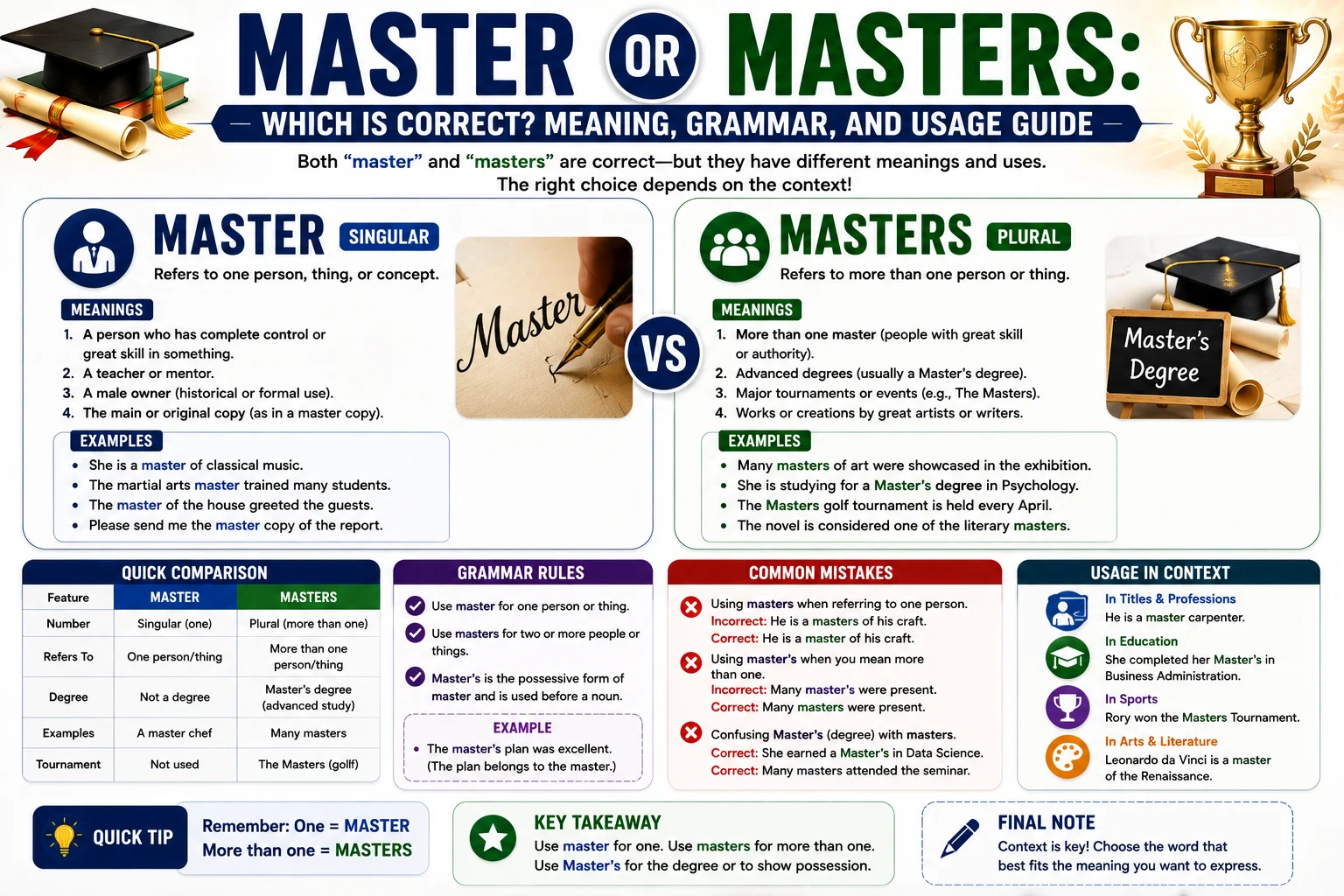
Both master and masters are correct, but they are not interchangeable.
- Master is singular.
- Example: She is a master chef.
- Example: I want to master this skill.
- Masters is the plural form.
- Example: Several masters attended the meeting.
- Example: The tournament has many past masters.
When talking about a university qualification, the correct form is usually master’s degree.
Examples:
- ✅ I earned a master’s degree in Engineering.
- ✅ She became a master of her craft.
- ✅ The museum displayed works by old masters.
The Origin of Master or Masters
The word master comes from the Latin word magister, meaning “teacher,” “chief,” or “leader.” It entered English through Old French many centuries ago.
Originally, master described someone with great authority or skill. Over time, it gained several meanings, including:
- A person with expert knowledge
- A teacher or leader
- Someone in control
- An advanced university degree
The word masters simply developed as the regular plural form of master.
Confusion often happens because people shorten master’s degree to master or mistakenly write masters degree without the apostrophe.
British English vs American English Spelling
The words master and masters are spelled the same in both British English and American English.
The difference is not spelling. Instead, it is usually about grammar and style, especially when writing academic degrees.
Comparison Table
| Topic | American English | British English |
|---|---|---|
| Singular | master | master |
| Plural | masters | masters |
| Academic degree | master’s degree | master’s degree |
| Missing apostrophe | Usually incorrect | Usually incorrect |
| Professional writing | Use master’s degree | Use master’s degree |
In both versions of English:
- ✅ master’s degree
- ❌ masters degree
Which Spelling Should You Use?
Choose the word based on your meaning and audience.
For US Readers
Use master for one person or one thing.
Use masters when talking about more than one.
Write master’s degree when referring to an academic qualification.
For UK and Commonwealth Readers
The same grammar rules apply.
Use master for singular.
Use masters for plural.
Use master’s degree in formal writing.
For a Global Audience
The safest choice is to follow standard grammar.
- master = one
- masters = more than one
- master’s degree = academic qualification
This keeps your writing clear for readers everywhere.
Common Mistakes with Master or Masters
Many writers make small grammar mistakes.
| Incorrect | Correct |
|---|---|
| masters degree | master’s degree |
| She is masters of science. | She has a master’s degree in science. |
| He is a masters chef. | He is a master chef. |
| I want to become masters. | I want to become a master. |
| The master are here. | The masters are here. |
Remember:
- Master = singular
- Masters = plural
- Master’s = shows possession and is used for the academic degree
Master or Masters in Everyday Examples
“I recently completed my master’s degree in Computer Science.”
News
“The chess master won another international title.”
Social Media
“Finally finished my master’s degree! So proud of this achievement.”
Formal Writing
“The candidate holds a master’s degree in Business Administration.”
Everyday Conversation
“My grandfather is a master carpenter.”
“The gallery features paintings by famous masters.”
Master or Masters – Google Trends & Usage Data
Search interest for master or masters remains steady because people often need grammar help when writing resumes, college applications, and professional documents.
General usage patterns include:
| Keyword Variation | Common Use |
|---|---|
| master | Singular noun or verb |
| masters | Plural noun |
| master’s degree | Academic qualification |
| masters degree | Common but incorrect spelling |
| master program | Often used informally |
| master’s program | Preferred formal usage |
Popular Regions
- United States: High interest in master’s degree and grammar questions.
- United Kingdom: Similar interest with the same grammar rules.
- Canada: Common searches related to education.
- Australia: Frequent use in university writing.
- India: High search volume because of higher education applications.
Most searches happen during university admission periods and job application seasons.
Keyword Comparison Table
| Keyword | Meaning | Correct Usage |
|---|---|---|
| master | One person or expert | Yes |
| masters | More than one master | Yes |
| master’s | Possessive form | Yes |
| master’s degree | Academic qualification | Yes |
| masters degree | Missing apostrophe | No |
| master degree | Informal and generally incorrect | No |
FAQs
Is it master or masters?
Use master for one person or thing. Use masters for more than one.
Is it master’s degree or masters degree?
The correct form is master’s degree with an apostrophe.
Why is there an apostrophe in master’s degree?
The apostrophe shows possession. The degree belongs to the level of a master.
Is master used as a verb?
Yes. Example: I want to master the English language.
Is masters ever correct?
Yes. It is the plural form of master.
Do British and American English spell master differently?
No. Both use the same spelling and grammar.
Which form should I use on my resume?
Write Master’s Degree or the full degree name, such as Master of Science or Master of Arts, depending on your qualification.
Conclusion
Choosing between master and masters is easier once you understand the difference. Master is the singular form and describes one person, one expert, or the act of becoming highly skilled at something. Masters is simply the plural form and refers to more than one master. When discussing higher education, the correct expression is master’s degree, with an apostrophe. This small punctuation mark is important because it follows standard English grammar and is expected in academic and professional writing.
The rules are the same in both British English and American English, making them easy to apply wherever you write. Whether you are preparing a resume, completing a university application, writing an email, or publishing online content, using the correct form improves clarity and professionalism. When in doubt, remember this simple guide: master for one, masters for many, and master’s degree for academic qualifications. Following these rules will help your writing look accurate, polished, and trustworthy.
Fly or Die: Meaning, Origin, Usage, Examples & Complete Guide

I am an English Literature expert and professional content writer with a passion for language, grammar, and effective communication. I specialize in creating well-researched, reader-friendly articles on English usage, spelling, vocabulary, writing techniques, and literary topics. My goal is to simplify complex concepts and provide accurate, engaging content that helps readers strengthen their language skills and communicate with confidence.