Have you ever written a sentence and stopped at “your or youre”? This small spelling choice causes a big problem for many English writers. The confusion is common because your and you’re sound similar when spoken. Yet they have different meanings and different jobs in a sentence.
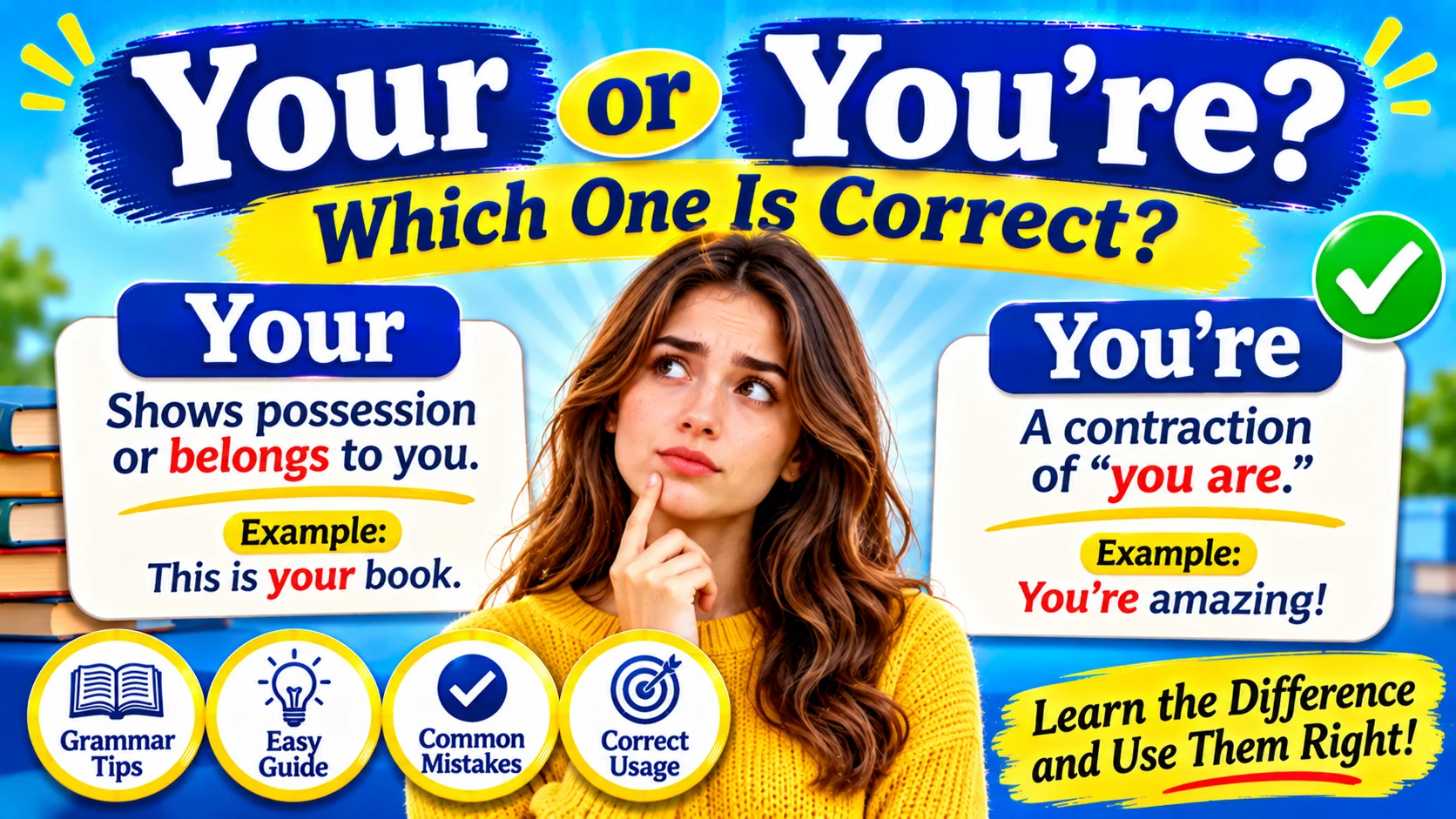
The key is simple: your shows ownership, while you’re means “you are.” For example, “Is this your phone?” shows that the phone belongs to you. “You’re very helpful” means “You are very helpful.”
People search for “your or youre” when writing emails, schoolwork, social media posts, business content, and formal documents. They want a fast answer, but they also want to understand the rule so they do not make the same mistake again.
This guide explains the difference between your and you’re in simple English. You will learn the history, spelling rules, common mistakes, regional usage, everyday examples, and a quick trick that makes the choice much easier.
The correct forms are your and you’re.
- Your = shows that something belongs to you.
- You’re = short for you are.
Examples with “your”
- Is this your book?
- I like your new car.
- Please check your email.
- What is your name?
Examples with “you’re”
- You’re very kind.
- You’re late for work.
- I think you’re right.
- You’re going to love this movie.
The easiest test
Replace you’re with you are.
If the sentence still makes sense, use you’re.
You’re ready. → You are ready. ✓
Your ready. → You are ready. ✗
If the sentence talks about something belonging to you, use your.
Your phone is ringing. ✓
You’re phone is ringing. ✗
One important point: “youre” without an apostrophe is normally incorrect in standard English. The correct contraction is you’re.
The Origin of Your or Youre
The words your and you’re have different histories.
Your developed from older forms of the second-person possessive in English. It is used to show a connection or relationship with the person being addressed. Modern dictionaries define your as the possessive form of you.
You’re is a contraction of you are. The apostrophe shows that letters have been removed from the two-word form.
For example:
You are happy. → You’re happy.
You are ready. → You’re ready.
English has used contractions for centuries. Common examples include I’m for “I am,” we’re for “we are,” and they’re for “they are.”
The spelling difference exists because these words perform different grammatical jobs:
- Your is a possessive determiner used before a noun.
- You’re is a contraction of you + are.
The forms sound alike in many accents, which is why they are easy to confuse in writing.
British English vs American English Spelling
There is no major British-American spelling difference between your and you’re.
Both British English and American English use:
- your for possession
- you’re for “you are”
For example:
British: “Is this your bag?”
American: “Is this your bag?”
And:
British: “You’re very welcome.”
American: “You’re very welcome.”
The grammar is the same in both varieties.
| Form | British English | American English | Meaning |
|---|---|---|---|
| your | Correct | Correct | Belonging to you |
| you’re | Correct | Correct | You are |
| youre | Usually incorrect | Usually incorrect | Missing apostrophe |
| you are | Correct | Correct | Full form of you’re |
The main difference is often formality, not nationality. Contractions such as you’re are common in everyday speech and informal writing. In very formal writing, some writers may prefer the full form you are.
Which Spelling Should You Use?
The choice is simple.
For US readers
Use your when showing possession and you’re when you mean “you are.”
Example:
Please bring your ID because you’re required to show it.
For UK and Commonwealth readers
Use exactly the same rule.
Is this your coat?
You’re welcome to stay.
There is no need to change the spelling for British English.
For global audiences
Use your and you’re correctly. These forms are standard across major varieties of English.
If your audience includes English learners, clear sentences can help:
Please check your account before you’re ready to submit the form.
For formal writing
Both forms are grammatically correct. However, some formal documents may prefer fewer contractions.
For example:
You are required to submit the form by Friday.
This can sound more formal than:
You’re required to submit the form by Friday.
Common Mistakes with Your or Youre
Mistake 1: Using “your” instead of “you’re”
Incorrect:
Your going to enjoy this.
Correct:
You’re going to enjoy this.
Why? “You’re” means “you are.”
Mistake 2: Using “you’re” instead of “your”
Incorrect:
I like you’re new shoes.
Correct:
I like your new shoes.
Why? The shoes belong to you, so use “your.”
Mistake 3: Writing “youre”
Incorrect:
Youre doing a great job.
Correct:
You’re doing a great job.
The apostrophe is needed because you’re is a contraction of you are.
Mistake 4: Using “your” before a verb
Incorrect:
Your going to miss the train.
Correct:
You’re going to miss the train.
Mistake 5: Using “you’re” before a noun
Incorrect:
You’re phone is on the table.
Correct:
Your phone is on the table.
A quick check is to look at the word after your. It often introduces a noun:
your car
your idea
your friend
your home
Your or Youre in Everyday Examples
In emails
Correct:
Please send your documents before you’re ready to leave.
Incorrect:
Please send you’re documents before your ready to leave.
In professional email, correct grammar helps your message look polished and trustworthy.
In news writing
“If you’re planning a trip, check your travel documents first.”
News writing often uses contractions when the tone is direct and conversational.
On social media
“Hope you’re having a great day! Share your photos below.”
Social media is informal, but the grammar rule does not change.
In formal writing
“You are responsible for submitting your application on time.”
Here, the writer uses you are instead of you’re for a more formal tone.
In everyday speech
“Where is your brother?”
“You’re going to love this!”
Both forms are common in normal conversation.
Your or Youre – Google Trends & Usage Data
Google Trends measures relative search interest, not the exact number of searches for a phrase. It can show how interest changes over time and across locations.
Searches for “your or youre” are mainly connected to grammar confusion. People may search the phrase when they are unsure about:
- your vs you’re
- apostrophe use
- English grammar
- school assignments
- email writing
- proofreading
- English learning
The search phrase is often typed without punctuation. People may search “your or youre” instead of “your or you’re” because they are unsure about the apostrophe.
Interest can vary by country because English is used differently around the world. However, the core grammar rule remains the same in the US, UK, Canada, Australia, and other major English-speaking regions.
For SEO, “your or youre” is a useful search-intent keyword. A strong article should answer the question quickly, then explain your vs you’re, examples, mistakes, and the apostrophe rule.
Related keywords can include:
- your or you’re
- your vs you’re
- difference between your and you’re
- when to use your
- when to use you’re
- your and you’re examples
Avoid keyword stuffing. Natural, useful writing is better for readers and search engines.
Your, You’re, and Youre: Comparison Table
| Variation | Correct? | Meaning | Example |
|---|---|---|---|
| your | Yes | Belonging to you | Where is your bag? |
| you’re | Yes | You are | You’re very helpful. |
| youre | No in standard English | Usually intended as “you’re” | Youre late. ✗ |
| you are | Yes | Full form of “you’re” | You are late. |
Here is the rule in one line:
Your = belonging to you. You’re = you are.
That single rule solves most cases.
FAQs
1. Is “your” or “you’re” correct?
Both are correct, but they have different meanings. Your shows possession. You’re means “you are.”
2. Is “youre” a correct spelling?
In standard English, youre without an apostrophe is normally incorrect. Write you’re when you mean “you are.”
3. How can I remember your vs you’re?
Try replacing you’re with you are. If the sentence works, use you’re. If you are showing ownership, use your.
4. Is “your” a possessive word?
Yes. Your is a possessive determiner used before a noun.
Examples:
- your house
- your phone
- your idea
- your car
5. Is “you’re” short for “you are”?
Yes. You’re is the contraction of you are.
6. Is your or you’re the same in British and American English?
Yes. The basic rule is the same in both varieties. British and American writers use your for possession and you’re for “you are.”
7. Should I use “you are” instead of “you’re” in formal writing?
You can. You’re is grammatically correct, but you are may sound more formal. In official documents, academic writing, and legal writing, the full form may be preferred.
Conclusion
The difference between your or youre is simple once you know the basic rule. Your shows possession, while you’re is short for you are. The spelling youre, without an apostrophe, is normally incorrect in standard English.
Use your when something belongs to or relates to the person you are speaking to. For example, “Where is your phone?” Use you’re when you can replace it with you are, as in “You’re doing well.”
The rule does not change between British and American English. It also works across global English. The main difference you may notice is style. In casual writing, you’re is very common. In formal documents, you are may sound more professional.
When you are unsure, use the simple replacement test: change you’re to you are. If the sentence still makes sense, choose you’re. If it shows ownership, choose your.
Remember this simple rule: your = belonging to you; you’re = you are. Once you learn it, one of the most common English grammar mistakes becomes easy to avoid.
Taught or Tought: Which Spelling Is Correct?

I am an English Literature expert and professional content writer with a passion for language, grammar, and effective communication. I specialize in creating well-researched, reader-friendly articles on English usage, spelling, vocabulary, writing techniques, and literary topics. My goal is to simplify complex concepts and provide accurate, engaging content that helps readers strengthen their language skills and communicate with confidence.