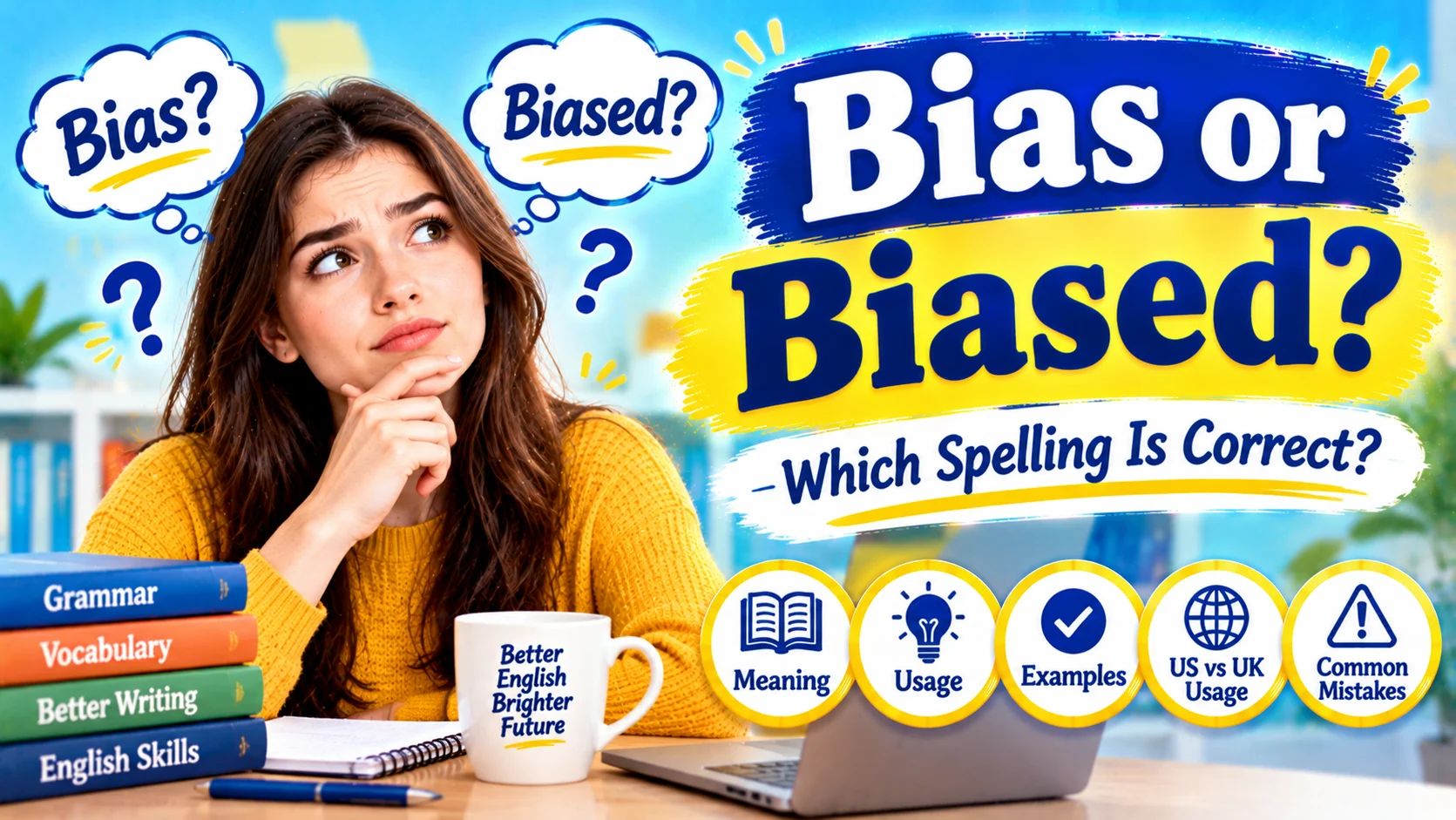
Have you ever stopped while writing and wondered, “Should I use bias or biased?” You are not alone. These two words look almost the same, but they do different jobs in a sentence. Choosing the wrong one can make an email, essay, report, or social media post sound unclear.
The simple answer is this: bias is usually a noun or a verb, while biased is usually an adjective. For example, “The report shows bias” uses bias as a noun. “The report is biased” uses biased as an adjective.
People search for “bias or biased” because the words are closely related. They may also be unsure which form works after words such as is, was, seems, or shows. The confusion becomes greater because both words describe unfair preference or a lack of neutrality.
This guide explains the difference in simple English. You will learn the correct grammar, word history, British and American usage, common mistakes, real-life examples, search trends, and an easy rule you can remember.
Bias and biased are both correct words, but they have different grammatical roles.
- Bias = usually a noun or verb.
- Biased = usually an adjective.
Use “bias” as a noun
The article contains bias.
Here, bias means an unfair preference or opinion.
The study may have a bias toward older participants.
Use “bias” as a verb
Personal opinions can bias the results.
Here, bias means to influence someone or something unfairly.
Use “biased” as an adjective
The article is biased.
Here, biased describes the article.
He gave a biased opinion.
Here, biased describes the opinion.
Easy rule
If you are naming the unfair preference, use bias.
If you are describing someone or something as unfairly influenced, use biased.
Compare:
The report contains bias. ✓
The report is biased. ✓
The report contains biased. ✗
The report is bias. ✗
The Origin of Bias or Biased
The word bias has a long history. English borrowed it from French biais, meaning a slant or oblique direction. The word is also connected to an earlier Provençal form. Over time, its meaning moved from a physical slant to a figurative preference or tendency.
Today, bias can describe a tendency to favor one person, group, idea, or result over another.
The word can work as both a noun and a verb.
As a noun:
The newspaper showed political bias.
As a verb:
The sample may bias the results.
The form biased developed from the verb bias and is normally used as an adjective.
For example:
The sample was biased.
The spelling can sometimes cause confusion because verbs ending in a consonant plus -s can take different endings when forming related words. With bias, the standard adjective is biased, not biasd.
The pronunciation can also cause uncertainty. Bias is pronounced roughly like “BY-us,” while biased is usually pronounced “BY-ust.”
British English vs American English Spelling
There is no major spelling difference between British and American English for bias and biased.
Both varieties use:
- bias as a noun
- bias as a verb
- biased as an adjective
For example:
British: The report shows bias.
American: The report shows bias.
And:
British: The report is biased.
American: The report is biased.
The main difference is not spelling. It may instead be differences in style, pronunciation, or preferred wording.
| Word | British English | American English | Main Function |
|---|---|---|---|
| bias | Correct | Correct | Noun or verb |
| biased | Correct | Correct | Adjective |
| biases | Correct | Correct | Plural noun or verb |
| biasing | Correct | Correct | Present participle |
| biasd | Incorrect | Incorrect | Misspelling |
For example:
The researcher tried to avoid bias.
The researcher tried to avoid biased. ✗
But:
The researcher was biased.
The same grammar applies in British and American English.
Which Spelling Should You Use?
Unlike words such as colour/color, there is no US-versus-UK spelling choice here. The correct form depends on what you mean.
For US readers
Use bias when you mean a tendency or influence.
The survey has a potential bias.
Use biased when describing something.
The survey is biased.
For UK and Commonwealth readers
The same rule applies.
The newspaper showed bias.
The newspaper was biased.
For global audiences
Use the form that matches the grammar of your sentence.
A useful pattern is:
shows bias
but:
is biased
This pattern works clearly for most readers.
For professional writing
Choose precise language.
Instead of:
The report is bias.
Write:
The report is biased.
Instead of:
The report shows biased.
Write:
The report shows bias.
In formal writing, you may also specify the type of bias:
The study may contain selection bias.
The article appears politically biased.
Common Mistakes with Bias or Biased
Mistake 1: “The article is bias”
Incorrect:
The article is bias.
Correct:
The article is biased.
Why? Biased is the adjective that describes the article.
Mistake 2: “The article shows biased”
Incorrect:
The article shows biased.
Correct:
The article shows bias.
Why? Bias is the noun being shown.
Mistake 3: Writing “biasd”
Incorrect:
The writer is biasd.
Correct:
The writer is biased.
The correct spelling adds -ed.
Mistake 4: Confusing “biased” with “biases”
These words are different.
The report is biased.
The report contains several biases.
Biased is an adjective. Biases can be the plural noun or a third-person singular verb.
Mistake 5: Assuming bias always means intentional dishonesty
Bias does not always mean that someone deliberately tries to mislead others. A person or study can have bias without conscious intent.
For example:
The sample had a geographic bias.
This does not necessarily mean the researchers acted dishonestly.
Bias or Biased in Everyday Examples
In emails
I want to make sure the review process does not introduce bias.
Or:
The original review may have been biased.
Both forms are correct because they perform different jobs.
In news writing
Critics accused the newspaper of political bias.
Or:
Critics said the newspaper was biased.
News writing often uses both forms depending on the sentence.
On social media
“That review is so biased!”
Here, biased describes the review.
Another example:
“I think there is some bias in these comments.”
Here, bias is a noun.
In formal writing
The researchers took steps to reduce bias in the study.
Or:
The researchers used a method designed to reduce sampling bias.
In everyday speech
“That seems biased.”
“There is a clear bias in the results.”
Both are natural and correct.
Bias or Biased – Google Trends & Usage Data
Google Trends measures relative search interest. It can show how often people search for related terms across locations and time, but it does not provide a perfect count of total searches.
People searching for “bias or biased” are often looking for grammar help. They may be writing:
- School assignments
- Research papers
- Business reports
- News articles
- Emails
- Social media posts
- Professional documents
- English-learning exercises
The search can also reflect different meanings of bias, including media bias, political bias, research bias, artificial intelligence bias, gender bias, and personal bias.
This makes the keyword useful for SEO because the search intent is clear. A reader wants to know which word belongs in a sentence.
For content targeting “bias or biased,” answer the grammar question early. Then cover examples, common mistakes, related terms, and professional usage.
Useful related keywords include:
- bias vs biased
- is it bias or biased
- difference between bias and biased
- bias or biased in a sentence
- how to use bias
- how to use biased
- biased meaning
- bias meaning
Use these naturally. Do not repeat them so often that the article becomes difficult to read.
Bias and Biased: Comparison Table
| Variation | Correct? | Word Type | Example |
|---|---|---|---|
| bias | Yes | Noun / Verb | The study contains bias. |
| biased | Yes | Adjective | The study is biased. |
| biases | Yes | Plural noun / Verb | The study has several biases. |
| biasing | Yes | Verb form | The method is biasing the results. |
| biasd | No | Misspelling | The report is biasd. ✗ |
The easiest comparison is:
The report contains bias.
The report is biased.
If you remember those two sentences, you can solve most bias or biased questions.
FAQs
1. Is it “bias” or “biased”?
Both are correct. Bias is usually a noun or verb. Biased is usually an adjective.
2. Is “the article is bias” correct?
No. The correct sentence is:
The article is biased.
3. Is “the article shows biased” correct?
No. Use the noun:
The article shows bias.
4. What is the easiest way to remember bias vs biased?
Use this rule:
Shows bias. Is biased.
For example:
The report shows bias.
The report is biased.
5. Is “biased” an adjective?
Yes. Biased describes a person, opinion, report, decision, study, or other thing.
6. Is “bias” a noun or a verb?
It can be both.
Noun:
The study contains bias.
Verb:
The sample may bias the results.
7. Is “bias” spelled differently in British and American English?
No. Bias and biased are spelled the same in British and American English.
Conclusion
The difference between bias or biased is mainly a matter of grammar. Bias is usually a noun or verb, while biased is an adjective. Both are correct words, but you cannot use them interchangeably.
Use bias when you are naming a tendency, preference, or unfair influence. For example, “The study contains bias.” You can also use bias as a verb: “The sample may bias the results.”
Use biased when you are describing something or someone. For example, “The study is biased” or “The article seems biased.”
The same rule works in British English, American English, and other major forms of English. There is no special US or UK spelling difference to remember.
For a quick memory trick, remember: shows bias, is biased. This simple pattern will help you choose the correct word in most sentences.
If you are writing professionally, be precise and consistent. When possible, explain the type of bias involved, such as selection bias, confirmation bias, or political bias. Clear wording makes your writing stronger and easier to understand.
Taught or Tought: Which Spelling Is Correct?

I am an English Literature expert and professional content writer with a passion for language, grammar, and effective communication. I specialize in creating well-researched, reader-friendly articles on English usage, spelling, vocabulary, writing techniques, and literary topics. My goal is to simplify complex concepts and provide accurate, engaging content that helps readers strengthen their language skills and communicate with confidence.