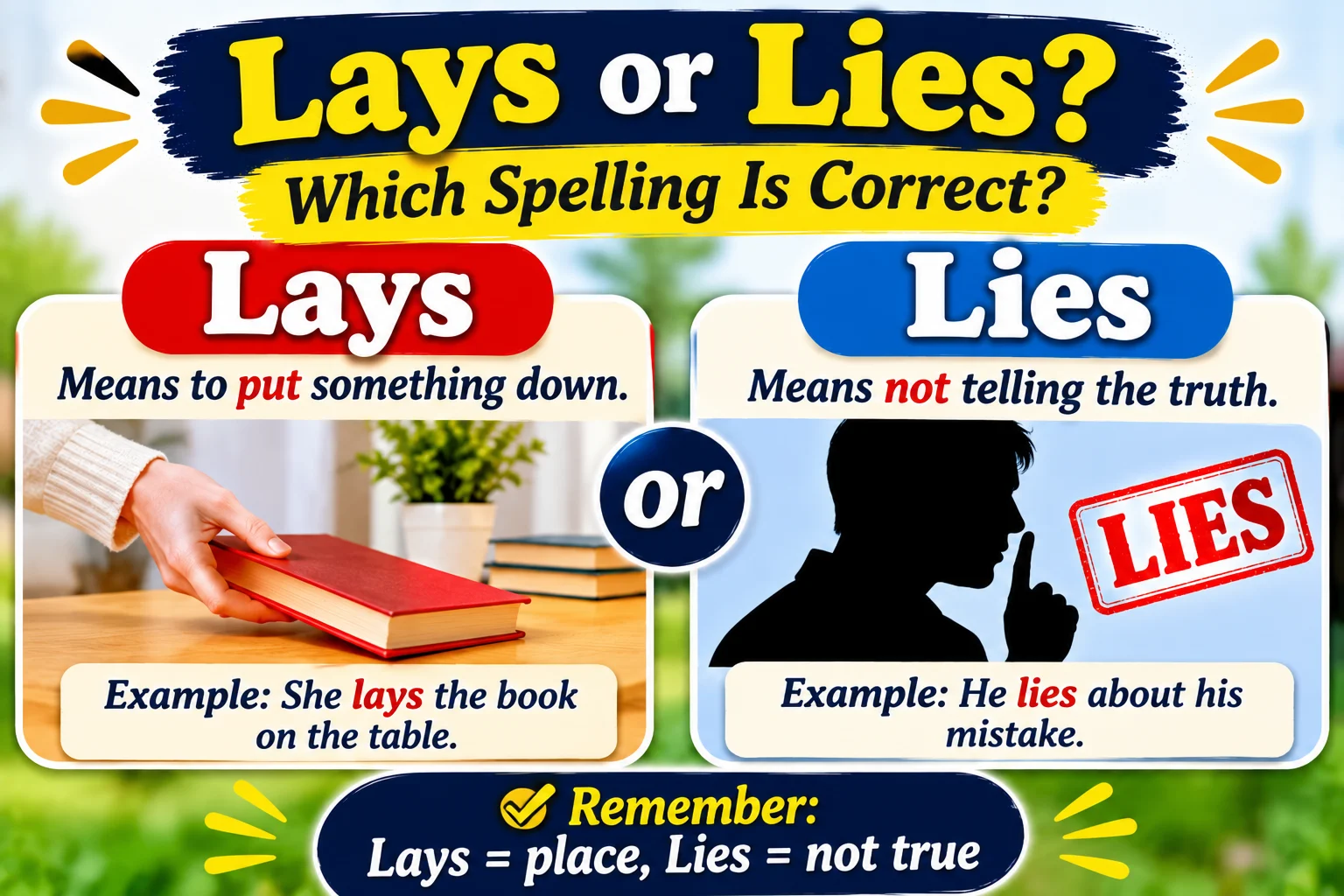
Choosing between lays or lies can be confusing, even for fluent English speakers. Both words are correct, but they have different meanings and grammar rules. The confusion often comes from the verbs lay and lie, which look and sound similar.
People search for “lays or lies” because they want to know which word to use in a sentence. They may wonder whether to write “He lays on the bed” or “He lies on the bed.” Others may be unsure about past forms such as “lay” and “laid.”
The key is simple: lay needs an object, while lie does not. You lay something down, but you lie down yourself. For example, “She lays the book on the desk” is correct, while “She lies on the sofa” is correct.
This guide explains the difference between lays and lies, their origins, common mistakes, regional usage, and everyday examples. By the end, you will know exactly which word to choose.
Lays and lies are both correct words, but they are used differently.
- Lays is the present-tense form of lay for he, she, or it. It needs an object.
- Lies is the present-tense form of lie for he, she, or it. It does not need an object.
Examples
- She lays the baby on the bed.
- He lays the book on the table.
- She lies on the bed.
- The cat lies under the chair.
A useful rule is:
You lay something, but you lie down.
Lays vs Lies: Quick Comparison
| Word | Base verb | Meaning | Example |
|---|---|---|---|
| lays | lay | Puts something somewhere | She lays the keys on the desk. |
| lies | lie | Rests or reclines | She lies on the sofa. |
Remember that lay can also be the past tense of lie. This creates another common source of confusion.
The Origin of Lays or Lies
The words lay and lie have very old roots in English and Germanic languages.
Lay comes from an Old English verb related to putting or placing something down. Its modern meaning still has this basic idea: someone places an object somewhere.
Lie comes from a different Old English verb meaning to rest or remain in a particular position.
The two verbs became confusing because their forms overlap.
For example:
- lie → lay → lain
- lay → laid → laid
The first line shows the forms of lie meaning “to rest.” The second shows lay meaning “to put something down.”
This creates sentences that can look strange at first:
- Today I lie on the sofa.
- Yesterday I lay on the sofa.
- I have lain on the sofa all morning.
But:
- Today I lay the book down.
- Yesterday I laid the book down.
- I have laid the book down.
The spelling difference is therefore not mainly about British or American English. It is primarily about different verbs and their grammatical forms.
British English vs American English Spelling
There is no major British-versus-American spelling difference between lays and lies.
Both British and American English normally use:
- lays
- lies
- lay
- lie
- laid
- lain
The main issue is grammar, not regional spelling.
| Meaning | British English | American English |
|---|---|---|
| Puts something down | lays | lays |
| Rests/reclines | lies | lies |
| Past of “lay” | laid | laid |
| Past of “lie” | lay | lay |
| Past participle of “lay” | laid | laid |
| Past participle of “lie” | lain | lain |
Examples in Both Varieties
British English:
- She lays the clothes on the bed.
- She lies on the bed.
American English:
- She lays the clothes on the bed.
- She lies on the bed.
The spelling stays the same. What changes is sometimes pronunciation, style, or informal usage, but the basic verb rules remain the same.
Which Spelling Should You Use?
For most writers, the choice is not between British and American spelling. Instead, choose the word based on what you mean.
Use “lays” when someone puts something somewhere
Examples:
- He lays his phone on the desk.
- She lays the blanket on the floor.
- The hen lays an egg.
In each example, there is something being placed or produced.
Use “lies” when someone or something rests
Examples:
- He lies on the floor.
- The dog lies beside the door.
- The village lies near the river.
There is no direct object receiving an action.
Advice for global writers
If you write for an international audience, use the standard forms lays and lies. Do not change them based on whether your readers are in the United States, United Kingdom, Canada, Australia, or another English-speaking country.
The important thing is to understand the verb.
Common Mistakes with Lays or Lies
Mistake 1: “He lays on the bed.”
When you mean that he is resting, this is incorrect in standard English.
Correct:
“He lies on the bed.”
Mistake 2: “She lies the book on the table.”
This is incorrect because book is the object being placed.
Correct:
“She lays the book on the table.”
Mistake 3: Confusing “lay” and “laid”
The past tense of lay is laid.
Correct:
- She lays the book down every day.
- She laid the book down yesterday.
Mistake 4: Confusing “lay” as the past of “lie”
The past tense of lie is lay.
Correct:
- I lie down every afternoon.
- Yesterday, I lay down after lunch.
Mistake 5: Using “layed”
Layed is not the standard past form of the verb lay.
Use laid instead.
Incorrect: She layed the clothes on the bed.
Correct: She laid the clothes on the bed.
Lays or Lies in Everyday Examples
Understanding real examples makes the difference easier to remember.
In emails
- “The report lies on your desk.”
- “She lays the documents on the table before each meeting.”
In news writing
- “The town lies near the border.”
- “The company lays new plans before its investors.”
On social media
- “My cat lies on my keyboard all day.”
- “He lays his jacket on the chair.”
In formal writing
- “The responsibility lies with the manager.”
- “The committee lays the foundation for future reforms.”
Notice that lies can also be used in an abstract sense. For example, “The problem lies in the lack of funding” means that the problem exists or is found in that area.
Lays or Lies – Google Trends & Usage Data
Search interest for “lays or lies” reflects a common English grammar question. People often search the phrase when they are writing emails, school assignments, articles, captions, or professional documents.
The exact search volume can change over time and by country. Search interest may also rise when people encounter related questions such as:
- “Is it lay or lie?”
- “Lay vs lie”
- “Lays or lies in a sentence”
- “Lay or lie on the bed”
- “Laid or lay”
The question is especially useful for English learners because the verbs have overlapping forms.
For SEO content, the keyword “lays or lies” works well as a primary phrase, while related terms such as “lay vs lie,” “lays vs lies,” “lay or lie,” and “laid vs lay” can help cover different search intents naturally.
Lays vs Lies: Variations Side by Side
| Search term | What the user usually wants |
|---|---|
| lays or lies | Which word is correct? |
| lays vs lies | Difference between the two words |
| lay vs lie | Full verb comparison |
| lay or lie | Correct word for a sentence |
| laid vs lay | Past-tense explanation |
| lie vs lay | Grammar rules and examples |
FAQs About Lays or Lies
1. Is it “lays” or “lies”?
Both are correct. Use lays when someone puts something somewhere. Use lies when someone or something rests.
2. Is “he lays down” correct?
In standard English, use “he lies down” when you mean that he reclines or rests.
3. Is “she lays the book down” correct?
Yes. “She lays the book down” is correct because the book is the object being placed.
4. What is the past tense of “lie”?
The past tense of lie meaning “to rest” is lay.
Example: “I lay on the sofa yesterday.”
5. What is the past tense of “lay”?
The past tense of lay meaning “to put” is laid.
Example: “She laid the book on the desk.”
6. What is the easiest way to remember lay and lie?
Remember:
Lay = put something down.
Lie = rest yourself.
7. Do British and American English spell these words differently?
No. British and American English normally use the same spellings: lays and lies. The main challenge is choosing the correct verb.
Conclusion
The difference between lays or lies becomes easy once you focus on meaning. Lays comes from lay, which means to put or place something. Lies comes from lie, which means to rest or remain in a position.
Use lays when there is an object: “She lays the book on the desk.” Use lies when the subject is resting: “She lies on the sofa.” This simple rule solves most everyday questions.
The past forms cause more confusion. The past tense of lie is lay, while the past tense of lay is laid. The past participle of lie is lain.
There is also no major British-American spelling difference here. Writers in both varieties generally use the same forms.
If you are unsure, ask yourself one question: Is someone putting something somewhere, or is someone resting? If something is being placed, choose lay/lays. If someone is resting, choose lie/lies. This approach will help you write clearly and correctly in emails, articles, academic work, and everyday communication.
Cankles or Kankles: Which Spelling Is Correct?

I am an English Literature expert and professional content writer with a passion for language, grammar, and effective communication. I specialize in creating well-researched, reader-friendly articles on English usage, spelling, vocabulary, writing techniques, and literary topics. My goal is to simplify complex concepts and provide accurate, engaging content that helps readers strengthen their language skills and communicate with confidence.