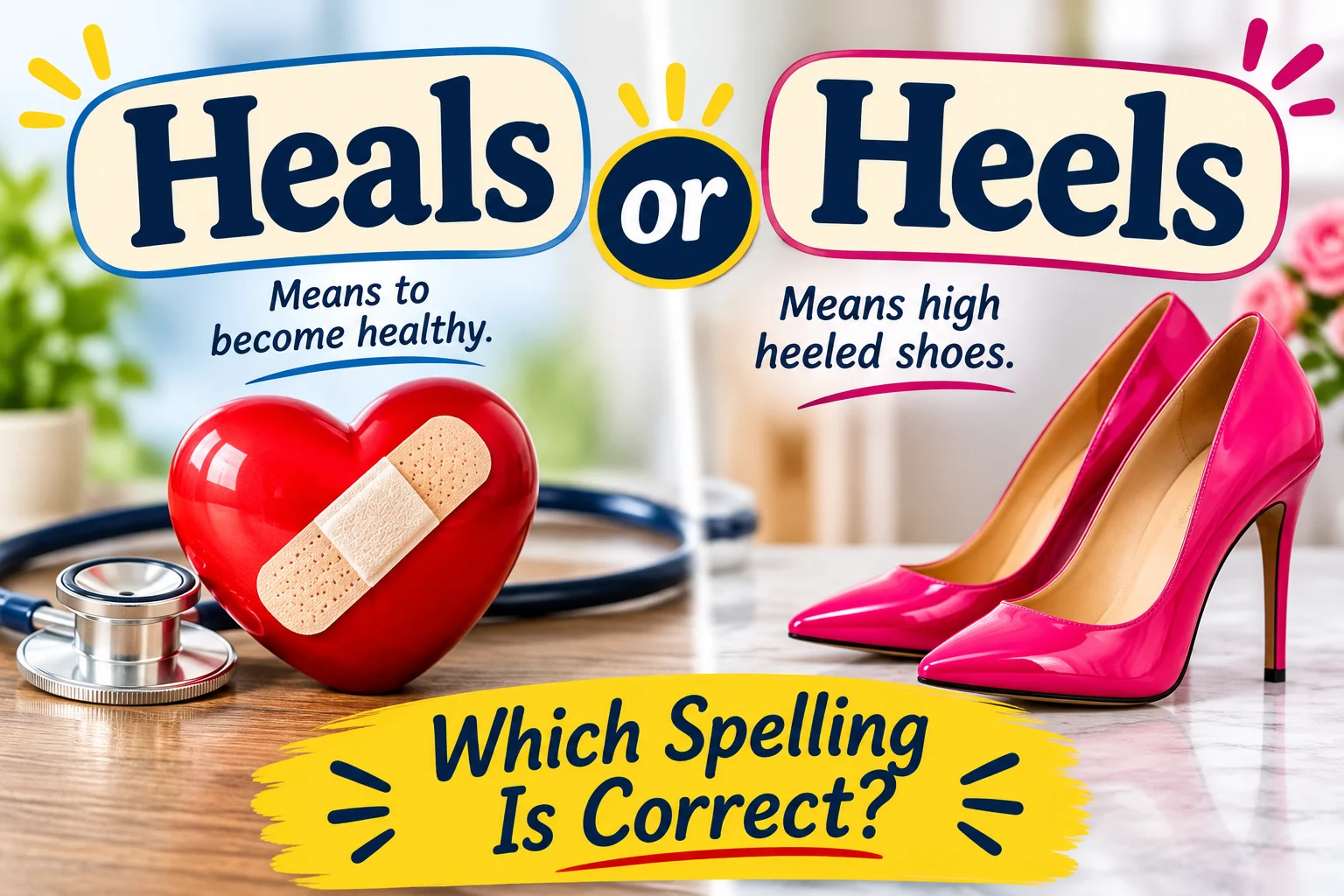
Have you ever typed heals or heels and wondered which word is correct? These two words sound almost the same, but they have completely different meanings. One relates to getting better, while the other relates to shoes and the back of the foot.
This is why people often search for “heals or heels”. The words are homophones in many accents, meaning they sound alike but have different spellings and meanings. A small spelling mistake can change the meaning of a sentence.
For example, “The wound heals quickly” means that an injury gets better. But “She bought new heels” means she bought shoes with raised backs. The correct word depends on what you want to say.
This guide explains the difference between heals and heels in simple English. You will learn their meanings, origins, spelling differences, common mistakes, everyday uses, and practical writing tips. You will also see examples from emails, news, social media, and formal writing.
By the end, you will know exactly when to use heals and when to use heels.
Both heals and heels are correct words, but they have different meanings.
- Heals = gets better or makes something better
- Heels = the back parts of feet or shoes
Examples with “heals”
Time heals many emotional wounds.
The cut heals quickly.
Here, heals comes from the verb heal.
Examples with “heels”
She bought a new pair of heels.
My heels hurt after walking all day.
Here, heels refers to feet or shoes.
Quick memory trick
Think:
Heal = health
Heel = foot or shoe
If you are talking about recovery, use heals.
If you are talking about feet or shoes, use heels.
The Origin of Heals or Heels
Although heals and heels sound similar, they come from different words.
The origin of “heals”
Heals comes from the verb heal, meaning to become healthy again or to make something healthy again.
The word heal has Old English roots. It is related to old Germanic words connected with health and wholeness.
Examples include:
The injury heals over time.
Good care helps the body heal.
The -s in heals is added because the subject is singular in the present tense.
For example:
The wound heals.
She heals quickly.
The origin of “heels”
Heels comes from the noun heel, meaning the back part of the human foot. It can also refer to the raised part of a shoe under the back of the foot.
The word also has Old English roots and has been used for the back part of the foot for many centuries.
Examples:
My heels hurt.
Her shoes have high heels.
The plural form is heels because there are normally two heels on a person.
Why are they spelled differently?
The spelling difference helps separate two different meanings:
- heal → heals = recovery
- heel → heels = foot or shoe
The extra e in heels is part of the word heel. It is not an alternative spelling of heals.
British English vs American English Spelling
Unlike some British and American spelling differences, heals and heels are spelled the same way in both major varieties of English.
| Meaning | British English | American English | Example |
|---|---|---|---|
| Gets better | heals | heals | The wound heals quickly. |
| Back of the foot | heels | heels | My heels hurt. |
| Shoe type | heels | heels | She wore high heels. |
| Base verb | heal | heal | Time can heal. |
| Singular foot/shoe part | heel | heel | My heel hurts. |
There is no standard British-American spelling difference for these words.
The challenge is not regional spelling. It is meaning and pronunciation.
Which Spelling Should You Use?
You do not need to choose between British and American spelling for heals and heels. Both versions use the same spellings.
Instead, choose the word based on meaning.
When to use “heals”
Use heals when you mean that something becomes healthy or whole again.
Examples:
The body heals naturally.
Time heals emotional pain.
The wound heals after proper treatment.
When to use “heels”
Use heels when you mean the back parts of the feet or shoes.
Examples:
My heels are sore.
She bought black heels.
The shoes have high heels.
For US, UK, and Commonwealth audiences
The spelling is the same:
- US: heals / heels
- UK: heals / heels
- Australia: heals / heels
- Canada: heals / heels
Your audience does not change the spelling. Your intended meaning does.
Common Mistakes with Heals or Heels
Mistake 1: Using “heels” for recovery
Incorrect:
Time heels all wounds.
Correct:
Time heals all wounds.
The sentence is about emotional recovery, so heals is correct.
Mistake 2: Using “heals” for shoes
Incorrect:
She bought a new pair of heals.
Correct:
She bought a new pair of heels.
The sentence refers to shoes, so heels is correct.
Mistake 3: Confusing “heel” and “heal”
Incorrect:
My heal hurts after walking.
Correct:
My heel hurts after walking.
The back of your foot is your heel.
Mistake 4: Confusing “healing” and “heeling”
For recovery, use healing:
The wound is healing.
For the back of the foot, use heel:
The heel of my shoe is damaged.
Mistake 5: Choosing the spelling by sound
Because heals and heels can sound alike, pronunciation alone cannot tell you which word to write.
Instead, think about the meaning.
Ask:
Am I talking about recovery?
If yes, use heals.
Ask:
Am I talking about a foot or shoe?
If yes, use heels.
Heals or Heels in Everyday Examples
In emails
Recovery:
The injury heals slowly, so please allow more time.
Shoes:
Please bring comfortable heels for the event.
In news writing
Recovery:
The doctor said the injury heals with proper care.
Shoes:
The designer’s new collection includes colorful heels.
On social media
Recovery:
Time heals. Keep going.
Shoes:
New heels, new outfit! 👠
In formal writing
Recovery:
The body heals through a complex biological process.
Shoes:
The study examined the effects of prolonged high-heel use.
In everyday conversation
This cut heals quickly.
My heels hurt.
These examples show how context makes the difference clear.
Heals or Heels – Google Trends & Usage Data
Google Trends can help show how often people search for different words and phrases across countries and time periods. However, it measures relative search interest, not an exact number of searches.
The search phrase “heals or heels” is mainly a spelling and grammar query. People may search it because heals and heels can sound the same but have different meanings.
Search interest may also come from different topics.
Heals is associated with:
- Health
- Recovery
- Injuries
- Emotional healing
- Medicine
- Fitness
Heels is associated with:
- Shoes
- Fashion
- Clothing
- Beauty
- Shopping
- Footwear
This means search context matters. Someone searching for “high heels” has a very different intent from someone searching for “time heals”.
For SEO, content about the spelling difference should clearly explain both meanings. This helps readers who are searching for grammar help as well as people who are unsure which word fits their sentence.
Heals and Heels Comparison Table
| Word | Meaning | Word type | Example |
|---|---|---|---|
| heal | To become healthy or whole | Verb | The injury will heal. |
| heals | Gets better or makes better | Verb | The wound heals quickly. |
| healing | Becoming healthy again | Verb/noun | The wound is healing. |
| heel | Back part of the foot or shoe | Noun | My heel hurts. |
| heels | More than one heel; high-heeled shoes | Noun | She wore red heels. |
| heeled | Having a particular type of heel | Adjective/verb form | She wore high-heeled shoes. |
FAQs About Heals or Heels
1. Is it “heals” or “heels”?
Both are correct words. Use heals for recovery and heels for feet or shoes.
2. What does “heals” mean?
Heals means becomes healthy or makes something healthy again.
Example:
The wound heals quickly.
3. What does “heels” mean?
Heels can mean the back parts of the feet or the raised parts of shoes.
Example:
My heels hurt.
She bought new heels.
4. Is “time heals” correct?
Yes.
Time heals many wounds.
Here, heals means that emotional pain may become less severe over time.
5. Is “high heals” correct?
No. The correct phrase is:
high heels
The shoes are called heels, not heals.
6. Is “my heals hurt” correct?
No, if you mean the back parts of your feet.
The correct sentence is:
My heels hurt.
7. Are heals and heels pronounced the same?
In many varieties of English, heals and heels are pronounced the same or very similarly. They are therefore easy to confuse when listening or speaking.
Conclusion
The difference between heals and heels is simple once you remember their meanings. Heals comes from the verb heal and means to become healthy or to make something better. Heels is the plural of heel, which means the back part of the foot or the raised part of a shoe.
For example, write “The wound heals quickly” when you are talking about recovery. Write “She wore high heels” when you are talking about shoes.
Unlike many English spelling questions, this one does not depend on whether you use British or American English. Both varieties spell the words the same way. The correct choice depends entirely on meaning.
A useful memory trick is simple: heal is connected with health, while heel is connected with your foot or shoes. If you hear the word and are unsure how to spell it, look at the sentence around it. Context will usually tell you which word you need.
Once you learn this difference, you can easily avoid common errors in emails, social media posts, schoolwork, business writing, and everyday communication.
Taught or Tought: Which Spelling Is Correct?

I am an English Literature expert and professional content writer with a passion for language, grammar, and effective communication. I specialize in creating well-researched, reader-friendly articles on English usage, spelling, vocabulary, writing techniques, and literary topics. My goal is to simplify complex concepts and provide accurate, engaging content that helps readers strengthen their language skills and communicate with confidence.