Have you ever stopped while writing and wondered whether you should use bolder or boulder? You are not alone. These two words look very similar, but they have completely different meanings. Because they differ by only one letter, many people accidentally use the wrong one in emails, school work, blog posts, and social media.
People search for “bolder or boulder” because they want to know which spelling is correct in a specific sentence. Some want to describe someone who is more confident, while others are talking about a large rock. Spell-check tools do not always catch the mistake because both words are real English words. That makes the confusion even more common.
This guide explains the difference in simple language. You will learn what each word means, where it comes from, when to use it, and how British and American English treat these words. You will also find examples, comparison tables, common mistakes, FAQs, and practical advice so you can choose the correct word every time.
The answer is simple:
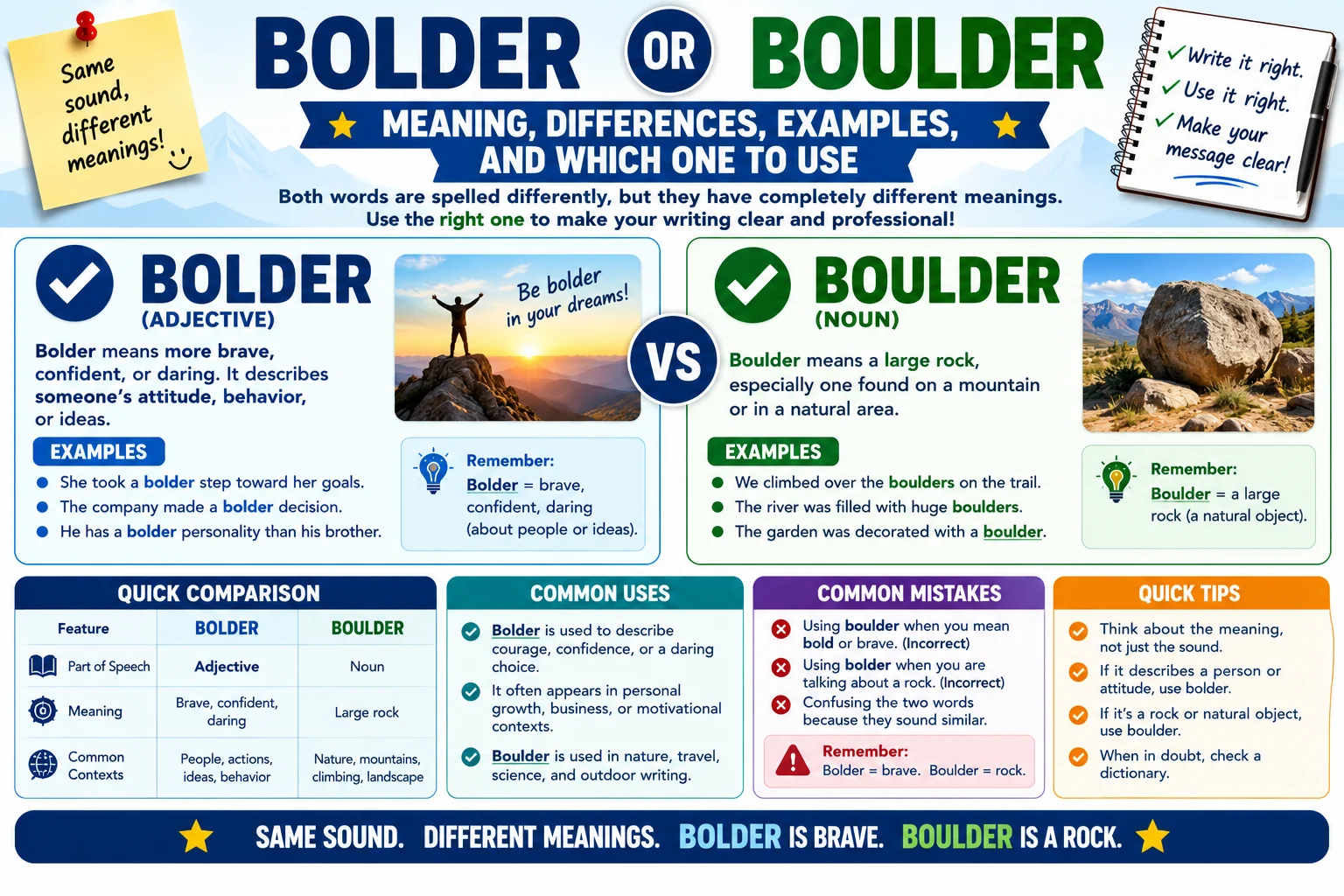
- Bolder is the comparative form of bold. It means more brave, more confident, or more noticeable.
- Boulder is a large rock or stone found in nature.
Examples
| Word | Meaning | Example |
|---|---|---|
| Bolder | More confident or brave | She became bolder after gaining experience. |
| Boulder | A large rock | A huge boulder blocked the road. |
If you are talking about confidence or style, use bolder.
If you are talking about rocks or nature, use boulder.
The Origin of Bolder or Boulder
Although these words look alike, they come from different origins.
Bolder
The word bolder comes from bold, an old Germanic word that meant brave, fearless, or confident. Adding -er creates the comparative form, meaning more bold.
Examples:
- He became bolder with practice.
- The company chose a bolder marketing plan.
Boulder
The word boulder comes from Middle English and older Scandinavian words referring to rounded stones or large rocks.
Today, boulder always means a very large rock.
Examples:
- The hikers climbed over a giant boulder.
- The earthquake moved several boulders.
The spelling difference exists because the words developed from different language families and have completely different meanings.
British English vs American English Spelling
Unlike many English words, bolder and boulder are not British and American spelling variations.
Both British English and American English use the same spellings because they are different words.
Comparison Table
| Topic | British English | American English |
|---|---|---|
| More brave | Bolder | Bolder |
| Large rock | Boulder | Boulder |
| Spelling difference | None | None |
| Meaning difference | Yes | Yes |
Examples
British English:
- We need a bolder solution.
- The path was blocked by a boulder.
American English:
- She made a bolder decision.
- A boulder rolled down the hill.
Which Spelling Should You Use?
The correct choice depends on what you want to say—not where your readers live.
If your audience is in the United States
Use:
- Bolder for confidence.
- Boulder for rocks.
If your audience is in the United Kingdom or Commonwealth countries
The same rule applies.
- Bolder means more bold.
- Boulder means a large rock.
If your audience is global
Choose the word based on its meaning.
Remember this easy trick:
- Bold → Bolder
- Rock → Boulder
Location does not change the spelling.
Common Mistakes with Bolder or Boulder
Here are some common errors.
| Incorrect | Correct |
|---|---|
| She became boulder after training. | She became bolder after training. |
| We climbed over a bolder. | We climbed over a boulder. |
| His speech was boulder than before. | His speech was bolder than before. |
| A huge bolder blocked traffic. | A huge boulder blocked traffic. |
Why People Make This Mistake
- The words sound similar.
- They differ by only one letter.
- Spell-check does not flag them because both are real words.
Bolder or Boulder in Everyday Examples
In Emails
✅ We need a bolder marketing strategy.
In News
✅ A massive boulder fell onto the highway.
On Social Media
✅ I’m making bolder choices this year.
In Formal Writing
✅ Researchers proposed a bolder approach to climate policy.
✅ Workers removed a large boulder from the construction site.
Bolder or Boulder – Google Trends & Usage Data
Search interest in “bolder or boulder” usually increases because people confuse the similar spellings.
General Usage
| Word | Common Context |
|---|---|
| Bolder | Business, fashion, writing, leadership, confidence |
| Boulder | Geography, hiking, construction, geology, travel |
Popular Search Regions
| Country | Common Search Reason |
|---|---|
| United States | Grammar confusion and writing |
| United Kingdom | Vocabulary meaning |
| Canada | English learning |
| Australia | Spelling questions |
| India | Student grammar searches |
Overall, boulder appears more often in geography and outdoor topics, while bolder is common in business, marketing, education, and personal development.
Keyword Comparison Table
| Keyword | Meaning | Part of Speech | Example |
|---|---|---|---|
| Bolder | More bold or confident | Adjective | She became bolder. |
| Boulder | Large rock | Noun | A boulder blocked the trail. |
| Bold | Brave or strong | Adjective | Be bold. |
| Boulders | More than one large rock | Noun | The valley has many boulders. |
Frequently Asked Questions
1. Is it bolder or boulder?
It depends on the meaning. Use bolder for “more confident” and boulder for “a large rock.”
2. Is boulder a spelling mistake?
No. Boulder is a correct English word that means a large rock.
3. Is bolder the comparative form of bold?
Yes. Bolder means more brave, confident, or noticeable.
4. Are bolder and boulder pronounced the same?
They are pronounced very similarly, which is why many people confuse them.
5. Is there a British spelling difference?
No. Both British and American English use bolder and boulder with the same meanings.
6. Which word should I use in professional writing?
Choose bolder when discussing confidence, design, or decisions. Use boulder only when referring to large rocks.
7. How can I remember the difference?
Think of bold → bolder and rock → boulder. This simple memory trick helps avoid mistakes.
Conclusion
The difference between bolder and boulder is easy to remember once you know what each word means. Bolder is the comparative form of bold, so it describes someone or something that is more confident, brave, or striking. Boulder, on the other hand, is a noun that refers to a large rock. Even though the words look and sound similar, they are unrelated and cannot replace each other.
There is no British versus American spelling difference for these words. Both forms are correct in every English-speaking country, but they are used in different situations. Before choosing one, simply ask yourself whether you are talking about confidence or a rock. If the answer is confidence, write bolder. If the answer is a large stone in nature, write boulder. Using this simple rule will help you write clearly and avoid one of the most common English spelling mistakes.
Roster or Roaster: What’s the Difference and Which Word Should You Use?

I am an English Literature expert and professional content writer with a passion for language, grammar, and effective communication. I specialize in creating well-researched, reader-friendly articles on English usage, spelling, vocabulary, writing techniques, and literary topics. My goal is to simplify complex concepts and provide accurate, engaging content that helps readers strengthen their language skills and communicate with confidence.