Have you ever stopped while writing and wondered whether you should use undescribable or indescribable? You are not alone. Many English learners, writers, students, and professionals search for this keyword because both words seem logical. After all, they both appear to mean “cannot be described.”
The confusion comes from how English forms negative words. Some adjectives use the prefix un-, while others use in-. Because of this, people often assume both spellings are correct. However, dictionaries, grammar guides, and professional editors treat these words differently.
This guide explains everything you need to know about undescribable or indescribable. You will learn which word is correct, where each spelling comes from, how British and American English treat it, and which version you should use in different situations. You’ll also find real-life examples, comparison tables, common mistakes, Google Trends insights, and frequently asked questions. By the end, you’ll know exactly which spelling to choose with confidence.
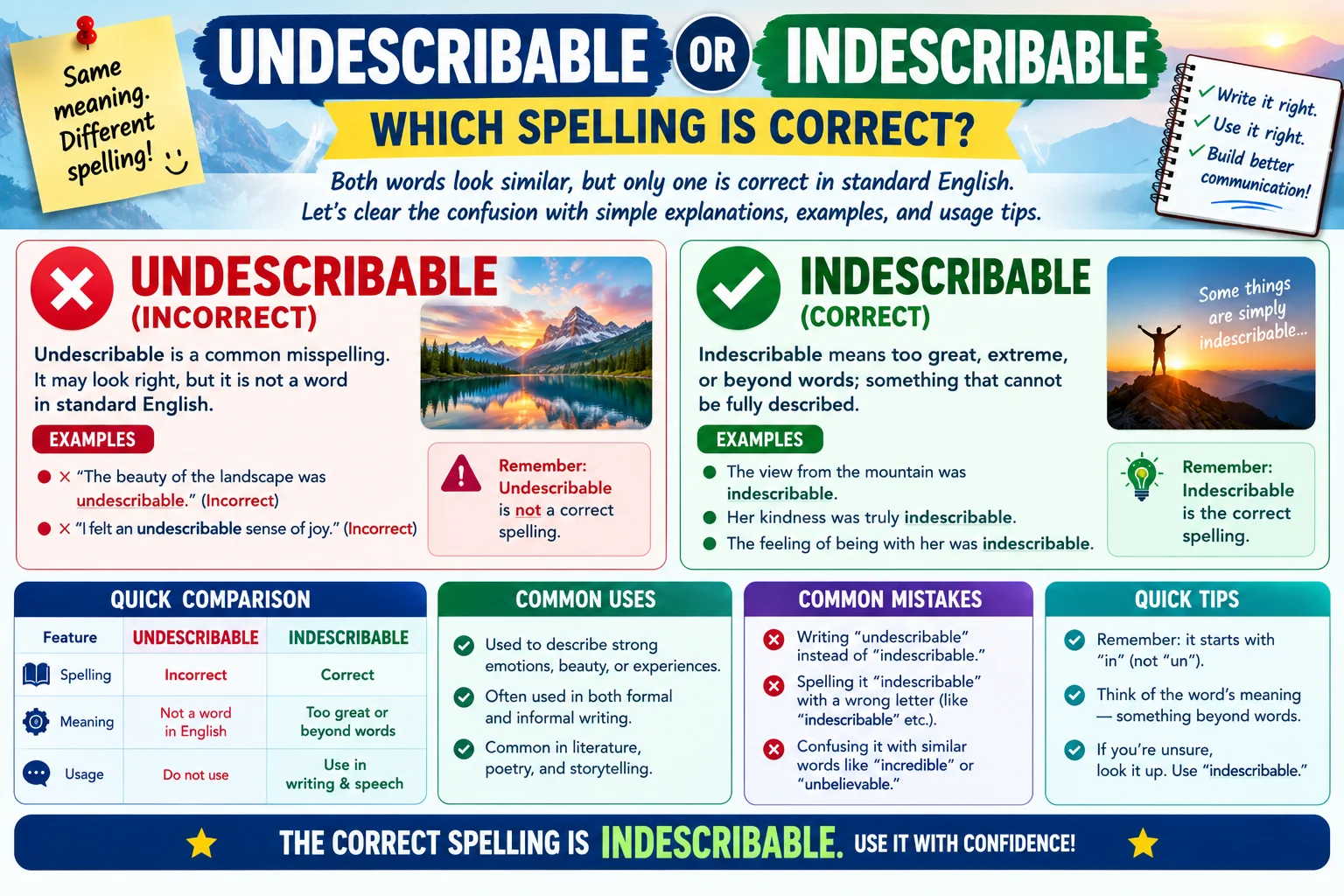
Indescribable is the correct and standard English word.
It means too great, unusual, or powerful to describe with words.
Examples
- The sunset was indescribable.
- She felt indescribable joy.
- The beauty of the mountains was indescribable.
The word undescribable is very rare. Most dictionaries do not list it as a standard English word. It may appear in old texts or informal writing, but professional writers almost always use indescribable.
| Word | Standard English? | Recommended? |
|---|---|---|
| Indescribable | ✅ Yes | ✅ Yes |
| Undescribable | ❌ Usually No | ❌ Avoid |
The Origin of Undescribable or Indescribable
The word indescribable comes from the Latin prefix in-, meaning not, combined with the word describable.
- Describe = to explain in words
- Describable = able to be described
- Indescribable = not able to be described
English has borrowed many words from Latin. Because of this, adjectives often use in- instead of un-.
Examples include:
- Incomplete
- Invisible
- Impossible
- Indirect
- Indescribable
The spelling undescribable seems reasonable because English also uses un- in many words such as:
- Unhappy
- Unclear
- Unfinished
- Unfair
However, history established indescribable as the accepted form, while undescribable never became common in standard English.
British English vs American English Spelling
Unlike words such as colour/color or organise/organize, there is no spelling difference between British and American English for this word.
Both varieties use:
✅ Indescribable
Neither variety commonly accepts undescribable.
Comparison Table
| Feature | British English | American English |
|---|---|---|
| Preferred spelling | Indescribable | Indescribable |
| Undescribable accepted? | Rare | Rare |
| Used in dictionaries | Yes | Yes |
| Recommended in formal writing | Yes | Yes |
Examples
British English:
- The view was indescribable.
American English:
- The excitement was indescribable.
The spelling stays the same in both regions.
Which Spelling Should You Use?
Your audience determines many spelling choices in English. However, this is not one of them.
If your audience is in the United States
Use indescribable.
If your audience is in the United Kingdom
Use indescribable.
If your audience is in Australia, Canada, New Zealand, or other Commonwealth countries
Use indescribable.
If your audience is global
Use indescribable because it is understood and accepted everywhere.
Professional advice: Avoid undescribable unless you are quoting historical text or discussing language itself.
Common Mistakes with Undescribable or Indescribable
Many writers make small mistakes with this word.
Mistake 1
❌ The movie was undescribable.
✅ The movie was indescribable.
Mistake 2
❌ Her happiness was hard to describe because it was undescribable.
✅ Her happiness was indescribable.
Mistake 3
❌ Using both words as if they are equal.
✅ Treat indescribable as the standard English word.
Mistake 4
❌ Assuming American English prefers undescribable.
✅ Both American and British English use indescribable.
Undescribable or Indescribable in Everyday Examples
Here are examples from everyday writing.
“The support from your team was indescribable. Thank you.”
News
“The rescue brought indescribable relief to the community.”
Social Media
“Today’s sunset was simply indescribable.”
Formal Writing
“The patient experienced indescribable pain following the accident.”
Creative Writing
“There was an indescribable beauty in the silent forest.”
Undescribable or Indescribable – Google Trends & Usage Data
Search interest for undescribable or indescribable usually comes from people checking which spelling is correct.
General usage patterns show:
- Indescribable is searched and used far more often.
- Undescribable receives much lower search interest.
- English learners commonly search this comparison.
- Teachers, editors, and writers recommend indescribable.
Popular Regions
| Country | Preferred Usage |
|---|---|
| United States | Indescribable |
| United Kingdom | Indescribable |
| Canada | Indescribable |
| Australia | Indescribable |
| India | Indescribable |
Keyword Comparison
| Variation | Standard? | Common Usage |
|---|---|---|
| Indescribable | ✅ Yes | Very High |
| Undescribable | ❌ Rare | Very Low |
| Undescribable or Indescribable | Search phrase | High |
| Indescribable meaning | Search query | High |
| Indescribable definition | Search query | High |
| How to spell indescribable | Search query | Medium |
Frequently Asked Questions (FAQs)
1. Is undescribable a real word?
It appears occasionally, but it is not considered standard English. Indescribable is the accepted word.
2. Which is correct: undescribable or indescribable?
Indescribable is correct in modern English.
3. Why do people write undescribable?
Many people think the negative prefix should be un-, but English uses the Latin-based prefix in- for this word.
4. Is indescribable correct in American English?
Yes. American English uses indescribable.
5. Is indescribable correct in British English?
Yes. British English also uses indescribable.
6. Can I use undescribable in formal writing?
No. Professional writing should use indescribable.
7. What does indescribable mean?
It means something is so amazing, powerful, beautiful, painful, or unusual that words cannot fully describe it.
Conclusion
The confusion between undescribable or indescribable is understandable because English uses different prefixes to create negative words. Even so, standard English is clear on this point. Indescribable is the correct spelling and is accepted by dictionaries, teachers, editors, and style guides around the world. It is used in American English, British English, and other major varieties without any spelling changes.
The word undescribable may appear occasionally in informal or historical contexts, but it is not recommended for everyday or professional writing. If you are writing an email, article, report, school assignment, business document, or social media post, indescribable is the safest and most accurate choice. Remember that the best writing is clear, consistent, and easy to understand. By choosing indescribable, you match modern English usage and avoid unnecessary confusion. Whenever you are unsure, think of indescribable as the standard form that works for every audience and every situation.
Roster or Roaster: What’s the Difference and Which Word Should You Use?

I am an English Literature expert and professional content writer with a passion for language, grammar, and effective communication. I specialize in creating well-researched, reader-friendly articles on English usage, spelling, vocabulary, writing techniques, and literary topics. My goal is to simplify complex concepts and provide accurate, engaging content that helps readers strengthen their language skills and communicate with confidence.