Have you ever wondered whether you should write “cite” or “site”? These two words sound exactly the same, but they have very different meanings. Because they are homophones, many people mix them up in writing. This confusion is common in school assignments, emails, blog posts, social media, and even professional documents.
People search for “cite or site” because they want to know which word is correct in a specific sentence. Students often need to cite books or websites in research papers. At the same time, businesses, travelers, and web users talk about a site, such as a construction site, camping site, or website. Choosing the wrong word can change the meaning of your sentence and make your writing look unprofessional.
This guide explains the difference between cite and site in simple words. You’ll learn their meanings, origins, spelling differences, real-life examples, common mistakes, and tips on choosing the correct word every time.
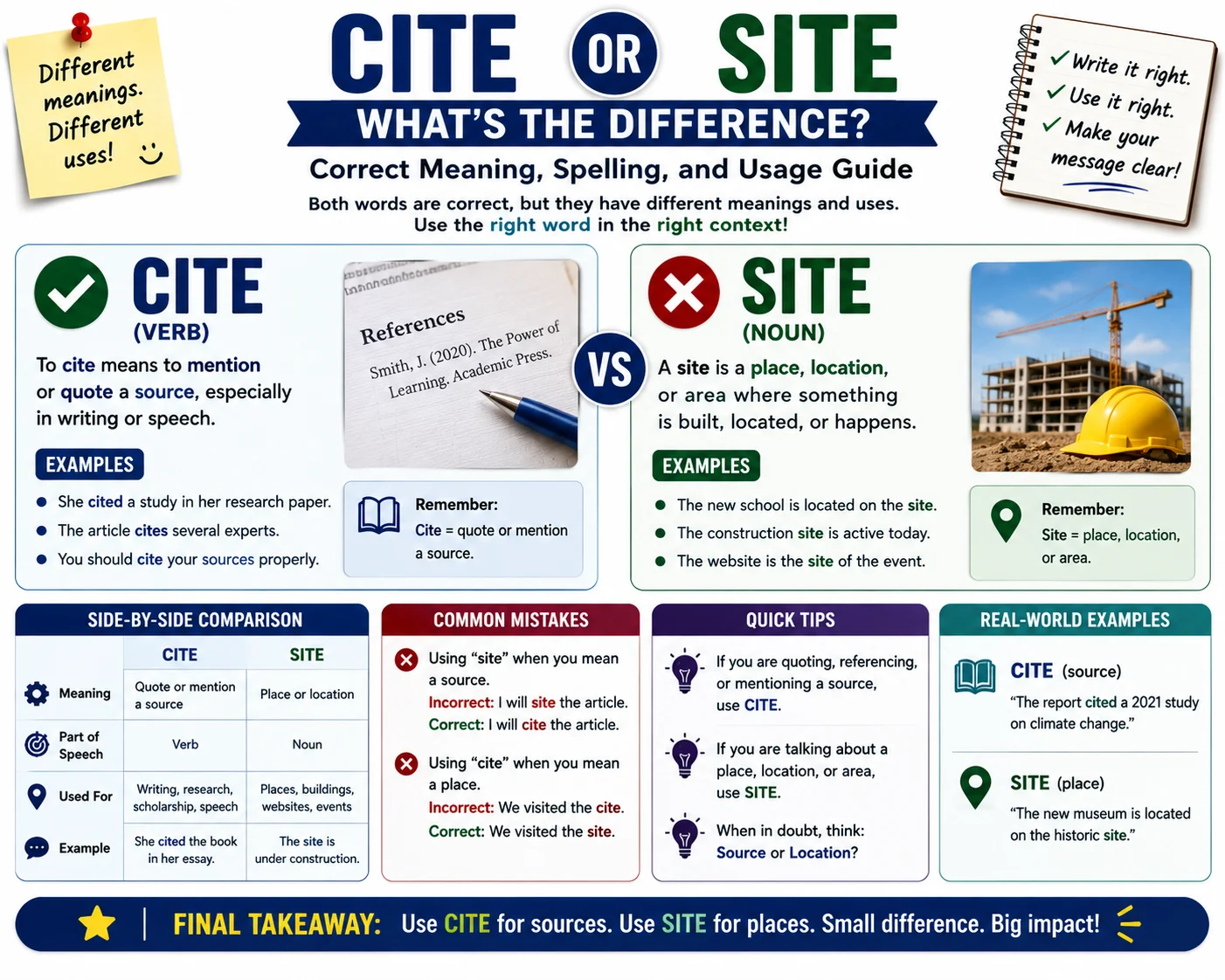
The quick answer is simple:
- Cite means to mention, quote, or refer to a source as evidence.
- Site means a place, location, or website.
Examples
| Word | Meaning | Example |
|---|---|---|
| Cite | To refer to a source | Please cite your references. |
| Site | A place or location | The building site is closed today. |
| Site | A website | Visit our site for more details. |
If you are talking about books, articles, research, or evidence, use cite.
If you are talking about a place or a website, use site.
The Origin of Cite or Site
Although cite and site sound the same, they come from different origins.
Cite
The word cite comes from the Latin word citare, meaning to summon or call. Over time, English speakers began using it when referring to calling attention to evidence or mentioning a source.
Site
The word site comes from the Latin word situs, meaning position, place, or location. Today, it refers to physical places as well as internet websites.
Why the Difference Exists
English has many words that sound alike but have different meanings. These are called homophones. Since cite and site developed from different Latin words, their spellings remained different even though their pronunciation became the same.
British English vs American English Spelling
Unlike many English words, cite and site are not different spellings between British and American English.
Both countries use:
- Cite
- Site
The difference is based only on meaning—not on regional spelling.
Comparison Table
| Meaning | Correct Word | British English | American English |
|---|---|---|---|
| Refer to a source | Cite | Cite | Cite |
| Physical location | Site | Site | Site |
| Website | Site | Site | Site |
Unlike words such as colour/color or centre/center, there is no spelling variation here.
Which Spelling Should You Use?
The correct choice depends on what you mean.
If your audience is in the United States
Use:
- Cite for references
- Site for locations and websites
If your audience is in the United Kingdom or Commonwealth countries
The same rule applies.
If your audience is global
Continue using:
- Cite for sources
- Site for places and websites
The spelling never changes between regions.
Common Mistakes with Cite or Site
Many writers confuse these words because they sound alike.
| Incorrect | Correct |
|---|---|
| Please site your sources. | Please cite your sources. |
| I will cite the construction area. | I will visit the construction site. |
| The company launched a new cite. | The company launched a new site. |
| You should site this book. | You should cite this book. |
Easy Memory Trick
- Cite = Citation
- Site = Location or Website
If you can replace the word with reference, use cite.
If you can replace it with place, use site.
Cite or Site in Everyday Examples
“Please cite your data sources before sending the report.”
News
“The new hospital site will open next year.”
Social Media
“Check out my new travel site!”
School Writing
“Students must cite every source they use.”
Business Report
“The company selected a new factory site.”
Academic Paper
“Always cite your references correctly.”
Cite or Site – Google Trends & Usage Data
Search interest for cite and site depends on context.
Site
- More popular worldwide.
- Frequently searched because of websites.
- Common in technology, business, construction, and travel.
Cite
- Popular among students, teachers, researchers, and writers.
- Common during school semesters and academic writing periods.
Usage by Country
| Country | More Common Search |
|---|---|
| United States | Site |
| United Kingdom | Site |
| Canada | Site |
| Australia | Site |
| India | Site |
| Academic communities worldwide | Cite |
The higher search volume for site comes mainly from internet-related searches rather than spelling confusion.
Cite or Site Comparison Table
| Feature | Cite | Site |
|---|---|---|
| Part of Speech | Verb | Noun |
| Meaning | Refer to a source | Place or location |
| Used in Research | Yes | No |
| Used for Websites | No | Yes |
| Used for Buildings | No | Yes |
| Example | Cite the article. | Visit the website. |
Frequently Asked Questions (FAQs)
1. Is it cite or site a source?
The correct phrase is cite a source because you are referring to evidence or a reference.
2. Is a website called a cite or site?
A website is always called a site.
3. Why do cite and site sound the same?
They are homophones—words with the same pronunciation but different meanings and spellings.
4. Is cite used only in academic writing?
No. It is also used in legal documents, journalism, reports, presentations, and professional writing.
5. Is there a British spelling of cite?
No. Both British and American English use cite.
6. Is there a British spelling of site?
No. Both British and American English use site.
7. How can I remember the difference?
Remember:
- Cite = Citation
- Site = Place or Website
Conclusion
Understanding the difference between cite and site is easier than it first appears. Although both words sound the same, they have completely different meanings and uses. Cite is used when you refer to information, quote a source, or provide evidence in academic, legal, or professional writing. Site, on the other hand, refers to a physical location, a building area, or a website on the internet.
The good news is that there is no difference between British English and American English for these words. Both countries use the same spellings. The only thing you need to remember is the meaning. If you are talking about a reference, choose cite. If you are talking about a place or a website, choose site.
Using the correct word improves clarity, builds trust with readers, and makes your writing look polished. Whether you’re writing an email, school assignment, blog post, news article, or business document, choosing the right word ensures your message is accurate and easy to understand.
Enquiry or Inquiry: Which Spelling Is Correct? Complete Guide With Examples

I am an English Literature expert and professional content writer with a passion for language, grammar, and effective communication. I specialize in creating well-researched, reader-friendly articles on English usage, spelling, vocabulary, writing techniques, and literary topics. My goal is to simplify complex concepts and provide accurate, engaging content that helps readers strengthen their language skills and communicate with confidence.