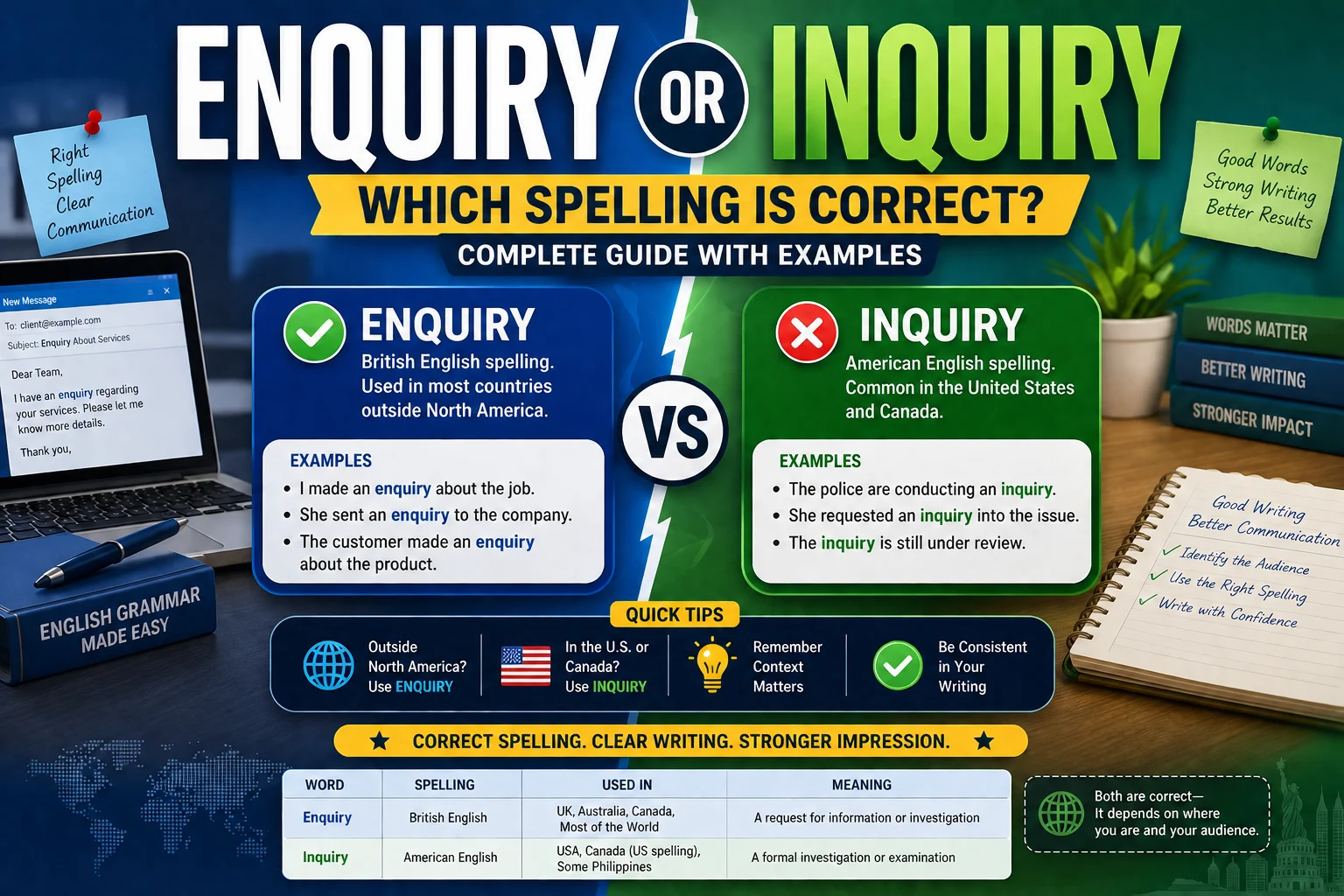
Have you ever stopped while writing an email because you couldn’t decide whether to write enquiry or inquiry? You are not alone. Thousands of people search for this question every month because both words look correct. The confusion comes from the fact that they are both accepted English spellings, but they are used in different parts of the world and sometimes in different situations.
Choosing the right spelling helps your writing look professional. It also helps you match the style your readers expect. If you write for customers, schools, businesses, or international audiences, using the correct form can improve clarity and trust.
In this guide, you will learn the difference between enquiry and inquiry, where each spelling comes from, how British and American English use them, common mistakes to avoid, and which version you should choose for your audience. You will also find simple examples, comparison tables, FAQs, and usage tips that make the choice easy.
The short answer is simple:
- Inquiry is the standard spelling in American English.
- Enquiry is the more common spelling in British English for a general question.
- In modern British English, inquiry is also used, especially for official investigations.
Examples
- I sent an inquiry about the product. (American English)
- I made an enquiry at the hotel reception. (British English)
- The government opened an inquiry into the accident. (Official investigation)
The Origin of Enquiry or Inquiry
Both words come from the Old French word enquerre, which means “to seek” or “to ask.” This word later became the Latin-based English verb inquire.
Over time, English developed two spellings:
- Enquiry
- Inquiry
In earlier British English, many writers used both spellings for different meanings.
Traditionally:
- Enquiry meant asking a question or requesting information.
- Inquiry referred to a formal investigation.
Today, that distinction is less strict. Most dictionaries accept both spellings, although regional preferences remain.
British English vs American English Spelling
The biggest difference is regional spelling.
| Feature | Enquiry | Inquiry |
|---|---|---|
| American English | Rare | Standard |
| British English | Common | Also used |
| Formal investigation | Less common | Preferred |
| General question | Common | Common in US |
Examples
British English
- I made an enquiry about train tickets.
- The council replied to my enquiry.
American English
- I sent an inquiry to customer service.
- She received an inquiry from a client.
Formal Investigation
- The court ordered an inquiry into the incident.
Which Spelling Should You Use?
The best spelling depends on your audience.
If You Write for an American Audience
Use inquiry.
Examples:
- business emails
- websites
- academic writing
- customer support
If You Write for a British Audience
Use enquiry for everyday questions.
Use inquiry when talking about official investigations.
If You Write for Australia, New Zealand, or Other Commonwealth Countries
Enquiry is still widely accepted for general questions.
Inquiry often appears in legal and government writing.
If You Write for a Global Audience
Choose one spelling and use it consistently.
Many international businesses prefer inquiry because American English is common online.
Common Mistakes with Enquiry or Inquiry
Here are mistakes people often make.
Mistake 1
❌ I received an enquiry from my US customer.
✅ I received an inquiry from my US customer.
Mistake 2
❌ The government started an enquiry into corruption.
✅ The government started an inquiry into corruption.
Mistake 3
❌ Switching spellings in the same article.
Choose one style and stay consistent.
Mistake 4
Thinking one spelling is incorrect.
Both are correct.
The right choice depends on your audience and writing style.
Enquiry or Inquiry in Everyday Examples
“Thank you for your inquiry about our software.”
“Thank you for your enquiry regarding your booking.”
News
“The government announced an inquiry into the accident.”
Social Media
“Thanks for your inquiry! We’ll reply soon.”
Customer Support
“We have received your enquiry and will respond within 24 hours.”
Business Writing
“We appreciate your inquiry about our services.”
Academic Writing
“The committee launched an inquiry into research ethics.”
Enquiry or Inquiry – Google Trends & Usage Data
Search behavior shows clear regional differences.
- Inquiry is much more popular in the United States.
- Enquiry is searched more often in the United Kingdom.
- Australia, New Zealand, and other Commonwealth countries use both spellings, but enquiry remains common for everyday communication.
- International companies often choose inquiry because it reaches a wider global audience.
The meaning stays the same in most situations. The main difference is the preferred regional spelling.
Comparison Table
| Feature | Enquiry | Inquiry |
|---|---|---|
| Meaning | Question or request | Question or investigation |
| British English | Preferred for general questions | Used for official investigations |
| American English | Rare | Standard spelling |
| Business Writing | UK businesses | US businesses |
| Legal Context | Less common | Preferred |
| Global Recognition | Good | Excellent |
FAQs
Is enquiry or inquiry correct?
Both are correct. The right spelling depends on whether you use British or American English.
Is inquiry American English?
Yes. Inquiry is the standard spelling in American English.
Is enquiry British English?
Yes. Enquiry is commonly used in British English for general questions.
Do enquiry and inquiry mean the same thing?
Most of the time, yes. Both refer to asking for information.
Which spelling should businesses use?
Use the spelling that matches your target audience. International businesses often choose inquiry.
Which spelling is used for legal investigations?
Inquiry is generally preferred for official investigations.
Can I use enquiry in the United States?
You can, but American readers usually expect inquiry.
Conclusion
The difference between enquiry and inquiry is mainly about regional spelling, not meaning. If you write for an American audience, inquiry is the correct and expected choice. If your readers are in the United Kingdom, enquiry is commonly used for everyday questions, while inquiry often appears in legal or official investigations.
For international websites and global businesses, inquiry is often the safer option because it is widely recognized online. However, whichever spelling you choose, the most important rule is consistency. Mixing both forms in the same document can make your writing look less polished.
Understanding this small spelling difference helps you communicate more clearly and professionally. Whether you are writing emails, business documents, blog posts, customer support messages, or academic content, choosing the right spelling for your audience creates a better reading experience. Keep your audience in mind, stay consistent, and you will always make the right choice between enquiry and inquiry.
Oriented or Orientated: Which Spelling Is Correct? Meaning, Differences, Examples & Usage Guide

I am an English Literature expert and professional content writer with a passion for language, grammar, and effective communication. I specialize in creating well-researched, reader-friendly articles on English usage, spelling, vocabulary, writing techniques, and literary topics. My goal is to simplify complex concepts and provide accurate, engaging content that helps readers strengthen their language skills and communicate with confidence.
5 thoughts on “Enquiry or Inquiry: Which Spelling Is Correct? Complete Guide With Examples”