Have you ever stopped while writing and wondered whether the correct word is carrys or carries? You are not alone. Many English learners, students, and even native speakers search for this keyword because English spelling rules can be confusing. A small spelling mistake can make writing look less professional, especially in school, business emails, and online content.
The confusion usually happens because many English verbs change their spelling when used with he, she, or it. People often guess that adding -s is enough, but some verbs follow a different rule. This is exactly why many people search for carrys or carries before sending an email, writing an article, or completing homework.
This guide gives you a quick answer first, then explains why the correct spelling is carries, where the rule comes from, how British and American English treat it, common mistakes to avoid, real-life examples, and usage trends. By the end, you’ll know exactly when and why to use carries with confidence.
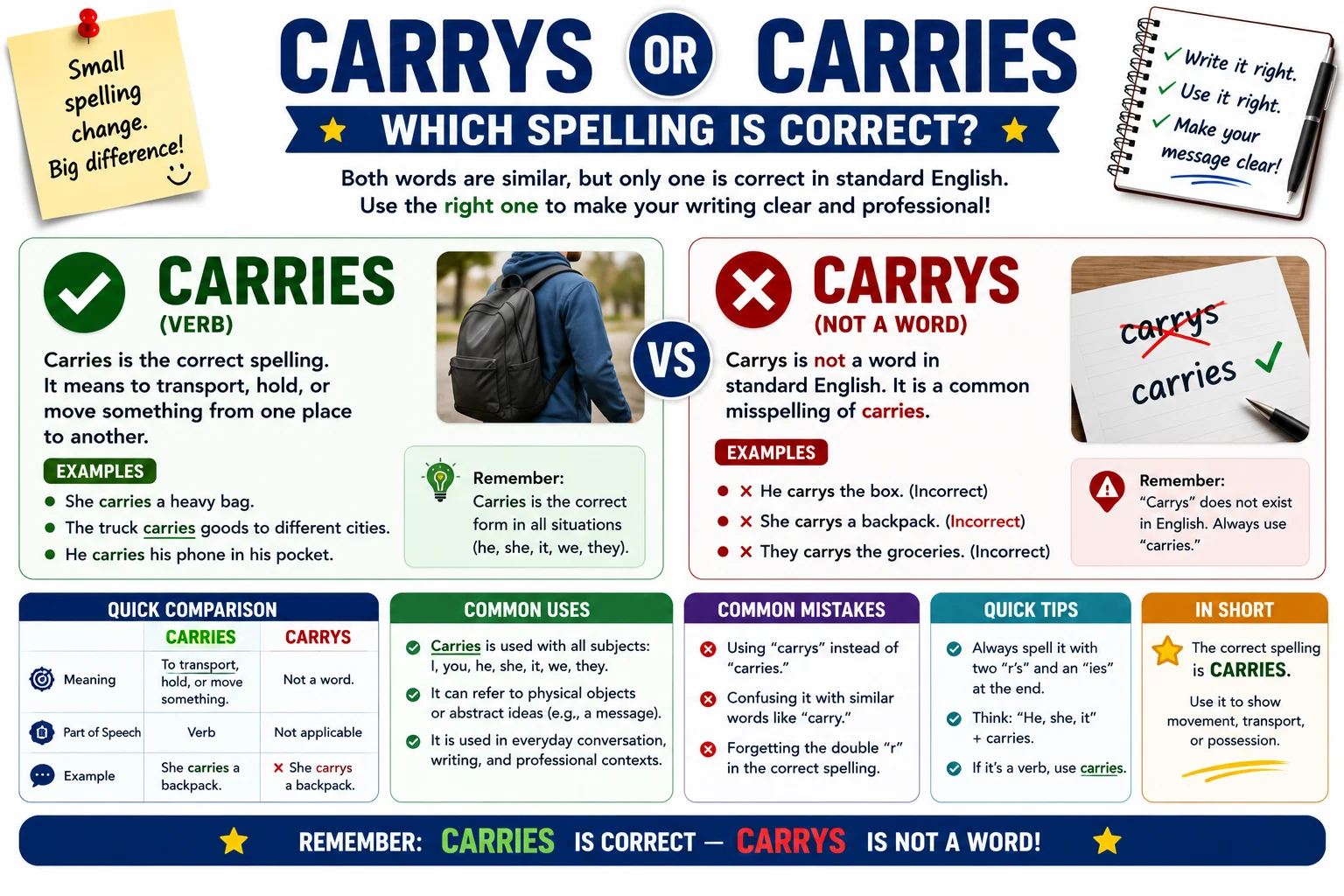
The correct spelling is carries.
Carrys is not a correct English word.
The verb carry changes to carries in the third-person singular present tense.
Examples
- She carries her books every day. ✅
- He carries a laptop to work. ✅
- The truck carries heavy equipment. ✅
- She carrys her books every day. ❌
Simple Rule
If a verb ends in a consonant + y, change the y to i and add -es.
carry → carries
Other examples:
| Base Verb | Correct Form |
|---|---|
| carry | carries |
| study | studies |
| try | tries |
| worry | worries |
| reply | replies |
The Origin of Carrys or Carries
The word carry comes from the Old French word carier, meaning “to transport” or “to move.” Over time, it became part of the English language and has kept the same basic meaning.
The spelling carries follows a long-standing English grammar rule. When a verb ends with a consonant followed by y, the y changes to i before adding -es.
This spelling rule developed to make English words easier to pronounce and read.
Examples include:
- cry → cries
- fly → flies
- marry → marries
- carry → carries
The spelling carrys ignores this grammar rule, so it has never been accepted as standard English.
British English vs American English Spelling
Unlike words such as colour/color or travelling/traveling, there is no difference between British and American English for carries.
Both use the same spelling because this is a grammar rule, not a regional spelling preference.
Examples
American English
- She carries her phone everywhere.
British English
- She carries her umbrella every day.
Both are correct.
Comparison Table
| Feature | American English | British English |
|---|---|---|
| Correct spelling | carries | carries |
| Incorrect spelling | carrys | carrys |
| Grammar rule | Change y to ies | Change y to ies |
Which Spelling Should You Use?
You should always use carries.
If your audience is in the United States
Use carries.
If your audience is in the United Kingdom
Use carries.
If your audience is in Australia, Canada, New Zealand, or other Commonwealth countries
Use carries.
For global writing
Use carries because it is the accepted spelling worldwide.
There is no situation where carrys is considered correct in standard English.
Common Mistakes with Carrys or Carries
Here are mistakes people often make.
| Incorrect | Correct |
|---|---|
| She carrys the bag. | She carries the bag. |
| He carrys groceries. | He carries groceries. |
| The company carrys products. | The company carries products. |
| It carrys extra weight. | It carries extra weight. |
Remember
- I carry
- You carry
- We carry
- They carry
- He carries
- She carries
- It carries
Only the third-person singular changes.
Carrys or Carries in Everyday Examples
Emails
She carries responsibility for the project.
News
The bridge carries thousands of vehicles every day.
Social Media
She always carries snacks in her backpack.
Formal Writing
The report carries important recommendations for future planning.
Everyday Conversation
He carries his lunch to work every morning.
Carrys or Carries – Google Trends & Usage Data
Search interest in carrys or carries comes mostly from people checking grammar and spelling before writing.
The correct spelling carries appears in books, newspapers, educational websites, business documents, and professional communication across English-speaking countries.
The misspelling carrys usually appears because people simply add -s instead of following the spelling rule.
General Usage
| Variation | Status | Usage |
|---|---|---|
| carries | Correct | Very common |
| carry | Base form | Very common |
| carrys | Incorrect | Misspelling |
| carryed | Incorrect | Misspelling |
| carried | Correct past tense | Very common |
Comparison Table: Keyword Variations
| Variation | Correct? | When to Use |
|---|---|---|
| carries | ✅ Yes | Third-person singular present |
| carry | ✅ Yes | Base verb |
| carried | ✅ Yes | Past tense |
| carrying | ✅ Yes | Present participle |
| carrys | ❌ No | Never use |
| carryed | ❌ No | Never use |
FAQs
1. Is carrys a real English word?
No. Carrys is not a correct English spelling.
2. Why is it carries instead of carrys?
Because verbs ending with a consonant followed by y change the y to i before adding -es.
3. Is carries correct in both British and American English?
Yes. Both varieties use carries.
4. What is the past tense of carry?
The past tense is carried.
5. What is the plural of carry?
Carry is a verb, so it does not have a plural form. The correct verb forms are carry, carries, carried, and carrying.
6. How do I remember the rule?
If a verb ends in consonant + y, change y to i and add -es.
Example:
carry → carries
7. Can I use carrys in informal writing?
No. It is always considered a spelling mistake.
Conclusion
Choosing between carrys or carries is simple once you know the spelling rule. The correct form is carries, while carrys is always incorrect. English verbs that end with a consonant followed by y change the y to i before adding -es in the third-person singular. This same pattern appears in words such as tries, studies, replies, and worries, making the rule easy to recognize and remember.
Another helpful point is that there is no difference between British English and American English for this word. Writers in the United States, the United Kingdom, Canada, Australia, New Zealand, and other English-speaking countries all use carries. Whether you are writing an email, a news article, a school assignment, a social media post, or business content, carries is always the correct choice. By following this simple grammar rule, you can avoid a common spelling mistake and make your writing clearer, more accurate, and more professional.
Enquiry or Inquiry: Which Spelling Is Correct? Complete Guide With Examples

I am an English Literature expert and professional content writer with a passion for language, grammar, and effective communication. I specialize in creating well-researched, reader-friendly articles on English usage, spelling, vocabulary, writing techniques, and literary topics. My goal is to simplify complex concepts and provide accurate, engaging content that helps readers strengthen their language skills and communicate with confidence.