Have you ever wondered whether you should write knick or nick? Many English learners, writers, and even native speakers search for this keyword because both words exist, but they do not always mean the same thing. The confusion grows because the two words sound almost identical, yet their spelling and meaning can change depending on the context.
People often search for “knick or nick” when writing emails, school assignments, blog posts, or social media captions. They want to know which spelling is correct and whether one is British English while the other is American English. In some situations, both words are accepted. In others, using the wrong spelling can make your writing look incorrect.
This guide explains the difference in simple language. You’ll learn the meanings, origins, spelling differences, examples, and when to use each word. By the end, you’ll know exactly whether to write knick or nick and avoid common mistakes.
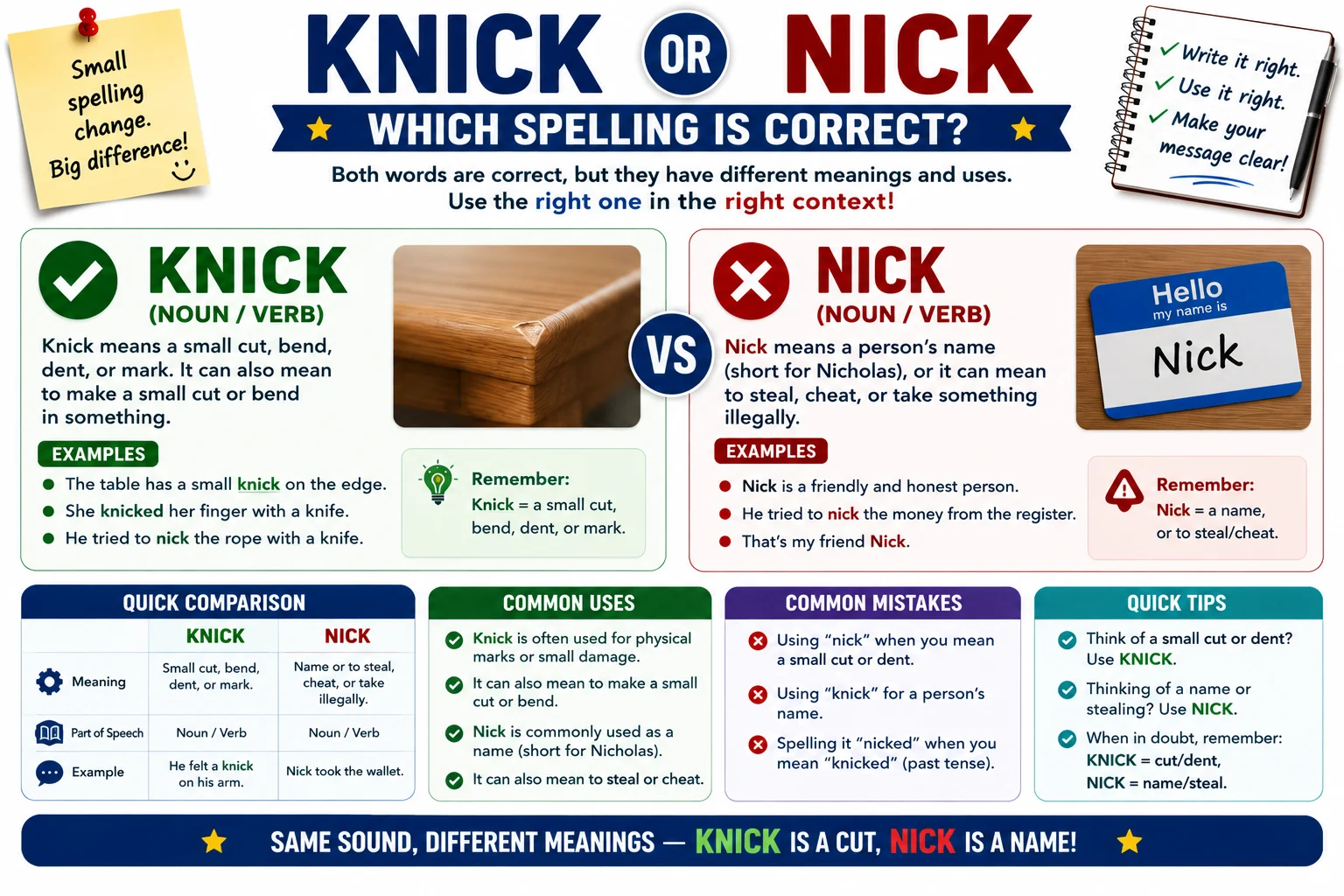
The short answer is:
- Nick is the standard spelling for a small cut, notch, or minor damage.
- Knick is much less common and usually appears in the phrase knick-knack, which means a small decorative object.
Examples
- ✅ I accidentally nicked my finger while cooking.
- ✅ The car door has a small nick.
- ✅ She collects colorful knick-knacks.
- ❌ The table has a knick. (Usually incorrect.)
In most situations, nick is the correct spelling.
The Origin of Knick or Nick
The word nick has been part of English for hundreds of years. It originally meant a small cut, notch, or groove. Over time, it also came to describe stealing something, making a slight mark, or narrowly missing something.
Examples include:
- Nick the edge of the paper.
- Nick someone’s wallet.
- A close nick in sports.
The spelling knick is much newer and much less common. It survives mainly because of the word knick-knack, which describes small decorative items or ornaments.
The silent K appears because English has borrowed words from several languages over time. However, for the meaning of a small cut or scratch, modern dictionaries almost always prefer nick.
British English vs American English Spelling
Unlike many English words, nick is not one of the common British versus American spelling differences.
Both British English and American English generally use nick for a small cut or notch.
The main difference is in usage rather than spelling.
| Meaning | American English | British English |
|---|---|---|
| Small cut | Nick | Nick |
| Small notch | Nick | Nick |
| Decorative objects | Knick-knacks | Knick-knacks |
| Minor damage | Nick | Nick |
Examples
American English
- There’s a small nick in the paint.
British English
- He got a nick on his hand while gardening.
In British English, nick can also be informal slang for prison or to steal.
Example:
- He was taken to the nick.
- Someone nicked my bicycle.
Which Spelling Should You Use?
The right spelling depends on what you mean.
If your audience is in the United States
Use nick for cuts, scratches, or small damage.
Example:
- The knife left a tiny nick.
If your audience is in the United Kingdom or Commonwealth countries
Use nick for cuts and damage.
Use knick-knack only when talking about decorative objects.
If your audience is global
Choose nick unless you are specifically referring to knick-knacks.
This choice is understood almost everywhere.
Common Mistakes with Knick or Nick
Many writers confuse these spellings because they sound alike.
| Incorrect | Correct |
|---|---|
| I got a knick on my finger. | I got a nick on my finger. |
| The wall has a knick. | The wall has a nick. |
| She bought many nicks and decorations. | She bought many knick-knacks. |
| My phone has a knick. | My phone has a nick. |
Remember
- Nick = cut, notch, scratch
- Knick = mostly used in knick-knack
Knick or Nick in Everyday Examples
The package arrived with a small nick on one corner.
News
The player suffered a minor nick but finished the match.
Social Media
Oops! I nicked my new phone today.
Formal Writing
The inspection found a small nick in the metal surface.
Home Decor
The shelf is full of vintage knick-knacks.
Knick or Nick – Google Trends & Usage Data
Search data and published writing show that nick is far more common than knick.
General usage patterns include:
- United States: “Nick” is overwhelmingly more common.
- United Kingdom: “Nick” is standard and also has slang meanings.
- Canada: “Nick” is the preferred spelling.
- Australia: “Nick” is commonly used.
- Global English: “Nick” dominates in books, websites, and news.
The spelling knick appears mainly in searches related to knick-knacks rather than cuts or scratches.
Keyword Comparison Table
| Keyword Variation | Meaning | Common Usage | Correct? |
|---|---|---|---|
| Nick | Small cut or notch | Very common | ✅ Yes |
| Knick | Rare outside knick-knack | Uncommon | Limited |
| Nicked | Received a small cut | Very common | ✅ Yes |
| Nicking | Making a small cut | Common | ✅ Yes |
| Knick-knack | Small decorative object | Common | ✅ Yes |
| Nick or Knick | Comparison search | Common online | ✅ Search phrase |
Frequently Asked Questions
1. Is it nick or knick?
For a small cut or scratch, nick is correct.
2. Is knick a real word?
Yes. It is a real word, but today it is mainly used in knick-knack.
3. Is nick correct in British English?
Yes. British English uses nick for cuts, scratches, and several informal slang meanings.
4. Is nick correct in American English?
Yes. American English also uses nick as the standard spelling.
5. What does knick-knack mean?
A knick-knack is a small decorative object or ornament.
6. Why do people confuse knick and nick?
They sound almost identical, making them easy to mix up in writing.
7. Which spelling should I use in professional writing?
Use nick unless you are specifically talking about knick-knacks.
Conclusion
The difference between knick and nick is simpler than many people expect. If you are talking about a small cut, scratch, notch, or minor damage, nick is the correct spelling in both American and British English. It is the standard form used in everyday conversations, professional writing, newspapers, and online content. You can also use nick as a verb when someone lightly cuts something or, in informal British English, when referring to stealing or prison.
The spelling knick is much less common. Most people encounter it only in the compound word knick-knack, which refers to small decorative objects or ornaments. Outside of that expression, using knick instead of nick is usually considered an error.
If you write for a global audience, choosing nick will almost always be the safest option. Remember this simple rule: Nick is for cuts and scratches, while knick belongs mainly in knick-knack. Keeping this distinction in mind will help your writing stay accurate, clear, and professional.
Enquiry or Inquiry: Which Spelling Is Correct? Complete Guide With Examples

I am an English Literature expert and professional content writer with a passion for language, grammar, and effective communication. I specialize in creating well-researched, reader-friendly articles on English usage, spelling, vocabulary, writing techniques, and literary topics. My goal is to simplify complex concepts and provide accurate, engaging content that helps readers strengthen their language skills and communicate with confidence.