Have you ever typed “stoped” and wondered if your spell checker was wrong? You are not alone. Many English learners, students, writers, and even native speakers search for “stopped or stoped” because the spelling rule is confusing. Some English words simply add -ed to form the past tense, while others double the last letter before adding -ed.
The good news is that the answer is simple once you understand the rule. Knowing the correct spelling helps you write better emails, school assignments, business documents, blog posts, and social media updates. Using the wrong spelling can make your writing look less professional and may confuse readers.
In this guide, you’ll learn the correct spelling, why the mistake happens, the grammar rule behind it, differences between British and American English, common errors to avoid, and real-life examples. By the end, you’ll know exactly when to use stopped and why stoped is incorrect.
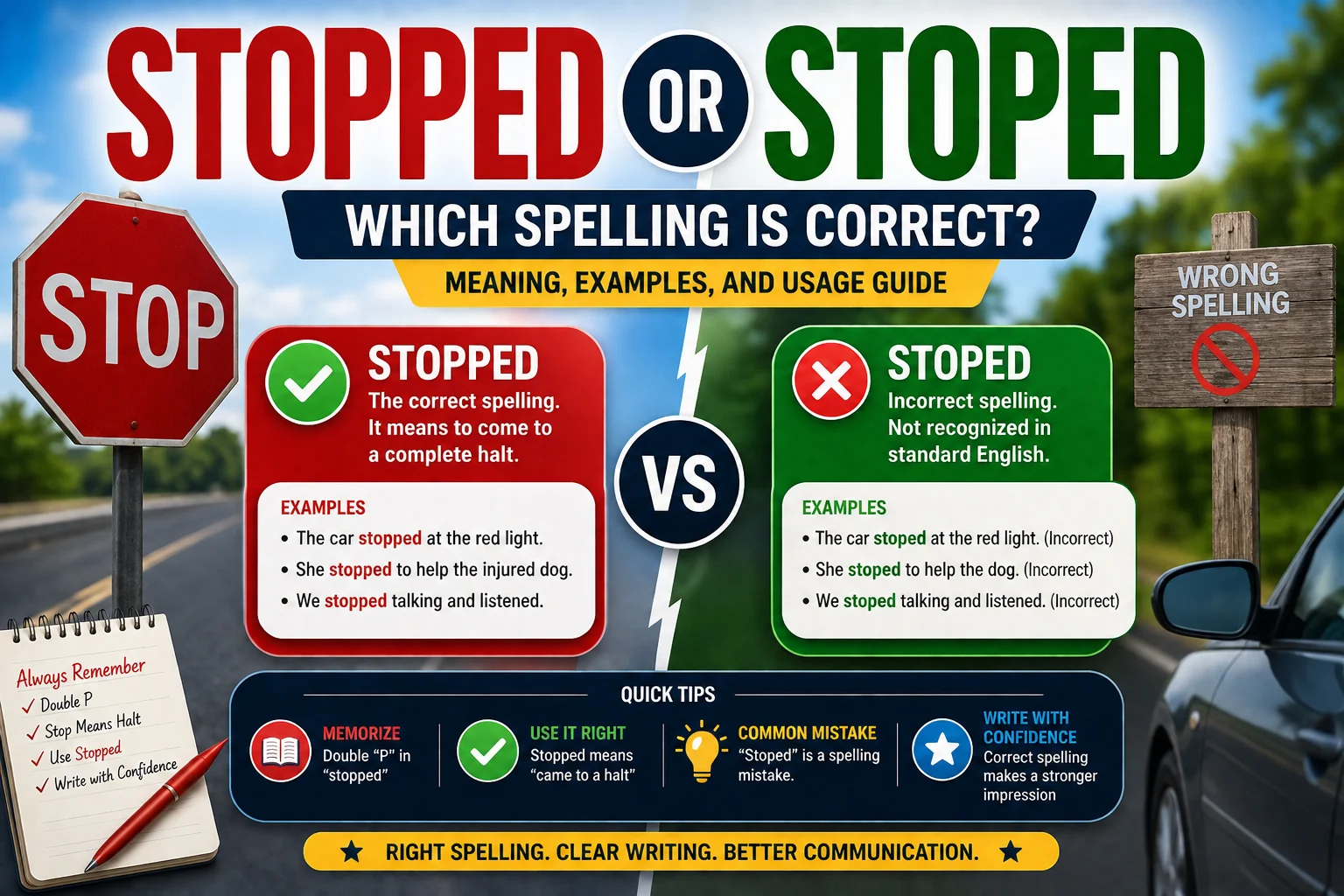
The correct spelling is stopped.
Stoped is not a correct English word.
The verb stop follows the consonant-vowel-consonant (CVC) spelling rule. Because the word ends with one vowel followed by one consonant, the final consonant p is doubled before adding -ed.
Correct Examples
- I stopped the car.
- She stopped talking.
- The rain stopped yesterday.
Incorrect Examples
- ❌ I stoped the car.
- ❌ She stoped talking.
- ❌ The rain stoped yesterday.
Quick rule:
Stop + ed = Stopped
The Origin of Stopped or Stoped
The word stop comes from Old English and Germanic languages. It has been used for hundreds of years to mean ending movement or bringing something to a halt.
The spelling stopped developed because English follows a common spelling rule. When a short verb ends with:
- one consonant
- one vowel
- one consonant
the final consonant is doubled before adding -ed or -ing.
Examples include:
| Base Verb | Past Tense |
|---|---|
| stop | stopped |
| plan | planned |
| drop | dropped |
| clap | clapped |
People often write stoped because many English verbs simply add -ed, such as:
- walk → walked
- clean → cleaned
- jump → jumped
Since English has many spelling patterns, this mistake is very common.
British English vs American English Spelling
Unlike words such as colour/color or travelling/traveling, there is no difference between British and American English for stopped.
Both varieties use the same spelling.
Comparison
| English Version | Correct Spelling |
|---|---|
| British English | stopped |
| American English | stopped |
| Australian English | stopped |
| Canadian English | stopped |
Examples
British English:
- The train stopped at the station.
American English:
- The bus stopped near the school.
The spelling stays the same everywhere.
Which Spelling Should You Use?
Always use stopped.
Here is simple advice based on your audience.
| Audience | Recommended Spelling |
|---|---|
| United States | stopped |
| United Kingdom | stopped |
| Canada | stopped |
| Australia | stopped |
| New Zealand | stopped |
| International Audience | stopped |
There is no situation where stoped is considered correct in modern English.
Common Mistakes with Stopped or Stoped
Many learners make the same spelling mistakes.
| Incorrect | Correct |
|---|---|
| stoped | stopped |
| stoping | stopping |
| stopes | stops |
| stopd | stopped |
Why These Mistakes Happen
- Forgetting to double the p
- Confusing English spelling rules
- Typing too quickly
- Depending only on pronunciation
Remember this rule:
One vowel + one consonant = double the consonant before adding -ed or -ing.
Examples:
- stop → stopped
- stop → stopping
- drop → dropped
- plan → planned
Stopped or Stoped in Everyday Examples
Here are examples from daily writing.
“I stopped working on the report after lunch.”
News
“The police stopped traffic because of the accident.”
Social Media
“I finally stopped eating junk food!”
School Writing
“The experiment stopped when the power failed.”
Business Writing
“The company stopped production last week.”
Conversation
“We stopped for coffee before heading home.”
Stopped or Stoped – Google Trends & Usage Data
Searches for “stopped or stoped” happen because many people want to confirm the correct spelling.
In general:
- Stopped is the standard spelling used worldwide.
- Stoped appears mostly as a spelling mistake.
- Students, English learners, and job seekers commonly search for this keyword.
- Countries with many English learners often generate more searches for spelling questions like this.
Online dictionaries, grammar websites, and search engines consistently recognize stopped as the correct form.
Comparison Table: Keyword Variations
| Variation | Correct? | Notes |
|---|---|---|
| stopped | ✅ Yes | Correct past tense of stop |
| stoped | ❌ No | Incorrect spelling |
| stopping | ✅ Yes | Present participle |
| stops | ✅ Yes | Third-person singular |
| stop | ✅ Yes | Base verb |
Frequently Asked Questions
1. Is “stoped” a real English word?
No. Stoped is considered an incorrect spelling of stopped.
2. Why is there a double “p” in “stopped”?
The verb stop follows the consonant-vowel-consonant spelling rule, so the final consonant is doubled before adding -ed.
3. Is “stopped” correct in both the UK and the US?
Yes. Both British and American English use stopped.
4. What is the present tense of “stopped”?
The present tense is stop.
Example:
“I stop at the store every morning.”
5. What is the present participle of “stop”?
The present participle is stopping.
Example:
“She is stopping by later.”
6. Why do people type “stoped”?
Most people forget the spelling rule that requires doubling the final consonant before adding -ed.
7. How can I remember the correct spelling?
Remember this simple formula:
Stop + double p + ed = stopped
Conclusion
The answer to “stopped or stoped” is straightforward. Stopped is the only correct spelling in modern English, while stoped is a common spelling mistake. The reason is the consonant-vowel-consonant rule, which requires doubling the final p before adding -ed. This same pattern appears in words like planned, dropped, and clapped.
Another helpful point is that there is no difference between British and American English for this word. Whether you are writing for readers in the United States, the United Kingdom, Canada, Australia, or anywhere else, stopped is always the correct choice. Learning this simple spelling rule will improve your grammar, strengthen your writing, and help you avoid one of the most common English spelling mistakes. Whenever you are unsure, remember the formula: stop + p + ed = stopped. Using the correct spelling makes your writing clearer, more accurate, and more professional in every situation.
Oriented or Orientated: Which Spelling Is Correct? Meaning, Differences, Examples & Usage Guide

I am an English Literature expert and professional content writer with a passion for language, grammar, and effective communication. I specialize in creating well-researched, reader-friendly articles on English usage, spelling, vocabulary, writing techniques, and literary topics. My goal is to simplify complex concepts and provide accurate, engaging content that helps readers strengthen their language skills and communicate with confidence.