Have you ever typed “planing or planning” into Google and wondered which word is correct? You are not alone. Many people get confused because the two words look almost the same. Yet, they have very different meanings.
Most users search for planing or planning because they want to avoid spelling mistakes in school assignments, business emails, blog posts, or social media. Others want to know if planing is simply a misspelling of planning. The answer is simple: planning is the correct word when you mean making a plan. Planing is a real English word too, but it has a different meaning. It refers to smoothing wood with a plane tool or moving across water in a special way, called hydroplaning.
This guide explains the difference between planing and planning in simple language. You will learn where each word comes from, how British and American English use them, common mistakes to avoid, and which spelling fits your audience. By the end, you will know exactly when to use each word.
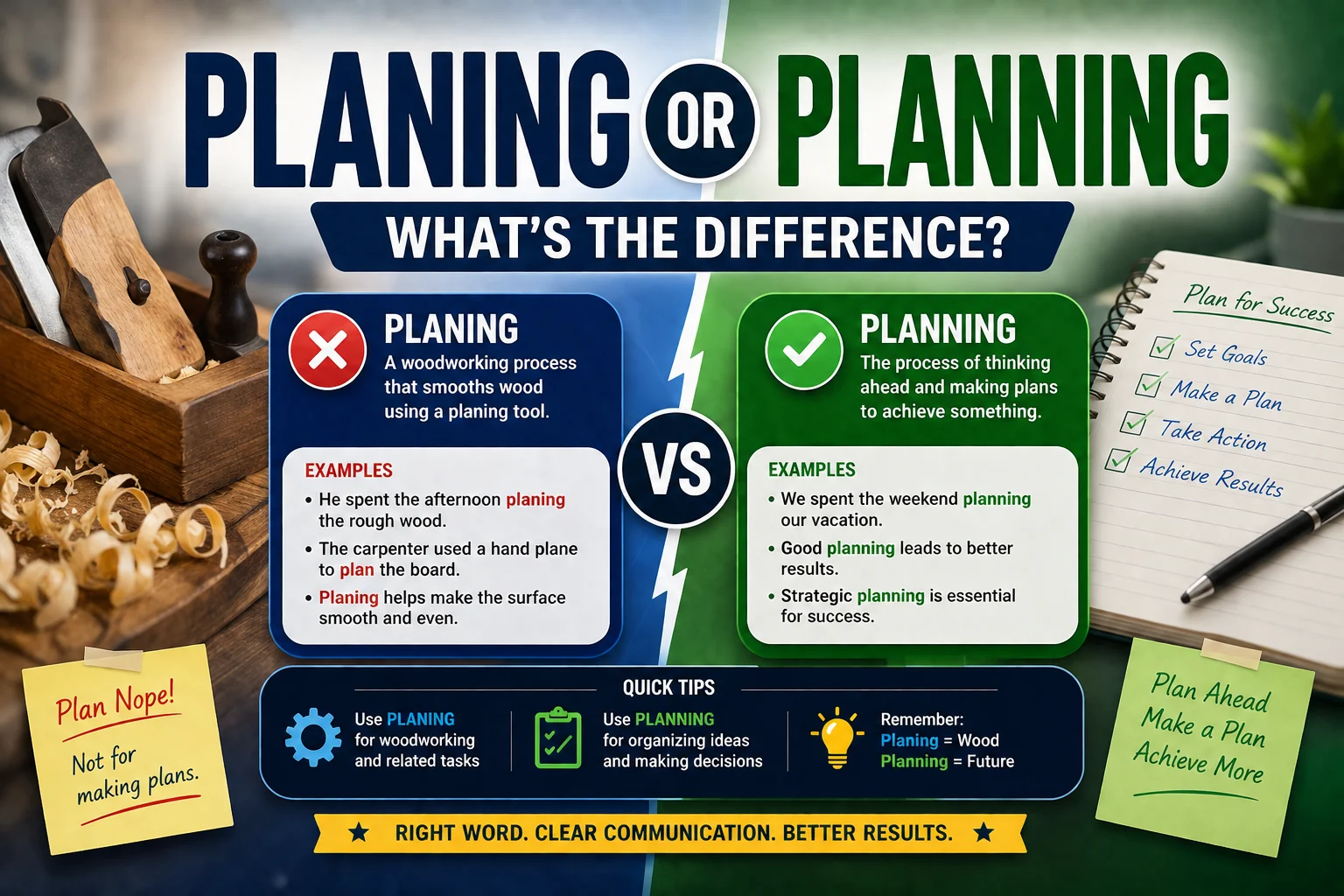
The quick answer is easy:
- Planning means making a plan or preparing for something.
- Planing means smoothing a surface with a plane or gliding over water.
Examples
✅ We are planning our summer vacation.
✅ She spent the morning planning the project.
✅ The carpenter is planing the wooden board.
✅ The boat was planing across the lake.
Remember: If you are talking about organizing, preparing, or thinking ahead, the correct spelling is planning.
The Origin of Planing or Planning
Both words come from the word plan, but they developed in different ways.
Planning
The word planning comes from the verb plan, which means to prepare or arrange something before it happens. When adding -ing, English doubles the final n because the word ends with a short vowel followed by one consonant.
- Plan → Planning
- Run → Running
- Sit → Sitting
Planing
The word planing comes from the noun and verb plane. A plane is a woodworking tool used to smooth wood. The verb plane means to make a surface flat or smooth.
Later, planing also came to describe boats or aircraft moving smoothly over water or air.
This is why both spellings exist today. They are different words with different meanings.
British English vs American English Spelling
Unlike many English words, planning is spelled the same in both British English and American English.
There is no spelling difference between the two versions of English.
| Feature | British English | American English |
|---|---|---|
| Correct spelling for making plans | Planning | Planning |
| Correct spelling for woodworking | Planing | Planing |
| Double “n” in planning | Yes | Yes |
| Same meaning | Yes | Yes |
Examples
British English
- We are planning a holiday.
- The carpenter is planing the table.
American English
- We are planning a road trip.
- He is planing the wooden shelf.
The spelling stays the same in both regions.
Which Spelling Should You Use?
Your choice depends on what you want to say.
For US Readers
Use planning when talking about goals, projects, events, or future activities.
Example:
- We are planning next year’s budget.
For UK and Commonwealth Readers
The rule is exactly the same.
Example:
- They are planning a charity event.
For Global Audiences
Use planning whenever you mean preparing or organizing something.
Use planing only when writing about:
- Woodworking
- Carpentry
- Boats moving across water
- Aircraft movement in special situations
For almost every business, education, or marketing article, planning is the correct word.
Common Mistakes with Planing or Planning
Many writers confuse these words because they look alike.
| Incorrect | Correct | Reason |
|---|---|---|
| I am planing my vacation. | I am planning my vacation. | Planning means preparing. |
| She is planing the meeting. | She is planning the meeting. | Meetings require planning. |
| The carpenter is planning the wood. | The carpenter is planing the wood. | Wood is planed, not planned. |
| We need better planing skills. | We need better planning skills. | Planning means organizing. |
Easy Tip
Ask yourself:
Am I talking about making a plan?
If yes, use planning.
Am I talking about wood or boats?
If yes, use planing.
Planing or Planning in Everyday Examples
In Emails
- We are planning a meeting for Friday.
- Thank you for planning the event.
In News
- The city is planning a new park.
- Officials are planning safety improvements.
On Social Media
- Planning my dream vacation!
- Planning my weekend already.
In Formal Writing
- Strategic planning helps businesses grow.
- Financial planning reduces future risks.
In Carpentry
- He is planing the edge of the board.
- The worker finished planing the wood.
Planing or Planning – Google Trends & Usage Data
Search data shows that planning is searched far more often than planing.
This is because most people are looking for:
- Business planning
- Financial planning
- Event planning
- Travel planning
- Project planning
The word planing is much less common. Most searches for this word relate to:
- Woodworking
- Carpentry
- Boat planing
- Hydroplaning
Popularity by Country
| Country | More Common Search |
|---|---|
| United States | Planning |
| United Kingdom | Planning |
| Canada | Planning |
| Australia | Planning |
| New Zealand | Planning |
In almost every English-speaking country, planning is the more popular spelling because it applies to everyday life and business.
Keyword Comparison Table
| Word | Meaning | Correct Usage | Example |
|---|---|---|---|
| Planning | Making plans | Everyday writing | We are planning a trip. |
| Planing | Smoothing wood or gliding | Carpentry and engineering | He is planing the board. |
| Planned | Past tense of plan | Correct | We planned ahead. |
| Planner | A person or tool for planning | Correct | She is an event planner. |
| Plane | Tool or flat surface | Correct | Use a plane to smooth wood. |
Frequently Asked Questions
1. Is planning the correct spelling?
Yes. Planning is correct when talking about making plans or preparing for something.
2. Is planing a real word?
Yes. Planing is a real English word used in woodworking and transportation.
3. Why does planning have two “n” letters?
English spelling rules double the final consonant before adding -ing to words like plan.
4. Is planning correct in British English?
Yes. British English and American English both use planning.
5. Can I use planing instead of planning?
No. They have different meanings and should not be used interchangeably.
6. Which spelling should businesses use?
Businesses should almost always use planning because it refers to organizing and preparing.
7. Why do people confuse planing and planning?
The words look very similar, but they come from different verbs and have different meanings.
Conclusion
Understanding the difference between planing or planning is simple once you know what each word means. If you are talking about preparing for the future, organizing an event, setting goals, or creating a strategy, planning is always the correct choice. It is the spelling used in schools, workplaces, businesses, and everyday conversations across both British and American English.
The word planing, however, is not a spelling mistake. It has a special meaning in woodworking, carpentry, and transportation. It describes smoothing a surface with a plane or moving quickly over water. Because this meaning is much more specific, most people will rarely need to use it.
A good way to remember the difference is to think about the topic. If your sentence is about ideas, schedules, or preparation, choose planning. If it is about wood or movement across water, choose planing. Using the correct spelling improves your writing, helps readers understand your message, and makes your content look more professional. Knowing this small difference can prevent common mistakes and build confidence in your English writing.
Oriented or Orientated: Which Spelling Is Correct? Meaning, Differences, Examples & Usage Guide

I am an English Literature expert and professional content writer with a passion for language, grammar, and effective communication. I specialize in creating well-researched, reader-friendly articles on English usage, spelling, vocabulary, writing techniques, and literary topics. My goal is to simplify complex concepts and provide accurate, engaging content that helps readers strengthen their language skills and communicate with confidence.