Have you ever wondered whether you should write honour or honor? You are not alone. Thousands of people search for this spelling difference every month because both words have the same meaning but different spellings.
The confusion comes from the difference between British English and American English. If you write for school, work, a blog, or social media, using the correct spelling helps your writing look professional. Choosing the wrong version for your audience can make your content seem inconsistent.
This guide explains everything you need to know about honour or honor. You will learn which spelling is correct, why two versions exist, where each one is used, and how to avoid common mistakes. We also include simple examples, comparison tables, Google Trends insights, and frequently asked questions. By the end, you will know exactly which spelling to use in every situation.
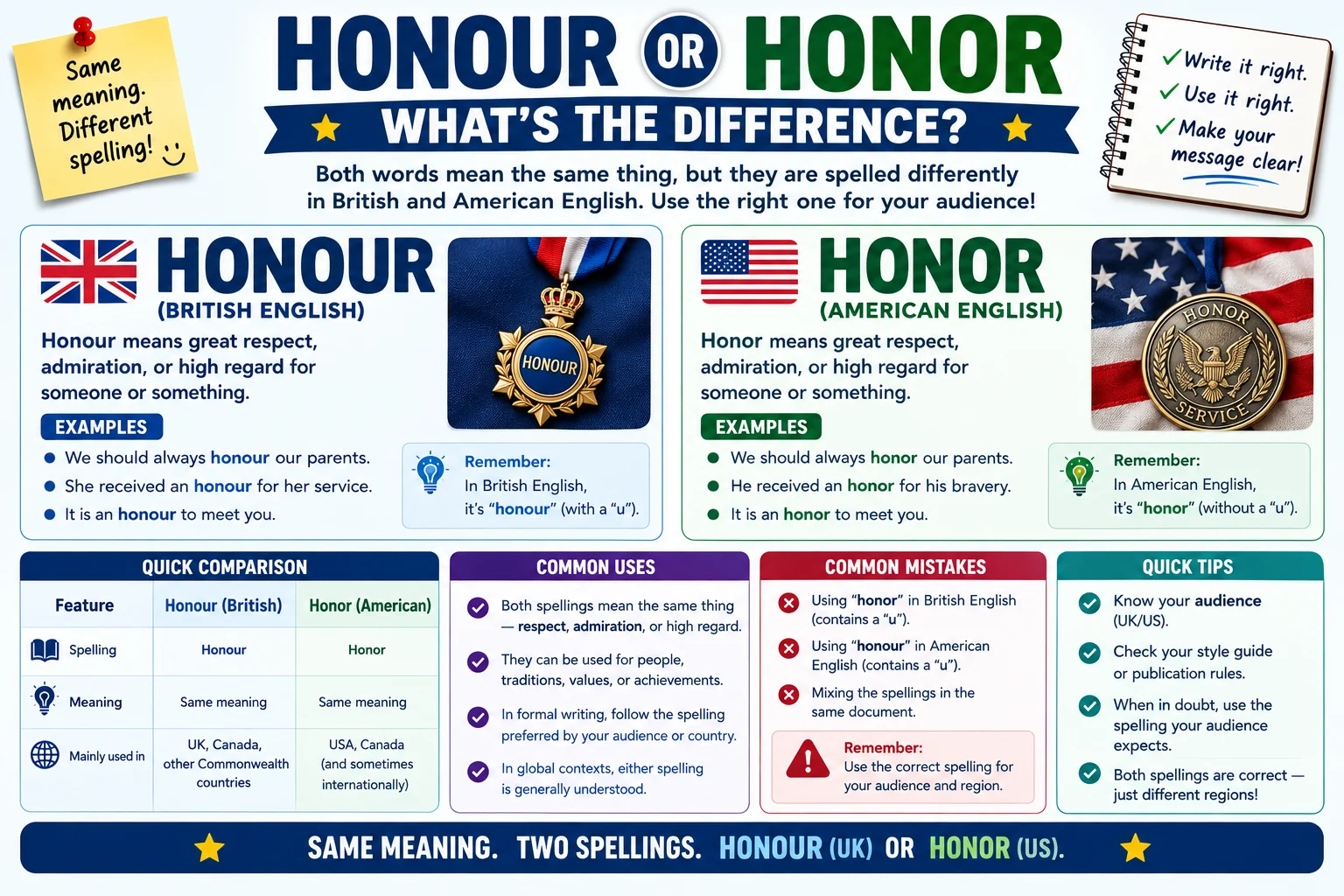
Both “honour” and “honor” are correct.
The difference depends on the type of English you use.
- Honour = British English
- Honor = American English
Examples
British English
- It was an honour to meet you.
- She received an honour from the Queen.
American English
- It was an honor to meet you.
- She received an honor from the President.
The meaning stays exactly the same.
The Origin of Honour or Honor
The word comes from the Latin word honor, meaning respect, dignity, or recognition.
Later, the word entered Old French as honour. When it became part of English, British writers kept the French-style spelling with -our.
In the early 1800s, American dictionary writer Noah Webster simplified many English spellings. He removed the extra “u” from words like:
- honour → honor
- colour → color
- favour → favor
- labour → labor
These simpler spellings became the American standard.
Today, both spellings are correct. The only difference is the regional style.
British English vs American English Spelling
British and American English often spell words differently while keeping the same meaning.
| British English | American English | Meaning |
|---|---|---|
| Honour | Honor | Respect |
| Colour | Color | Shade |
| Favourite | Favorite | Preferred choice |
| Labour | Labor | Work |
| Neighbour | Neighbor | Person living nearby |
Main Rule
- Use -our in British English.
- Use -or in American English.
This rule applies to many similar words.
Which Spelling Should You Use?
Choose the spelling based on your audience.
If Your Audience Is American
Use honor.
Examples:
- US websites
- American schools
- US businesses
- American newspapers
If Your Audience Is British or Commonwealth
Use honour.
Countries include:
- United Kingdom
- Canada (often prefers British spelling)
- Australia
- New Zealand
- South Africa
If Your Audience Is Global
Pick one spelling and use it consistently throughout your writing.
Consistency is more important than switching between the two forms.
Common Mistakes with Honour or Honor
Here are common errors people make.
| Incorrect | Correct |
|---|---|
| Mixing honour and honor in one article | Use one spelling style throughout |
| Using honor in British assignments | Use honour |
| Using honour in American business writing | Use honor |
| Thinking one spelling is wrong | Both are correct |
| Changing spelling randomly | Match your audience |
Always check the language setting in your document before writing.
Honour or Honor in Everyday Examples
British:
It was an honour to work with your team.
American:
It was an honor to work with your team.
News
British:
The athlete received the highest national honour.
American:
The athlete received the nation’s highest honor.
Social Media
British:
Such an honour to be part of this event!
American:
Such an honor to be part of this event!
Formal Writing
British:
We are honoured to welcome our guests.
American:
We are honored to welcome our guests.
Honour or Honor – Google Trends & Usage Data
Search interest for honour or honor comes from people who want to know which spelling is correct.
General Usage by Country
| Country | Common Spelling |
|---|---|
| United States | Honor |
| United Kingdom | Honour |
| Australia | Honour |
| New Zealand | Honour |
| Canada | Honour (more common) |
| India | Honour (often preferred) |
Usage Context
Honor
- American websites
- US education
- Government writing
- Business communication
Honour
- British publications
- Commonwealth schools
- Academic writing
- Official documents in many Commonwealth countries
Both spellings remain widely recognized around the world.
Honour or Honor Comparison Table
| Feature | Honour | Honor |
|---|---|---|
| English Style | British | American |
| Correct Spelling | Yes | Yes |
| Meaning | Respect | Respect |
| Pronunciation | Same | Same |
| Common Regions | UK, Australia, Canada, New Zealand | United States |
| Formal Writing | Yes | Yes |
| Everyday Writing | Yes | Yes |
FAQs
Is honour or honor correct?
Both are correct. The choice depends on whether you use British or American English.
Why does British English use honour?
British English keeps the traditional -our spelling from French influence.
Why does American English use honor?
American English follows simplified spelling introduced by Noah Webster.
Do honour and honor have different meanings?
No. They have exactly the same meaning.
Which spelling is better for SEO?
Use the spelling that matches your target audience. For US readers, use honor. For UK readers, use honour.
Can I use both spellings in one article?
No. Pick one style and stay consistent unless you are directly comparing the two spellings.
Which spelling is used internationally?
Many international organizations follow British spelling, but American spelling is also widely accepted. Choose the version that fits your readers.
Conclusion
Choosing between honour and honor is simple once you know your audience. Both spellings mean the same thing and are equally correct. The only difference is the variety of English being used. Honour is the standard spelling in British English and is common across many Commonwealth countries. Honor is the preferred spelling in American English and appears in most US publications, schools, and businesses.
If you write for a specific country, match that country’s spelling rules. If you write for an international audience, choose one version and use it consistently from beginning to end. Consistency improves readability, builds trust, and helps your writing look professional. Whether you are writing emails, academic papers, blog posts, marketing content, or social media updates, using the correct spelling for your audience creates a better experience for readers. Remember that neither spelling is wrong. The right choice depends entirely on where your readers are and which style of English they expect.
Enquiry or Inquiry: Which Spelling Is Correct? Complete Guide With Examples

I am an English Literature expert and professional content writer with a passion for language, grammar, and effective communication. I specialize in creating well-researched, reader-friendly articles on English usage, spelling, vocabulary, writing techniques, and literary topics. My goal is to simplify complex concepts and provide accurate, engaging content that helps readers strengthen their language skills and communicate with confidence.