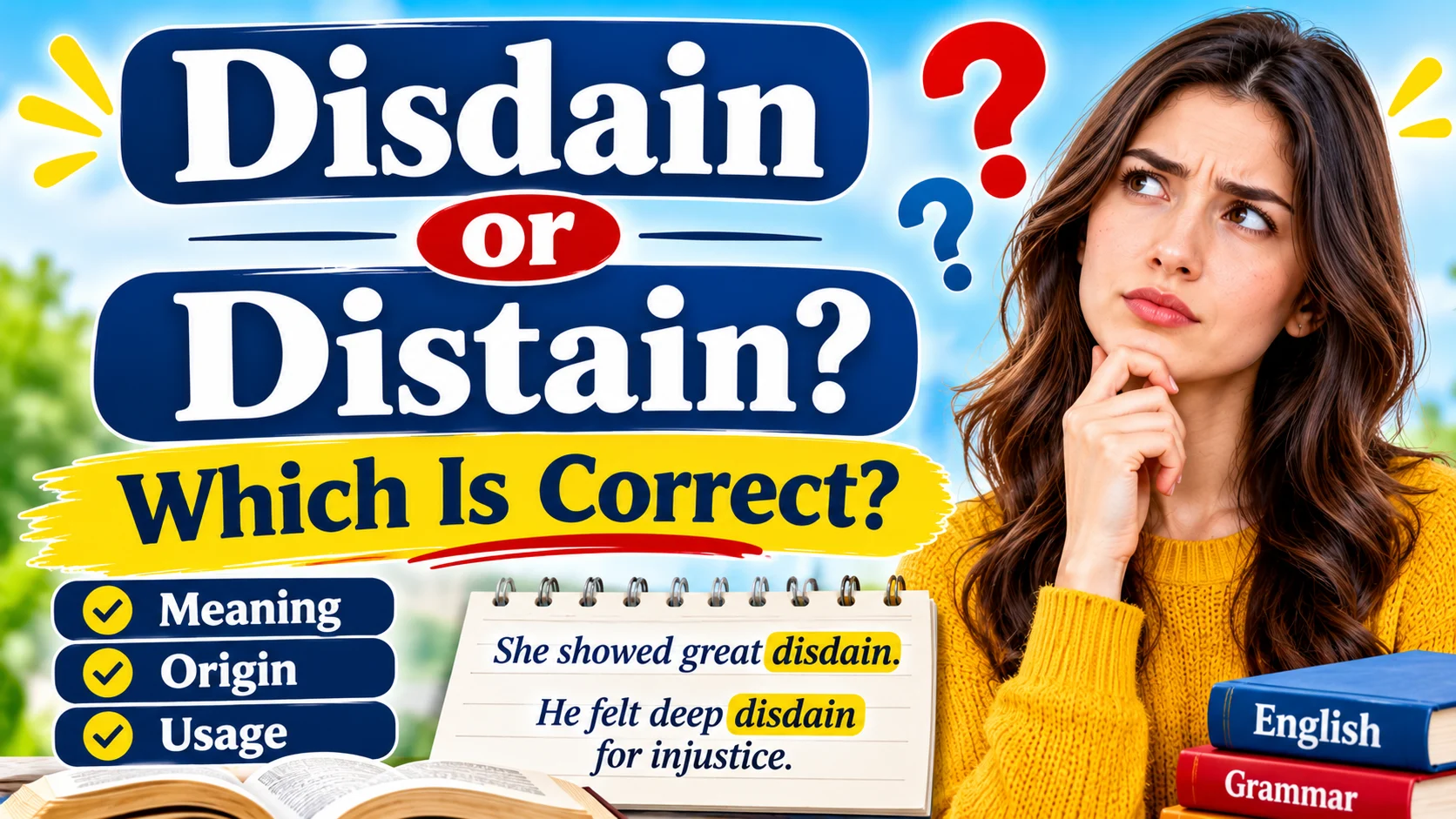
Have you ever wanted to write “disdain or distain” but stopped because you were unsure which spelling was correct? You are not alone. These words look almost identical, and their pronunciation can make the confusion worse.
The correct spelling is usually disdain. It means a strong feeling that someone or something is unworthy of respect. For example, “She looked at the dishonest behavior with disdain.” The word can describe both a feeling and an attitude.
Distain is a real word, but it is rare and has a different meaning. It can mean to stain, discolor, or spoil something. It is also found in older or literary English.
People search for “disdain or distain” because a single missing letter can change the word completely. The confusion often comes from hearing the words rather than seeing them written.
This guide explains the difference between disdain and distain, their origins, British and American usage, common mistakes, and everyday examples. It will help you choose the right spelling for emails, schoolwork, business writing, and professional content.
Disdain is the correct spelling for the common word meaning a lack of respect or strong dislike for someone or something considered unworthy.
Distain is a rare word. It can mean to stain, discolor, or spoil something.
Examples
- She treated the dishonest claim with disdain.
- He has disdain for rude behavior.
- The old fabric was distained by years of exposure. (rare/literary usage)
For normal modern English, you will almost always want disdain.
Quick Comparison
| Word | Meaning | Common? | Example |
|---|---|---|---|
| disdain | Strong lack of respect | Yes | She spoke with disdain. |
| distain | To stain, discolor, or spoil | Rare | The cloth was distained. |
The Origin of Disdain or Distain
The word disdain has a long history. It comes through Old French and ultimately from Latin roots associated with considering something unworthy.
The word contains the idea of dis-, meaning apart or away, and a root related to worth or value. Over time, disdain developed the sense of treating someone or something as beneath one’s respect.
English has used disdain for centuries. It appears in older literature and remains common in modern formal and everyday writing.
Distain has a different history. It is related to the idea of staining or discoloring. It is connected with older forms related to stain.
The similar appearance of the two words can cause spelling confusion. However, they do not represent British and American versions of the same word. They have different meanings and histories.
The easiest point to remember is:
disdain = lack of respect
distain = stain or discolor (rare)
British English vs American English Spelling
There is no standard British-American spelling difference between disdain and distain.
Both British and American English use disdain for the common meaning of strong disrespect.
Distain can appear in historical, archaic, or literary contexts, but it is not an American alternative spelling of disdain.
| Meaning | British English | American English |
|---|---|---|
| Strong lack of respect | disdain | disdain |
| Rare verb meaning to stain/discolor | distain | distain |
| Common spelling | disdain | disdain |
Examples
British English:
- “He regarded the idea with disdain.”
- “She showed disdain for the unfair decision.”
American English:
- “He regarded the idea with disdain.”
- “She showed disdain for the unfair decision.”
The spelling does not change between the two varieties.
Which Spelling Should You Use?
For almost every modern writing situation, choose disdain when you mean contempt, strong dislike, or lack of respect.
For US English
Use disdain:
“The manager viewed the proposal with disdain.”
Do not replace it with distain.
For UK and Commonwealth English
Use disdain in the same way:
“The journalist wrote about the politician’s disdain for criticism.”
Again, distain is not the British spelling of the word.
For a global audience
Disdain is the safest and most widely understood form.
If you are writing an email, article, report, essay, website, or social media post, use disdain when describing a negative attitude toward someone or something.
Use distain only when you specifically mean the rare verb connected with staining or discoloration, or when discussing historical or literary English.
Common Mistakes with Disdain or Distain
Mistake 1: Writing “distain” when you mean disrespect
❌ “She looked at the proposal with distain.”
✅ “She looked at the proposal with disdain.”
Mistake 2: Assuming “distain” is the American spelling
It is not.
❌ British: disdain
❌ American: distain
✅ British: disdain
✅ American: disdain
Mistake 3: Confusing disdain with dislike
Disdain is stronger than ordinary dislike. It often suggests that you believe someone or something is beneath respect or consideration.
For example:
- “I dislike the movie.” = I do not like it.
- “I view the movie with disdain.” = I have a strong negative attitude toward it and may consider it poor or unworthy.
Mistake 4: Using “disdain” as a simple synonym for anger
Disdain is not exactly the same as anger. It focuses more on contempt, disrespect, or a feeling of superiority.
Mistake 5: Using “distain” in everyday writing
Because distain is rare, using it when you mean disdain can make your writing look like it contains a spelling error.
Disdain or Distain in Everyday Examples
In emails
- “The team responded to the proposal with disdain.”
- “We should not treat customer concerns with disdain.”
In news writing
- “The candidate expressed disdain for the new policy.”
- “The report described his public disdain for the opposition.”
On social media
- “She has obvious disdain for online trolls.”
- “He spoke about the issue with disdain.”
In formal writing
- “The author portrays the character’s disdain for social convention.”
- “The study examines public disdain toward corrupt institutions.”
As a verb
Disdain can also be a verb.
- “She disdained the suggestion.”
- “He disdains dishonest behavior.”
In these examples, disdain means to regard something as unworthy or beneath consideration.
Disdain or Distain – Google Trends & Usage Data
Searches for “disdain or distain” usually come from people who have heard the word and are unsure about its spelling.
The confusion is understandable because the two words sound similar and differ by only one letter. However, modern English overwhelmingly uses disdain when people are discussing disrespect or contempt.
Searches may also appear in related forms, such as:
- “disdain definition”
- “distain definition”
- “disdain meaning”
- “disdain vs distain”
- “is distain a word?”
- “how do you spell disdain?”
Interest can vary by country, but disdain is the normal choice in both American and British English.
Keyword Variations Side by Side
| Keyword variation | Likely search intent |
|---|---|
| disdain or distain | Which spelling is correct? |
| disdain vs distain | Difference between the words |
| disdain or distain spelling | Correct spelling |
| distain meaning | Definition of the rare word |
| disdain meaning | Definition and examples |
| is distain a word | Whether “distain” is valid |
| how to spell disdain | Spelling confirmation |
Because search trends change over time, exact search volume and country rankings should be checked with a current keyword research or Google Trends tool before publishing an SEO campaign.
FAQs About Disdain or Distain
1. Is it “disdain” or “distain”?
For the common meaning of strong disrespect or contempt, the correct spelling is disdain.
2. Is “distain” a real word?
Yes. Distain is a real but rare word related to staining, discoloring, or spoiling something. It is not the normal spelling of disdain.
3. Is “distain” an American spelling?
No. Distain is not an American spelling of disdain. Both British and American English use disdain for the common meaning.
4. What does “disdain” mean?
Disdain means a strong feeling that someone or something is unworthy of respect or consideration.
Example: “He spoke about the plan with disdain.”
5. What is the difference between disdain and distain?
Disdain means strong disrespect or contempt. Distain is a rare word meaning to stain, discolor, or spoil.
6. Is “disdain” a noun or a verb?
It can be both.
As a noun: “She showed disdain for the idea.”
As a verb: “She disdained the idea.”
7. How can I remember the correct spelling?
Think of disdain = disrespect.
If you are talking about a negative attitude toward a person, idea, action, or thing, use disdain.
Conclusion
The answer to “disdain or distain” is simple in most cases: use disdain. It is the standard modern English word for a strong feeling of disrespect, contempt, or lack of regard.
Distain is also a real word, but it is rare. It is connected with staining, discoloring, or spoiling something and is more likely to appear in older or literary writing. It is not a British or American spelling variation of disdain.
The best way to remember the difference is to connect disdain with disrespect. If someone treats a person, idea, or action as unworthy, disdain is the word you need.
For emails, articles, business documents, academic writing, news stories, and most online content, disdain is the correct choice. Use distain only when its specific, uncommon meaning fits the context.
Understanding this small spelling difference can prevent errors and make your writing more precise. When in doubt, choose disdain for the common meaning of contempt or strong disrespect.
Fulfillment or Fulfilment? Which Spelling Is Correct?

I am an English Literature expert and professional content writer with a passion for language, grammar, and effective communication. I specialize in creating well-researched, reader-friendly articles on English usage, spelling, vocabulary, writing techniques, and literary topics. My goal is to simplify complex concepts and provide accurate, engaging content that helps readers strengthen their language skills and communicate with confidence.