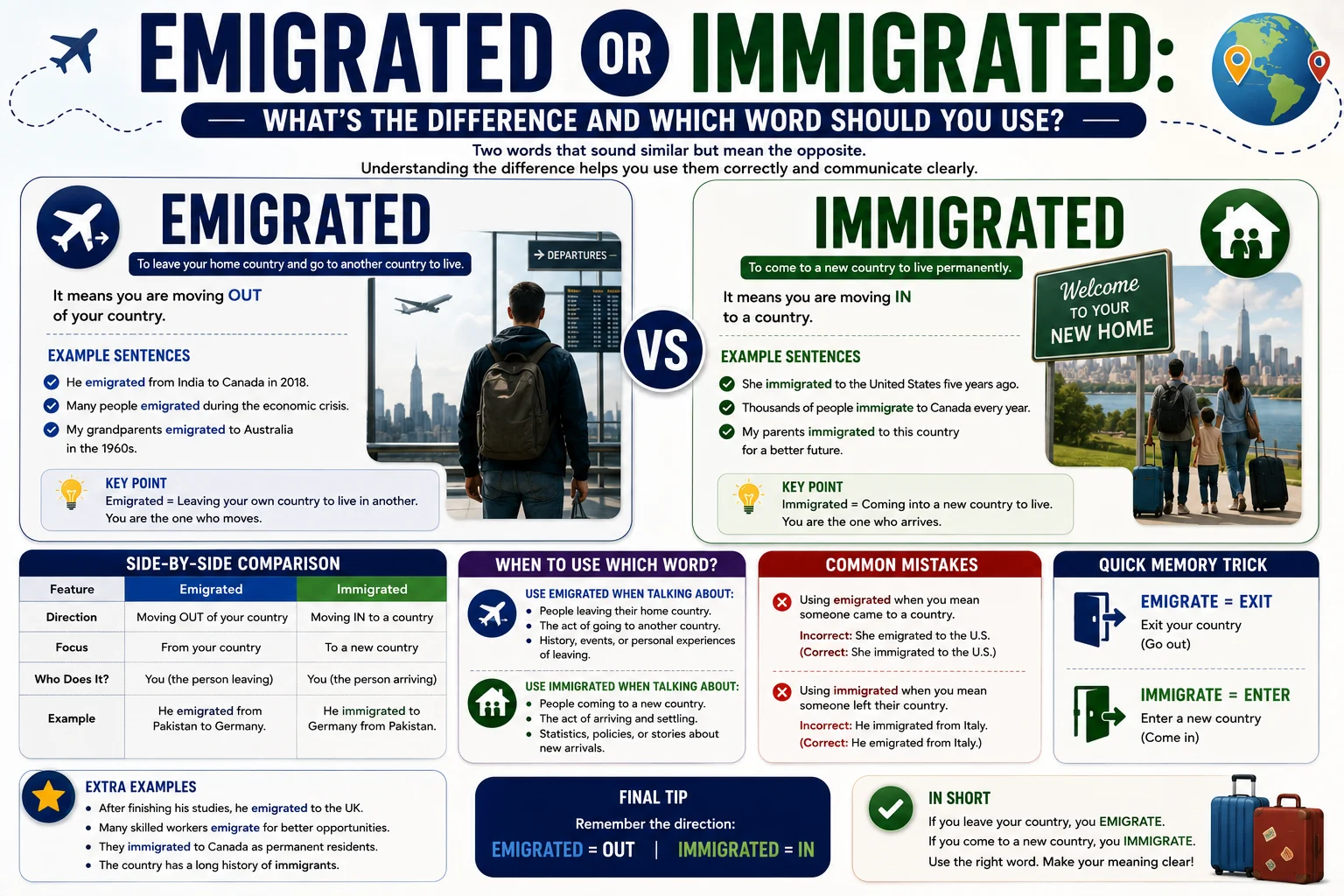
Have you ever stopped while writing and wondered whether you should use emigrated or immigrated? Many people search for this keyword because the two words look similar and both describe moving from one country to another. Yet they do not mean the same thing.
The confusion comes from the point of view. One word focuses on leaving a country, while the other focuses on entering a new country. Using the wrong word can change the meaning of your sentence. This is common in school assignments, business writing, immigration documents, news reports, and everyday conversations.
This guide explains the difference between emigrated or immigrated in simple language. You will learn what each word means, where the words came from, how British and American English use them, common mistakes to avoid, and which word is best for your audience. By the end, you will know exactly when to use each word with confidence.
The quick answer is simple:
- Emigrated means left a country to live somewhere else.
- Immigrated means entered a new country to live there.
The action is the same, but the viewpoint is different.
Examples
- She emigrated from India in 2018.
- She immigrated to Canada in 2018.
Both sentences describe the same move.
Think of it this way:
- Emigrate = Exit
- Immigrate = Into
The Origin of Emigrated or Immigrated
Both words come from the Latin word migrare, meaning to move.
The prefixes change the meaning:
| Word | Prefix Meaning | Full Meaning |
|---|---|---|
| Emigrate | e- = out of | Move out of a country |
| Immigrate | im- = into | Move into a country |
These words entered English centuries ago and became common as people moved between countries for work, education, trade, or safety.
There is no spelling difference between British English and American English for these words. The only difference is their meaning based on direction.
British English vs American English Spelling
Unlike words such as colour/color or organise/organize, emigrated and immigrated are spelled the same in both British and American English.
The difference is not spelling. It is meaning.
Comparison Table
| Feature | British English | American English |
|---|---|---|
| Emigrated | Same spelling | Same spelling |
| Immigrated | Same spelling | Same spelling |
| Meaning | Same | Same |
| Usage | Same grammar | Same grammar |
Examples
British English
- They emigrated from England.
- They immigrated to Australia.
American English
- His parents emigrated from Italy.
- His parents immigrated to the United States.
Which Spelling Should You Use?
Since both words have the same spelling everywhere, your choice depends on what you want to say.
For US Readers
Use:
- Emigrated when talking about leaving a country.
- Immigrated when talking about arriving in the United States.
Example:
- She immigrated to the United States after graduating.
For UK and Commonwealth Readers
The same rule applies.
Example:
- He emigrated from South Africa.
- He immigrated to New Zealand.
For Global Audiences
Choose the word based on direction.
Ask yourself:
- Is the person leaving? Use emigrated.
- Is the person arriving? Use immigrated.
Common Mistakes with Emigrated or Immigrated
Many writers mix these words because they describe the same journey.
Mistake 1
❌ She immigrated from France.
✅ She emigrated from France.
Mistake 2
❌ He emigrated to Canada.
✅ He immigrated to Canada.
Mistake 3
❌ They emigrated into Australia.
✅ They immigrated to Australia.
Mistake 4
❌ She immigrated out of Brazil.
✅ She emigrated from Brazil.
Easy Memory Trick
- Emigrate = Exit
- Immigrate = Into
Emigrated or Immigrated in Everyday Examples
“Our family immigrated to Canada last year.”
News
“Thousands emigrated from the country during the economic crisis.”
Social Media
“My grandparents emigrated from Ireland many years ago.”
Formal Writing
“The researchers studied people who immigrated to the United Kingdom after 1995.”
School Assignment
“Albert Einstein emigrated from Germany and later immigrated to the United States.”
Emigrated or Immigrated – Google Trends & Usage Data
Search interest for emigrated or immigrated stays steady because many people want to understand the difference before writing.
General usage patterns include:
| Country | More Common Search Context |
|---|---|
| United States | Immigration, citizenship, visas |
| Canada | Immigration programs |
| United Kingdom | Migration and history |
| Australia | Skilled migration |
| New Zealand | Immigration information |
People usually search this keyword when:
- Writing essays
- Completing immigration forms
- Reading news
- Learning English
- Preparing for language exams
Both words appear often in government documents, newspapers, educational materials, and legal writing.
Comparison Table: Emigrated vs Immigrated
| Feature | Emigrated | Immigrated |
|---|---|---|
| Meaning | Left a country | Entered a country |
| Focus | Departure | Arrival |
| Common Preposition | From | To |
| Example | Emigrated from Spain | Immigrated to Canada |
| Viewpoint | Country left behind | New country |
Frequently Asked Questions (FAQs)
1. What is the difference between emigrated and immigrated?
Emigrated means leaving a country. Immigrated means entering another country.
2. Can the same person be both an emigrant and an immigrant?
Yes. A person emigrates from one country and immigrates to another.
3. Is emigrated British English?
No. It is used in both British and American English.
4. Is immigrated correct in American English?
Yes. It is the standard word for entering a new country to live there.
5. Which comes first, emigrate or immigrate?
A person usually emigrates from one country before immigrating to another.
6. Is there a spelling difference between British and American English?
No. Both words are spelled the same in both forms of English.
7. How can I remember the difference?
Remember:
- Emigrate = Exit
- Immigrate = Into
This simple trick helps you choose the correct word quickly.
Conclusion
Understanding the difference between emigrated or immigrated is easier than it first appears. Both words describe the same journey, but they tell the story from different directions. Emigrated focuses on leaving a country, while immigrated focuses on arriving in a new one. Once you remember this viewpoint, choosing the right word becomes simple.
There is no spelling difference between British English and American English. Writers around the world use the same spellings. The important decision is selecting the word that matches your sentence. If your focus is the country someone left, use emigrated. If your focus is the country someone entered, use immigrated.
Whether you are writing an essay, a business email, a news article, or an immigration document, using these words correctly makes your writing clearer and more accurate. Keep the easy memory trick in mind—Emigrate = Exit and Immigrate = Into—and you will avoid one of the most common English vocabulary mistakes.
Fly or Die: Meaning, Origin, Usage, Examples & Complete Guide

I am an English Literature expert and professional content writer with a passion for language, grammar, and effective communication. I specialize in creating well-researched, reader-friendly articles on English usage, spelling, vocabulary, writing techniques, and literary topics. My goal is to simplify complex concepts and provide accurate, engaging content that helps readers strengthen their language skills and communicate with confidence.