Have you ever stopped while writing and wondered whether you should use devine or divine? You are not alone. Thousands of people search for this spelling question because both words look similar, but only one is correct in most situations.
The confusion often happens because English has many words with similar sounds but different spellings. Spell check may even miss the mistake if Devine is being used as a proper name. This leaves many writers unsure about which version to use in emails, school work, business writing, and social media posts.
This guide explains the difference between devine or divine in simple language. You will learn the correct spelling, where the confusion comes from, how British and American English treat the word, common mistakes to avoid, and which spelling fits your audience. By the end, you will know exactly when to use divine and when Devine is appropriate as a surname or brand name.
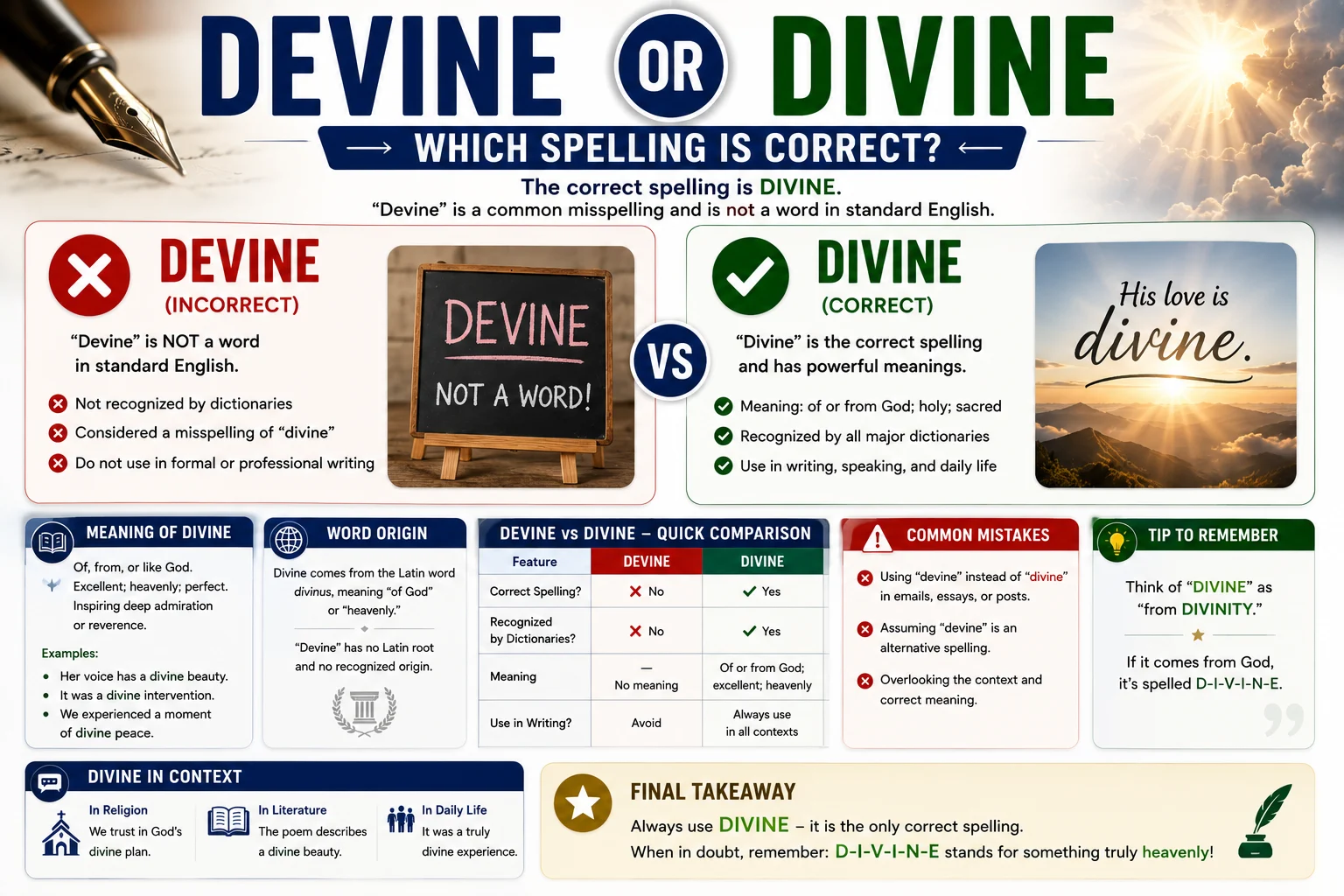
The correct English word is divine.
Divine is an adjective that means:
- Related to God or a god.
- Heavenly or sacred.
- Extremely beautiful or wonderful.
Examples
- The painting has a divine beauty.
- She believes in divine guidance.
- That cake tastes divine.
Devine is usually not a standard English word. It is most commonly:
- A family name (surname).
- A company or brand name.
- Part of a person’s name.
Examples
- Chris Devine wrote the report.
- The meeting was led by Sarah Devine.
Quick Tip: If you mean “heavenly,” “godly,” or “wonderful,” always use divine.
The Origin of Devine or Divine
The word divine comes from the Latin word divinus, which means “of a god” or “godlike.” It entered English through Old French and has been used for hundreds of years.
Over time, divine became common in both religious and everyday language. Today, people use it to describe:
- God or religion.
- Exceptional beauty.
- Excellent food.
- Wonderful experiences.
So where does Devine come from?
Devine is mainly an Irish surname. It developed from old Gaelic family names and became common as a last name. Because it looks almost the same as divine, many writers accidentally use it when they really mean the adjective.
This spelling difference exists because one is a regular English word, while the other is mainly a proper name.
British English vs American English Spelling
Unlike words such as colour/color or centre/center, there is no spelling difference between British and American English.
Both varieties use divine.
| Meaning | British English | American English |
|---|---|---|
| Heavenly | Divine | Divine |
| Sacred | Divine | Divine |
| Wonderful | Divine | Divine |
Comparison
| Word | Correct? | Meaning |
|---|---|---|
| Divine | ✅ Yes | Heavenly, sacred, wonderful |
| Devine | ❌ No (unless a name) | Usually a surname or brand |
No matter where you write, divine is the correct spelling for the adjective.
Which Spelling Should You Use?
The answer depends on what you mean.
For US Readers
Use divine whenever you describe something heavenly, religious, or amazing.
For UK Readers
The same rule applies. Use divine.
For Australia, Canada, New Zealand, and Other Commonwealth Countries
Use divine.
For Global Audiences
Choose divine unless you are referring to someone’s surname or an official business name.
Simple Rule
- Meaning heavenly or excellent → Divine
- Referring to a person’s last name → Devine
Common Mistakes with Devine or Divine
Many writers make small spelling mistakes.
Mistake 1
❌ This dessert is devine.
✅ This dessert is divine.
Mistake 2
❌ She received devine inspiration.
✅ She received divine inspiration.
Mistake 3
❌ The church spoke about devine power.
✅ The church spoke about divine power.
Mistake 4
❌ Divine is always a person’s name.
✅ Devine can be a surname, while divine is the common English word.
Devine or Divine in Everyday Examples
Here are common situations where the word appears.
“The presentation was divine. Great work.”
News
“The ceremony celebrated divine traditions.”
Social Media
“This sunset is absolutely divine.”
Formal Writing
“The poem explores themes of divine justice.”
Personal Name
“Professor Emily Devine will speak at today’s event.”
Devine or Divine – Google Trends & Usage Data
Search interest strongly favors divine because it is a standard English word used in religion, literature, food reviews, fashion, and everyday conversation.
People search devine or divine because they want to confirm the correct spelling before writing.
General Usage by Country
| Country | More Common Search |
|---|---|
| United States | Divine |
| United Kingdom | Divine |
| Canada | Divine |
| Australia | Divine |
| Ireland | Divine (Devine also appears as a surname) |
Common Search Intent
| Search Query | User Goal |
|---|---|
| devine or divine | Correct spelling |
| divine meaning | Definition |
| divine examples | Learn usage |
| divine synonym | Similar words |
| Devine surname | Learn about the family name |
Comparison Table
| Variation | Correct Word? | Main Use | Example |
|---|---|---|---|
| Divine | ✅ Yes | Adjective | A divine blessing |
| Devine | ⚠️ Name only | Surname | Emma Devine |
| Divinely | ✅ Yes | Adverb | Divinely inspired |
| Divinity | ✅ Yes | Noun | Study of divinity |
Frequently Asked Questions
1. Is it devine or divine?
Divine is the correct spelling for the English word. Devine is usually a surname.
2. Why do people spell divine as devine?
People often spell it based on pronunciation or confuse it with the surname Devine.
3. Is Devine ever correct?
Yes. It is correct when referring to a person’s last name or an official brand name.
4. Is divine used in British English?
Yes. Both British and American English use the spelling divine.
5. What does divine mean?
It means related to God, sacred, heavenly, or extremely beautiful.
6. Can divine describe food?
Yes. People often say food tastes divine when it is exceptionally delicious.
7. How can I remember the correct spelling?
Remember that divine contains “i” after d, and it is the standard dictionary spelling.
Conclusion
The answer to the question devine or divine is simple. If you are writing about something heavenly, sacred, beautiful, or excellent, the correct spelling is divine. This spelling is accepted in British English, American English, and every other major variety of English. There is no regional spelling difference for this word.
The spelling Devine is generally used only as a surname, family name, or official business name. Using Devine instead of divine in normal writing is a common spelling mistake that can make your work appear less professional. Checking the meaning before choosing the spelling is the easiest way to avoid errors.
Whether you are writing an email, article, report, social media post, or school assignment, remember this simple rule: divine is the standard English word, while Devine is usually a proper name. Following this guideline will help you write clearly, accurately, and confidently every time.
Fly or Die: Meaning, Origin, Usage, Examples & Complete Guide

I am an English Literature expert and professional content writer with a passion for language, grammar, and effective communication. I specialize in creating well-researched, reader-friendly articles on English usage, spelling, vocabulary, writing techniques, and literary topics. My goal is to simplify complex concepts and provide accurate, engaging content that helps readers strengthen their language skills and communicate with confidence.