Have you ever stopped while writing and wondered whether you should use flaky or flakey? You are not alone. Many writers, students, editors, and professionals search for this spelling question because both words appear online. That makes it easy to think they are equally correct.
The confusion comes from different dictionaries, writing styles, and regional preferences. Some websites use flaky, while others use flakey. If you want your writing to look polished, choosing the right spelling matters. It can improve clarity, build trust, and help your content match your audience’s expectations.
This guide explains the difference between flaky and flakey in simple language. You will learn which spelling is standard, why both versions exist, when each one is appropriate, and how to avoid common mistakes. Whether you are writing an email, a blog post, a social media update, or a business document, this article will help you use the correct spelling with confidence.
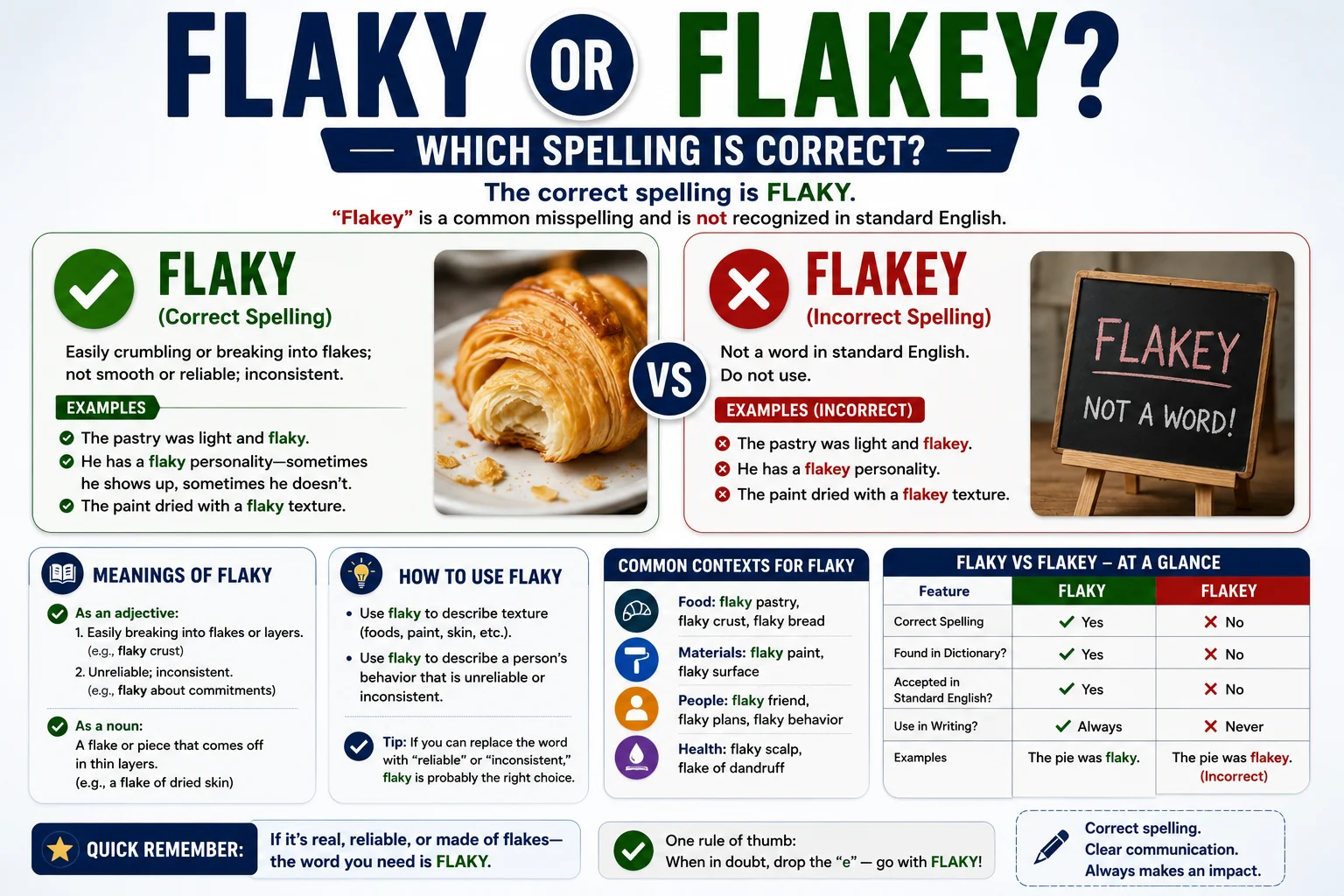
Flaky is the standard and preferred spelling in both American English and British English.
Flakey is an alternative spelling, but it is much less common. Most dictionaries list it as a variant rather than the main spelling.
Examples
✅ The pastry is flaky and buttery.
✅ He is flaky because he often cancels plans.
⚠️ The pastry is flakey and buttery. (Acceptable in some dictionaries but uncommon.)
For almost all writing, choose flaky.
The Origin of Flaky or Flakey
The word flaky comes from the noun flake, meaning a small, thin piece that breaks away from something.
Originally, flaky described food such as pie crusts, biscuits, and pastries that separate into thin layers. Later, people began using it to describe someone who is unreliable, forgetful, or inconsistent.
The spelling flakey appeared because English sometimes adds -ey to create adjectives. Over time, however, flaky became the standard spelling in dictionaries, newspapers, schools, and style guides.
Today, both spellings exist, but flaky is widely accepted as the correct and preferred form.
British English vs American English Spelling
Unlike words such as color/colour or organize/organise, this spelling difference is not mainly about British versus American English.
Both American and British English strongly prefer flaky.
| Feature | Flaky | Flakey |
|---|---|---|
| American English | ✅ Preferred | Rare variant |
| British English | ✅ Preferred | Rare variant |
| Australian English | ✅ Preferred | Occasionally seen |
| Canadian English | ✅ Preferred | Rare |
| Formal writing | ✅ Recommended | Usually avoided |
| Everyday writing | ✅ Common | Less common |
Examples
| American English | British English |
|---|---|
| The employee is flaky. | The employee is flaky. |
| The pastry has a flaky crust. | The pastry has a flaky crust. |
| Her excuse sounded flaky. | Her excuse sounded flaky. |
There is no major regional spelling rule that favors flakey.
Which Spelling Should You Use?
The best spelling depends on your audience, but in almost every case, flaky is the safest choice.
For American readers
Use flaky.
For British readers
Use flaky.
For Australia, Canada, and New Zealand
Use flaky.
For international audiences
Use flaky because it is the spelling most readers expect.
Professional advice
If you write for work, school, publishing, or SEO, always choose flaky unless a publisher specifically prefers flakey.
Common Mistakes with Flaky or Flakey
Here are common mistakes and their corrections.
| Mistake | Correct Form |
|---|---|
| Thinking both spellings are equally common | Flaky is far more common |
| Using flakey in formal documents | Use flaky |
| Assuming flakey is British spelling | It is not |
| Switching spellings in one article | Stay consistent |
| Ignoring dictionary preference | Follow flaky |
Correct examples
✅ She has a flaky personality.
✅ This pie has a flaky crust.
✅ The paint became flaky after years of weather.
Flaky or Flakey in Everyday Examples
Here are examples from different types of writing.
“The supplier has been flaky about delivery dates.”
News
“Experts described the old paint as flaky after years of exposure.”
Social Media
“My friend is so flaky. He always cancels at the last minute.”
Formal Writing
“The material developed a flaky surface after prolonged use.”
Food Writing
“The baker created a perfectly flaky pastry.”
Flaky or Flakey – Google Trends & Usage Data
Search data and online usage show that flaky is much more popular than flakey.
General usage
- Flaky appears far more often in books, news articles, blogs, and websites.
- Flakey appears mainly as an alternative spelling or personal preference.
By country
| Country | Most Common Spelling |
|---|---|
| United States | Flaky |
| United Kingdom | Flaky |
| Canada | Flaky |
| Australia | Flaky |
| New Zealand | Flaky |
Contexts where “flaky” is common
- Food and baking
- Personality descriptions
- Paint and materials
- Technology discussions
- Everyday conversation
Keyword Comparison Table
| Keyword Variation | Meaning | Recommended? |
|---|---|---|
| Flaky | Standard spelling | ✅ Yes |
| Flakey | Alternative spelling | ⚠️ Rarely |
| Flaky person | Unreliable person | ✅ Yes |
| Flaky pastry | Pastry with light layers | ✅ Yes |
| Flaky skin | Dry skin that peels | ✅ Yes |
| Flaky behavior | Unreliable actions | ✅ Yes |
Frequently Asked Questions
1. Is flaky or flakey correct?
Both exist, but flaky is the standard spelling and should be used in most writing.
2. Is flakey wrong?
Not completely. It is an accepted variant in some dictionaries, but it is much less common.
3. Which spelling is used in America?
American English strongly prefers flaky.
4. Which spelling is used in Britain?
British English also prefers flaky.
5. Why do some people write flakey?
Some writers use it as a personal preference or because they have seen the alternative spelling online.
6. Should I use flaky in professional writing?
Yes. Flaky is the recommended spelling for business, education, journalism, and academic writing.
7. Does flaky always describe a person?
No. It can describe food, paint, skin, materials, weathered surfaces, and unreliable people.
Conclusion
Choosing between flaky and flakey is easier than it first appears. Although both spellings can be found, flaky is the standard form used by major dictionaries, publishers, schools, and professional writers. It is accepted in American English, British English, Canadian English, Australian English, and other varieties of English. That makes it the safest and most reliable choice for almost every situation.
Using flaky also improves consistency and professionalism. Whether you are describing a buttery pastry, dry skin, peeling paint, or an unreliable person, readers will immediately recognize the standard spelling. While flakey is not entirely incorrect, it is uncommon and may distract some readers or appear less polished in formal writing.
If your goal is clear communication, better SEO, or professional writing, remember one simple rule: choose flaky. It is the spelling most people expect, the one most dictionaries recommend, and the version that works best for nearly every audience around the world.
Fly or Die: Meaning, Origin, Usage, Examples & Complete Guide

I am an English Literature expert and professional content writer with a passion for language, grammar, and effective communication. I specialize in creating well-researched, reader-friendly articles on English usage, spelling, vocabulary, writing techniques, and literary topics. My goal is to simplify complex concepts and provide accurate, engaging content that helps readers strengthen their language skills and communicate with confidence.