Have you ever stopped while writing and wondered whether to write occurred or occured? You are not alone. Thousands of people search for this spelling question every month because the two words look almost the same. A single missing letter can make anyone doubt their writing.
This confusion happens because English spelling rules are not always easy to remember. Some words double the final consonant before adding -ed, while others do not. As a result, many writers, students, bloggers, and professionals accidentally type occured instead of occurred.
This guide gives you a quick answer first and then explains everything in simple language. You will learn the correct spelling, why people make this mistake, how British and American English treat the word, common errors to avoid, real-life examples, and usage trends. By the end, you will know exactly which spelling to use with confidence.
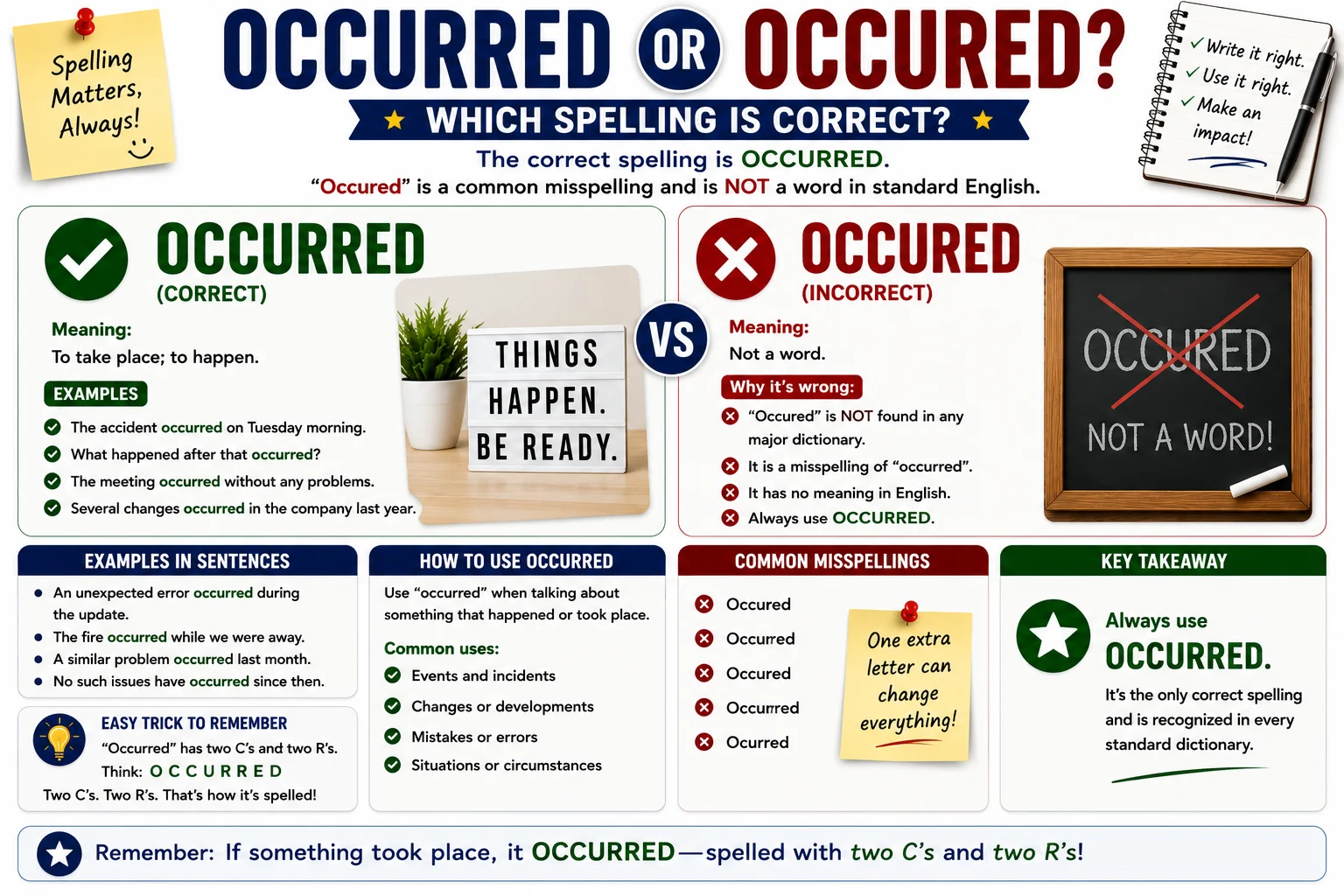
The correct spelling is occurred.
Occured is incorrect and should not be used.
Examples
✅ The accident occurred yesterday.
✅ The meeting occurred earlier than planned.
❌ The accident occured yesterday.
Easy Rule
The verb occur ends with one r. Before adding -ed, double the final r because the last syllable is stressed.
- Occur → Occurred ✅
- Occur → Occured ❌
The Origin of Occurred or Occured
The word occur comes from the Latin word occurrere, meaning “to happen,” “to come before,” or “to meet.”
Over time, it entered English as occur. When changing it into the past tense, English spelling rules require doubling the final r before adding -ed.
Many people write occured because they forget this doubling rule. The mistake is common, but dictionaries, grammar guides, and style manuals all recognize only occurred as the correct spelling.
British English vs American English Spelling
Unlike many English words, there is no spelling difference between British English and American English.
Both use occurred.
| Feature | British English | American English |
|---|---|---|
| Correct spelling | Occurred | Occurred |
| Incorrect spelling | Occured | Occured |
| Meaning | Happened | Happened |
Examples
British English
- The event occurred in London.
American English
- The storm occurred overnight.
The spelling stays the same everywhere.
Which Spelling Should You Use?
Your audience does not change the answer.
For American readers
Use occurred.
For British readers
Use occurred.
For Australia, Canada, New Zealand, and other Commonwealth countries
Use occurred.
For global audiences
Always choose occurred because it is the accepted spelling worldwide.
Common Mistakes with Occurred or Occured
Here are mistakes people often make.
| Incorrect | Correct |
|---|---|
| Occured | Occurred |
| It occured yesterday. | It occurred yesterday. |
| Error occured. | Error occurred. |
| What occured? | What occurred? |
Why the mistake happens
People often:
- Forget to double the r
- Type too quickly
- Rely on memory instead of spelling rules
A simple trick is to remember:
Occur has a stressed last syllable, so double the final r before adding -ed.
Occurred or Occured in Everyday Examples
“The issue occurred after the latest software update.”
News
“The earthquake occurred early Monday morning.”
Social Media
“I can’t believe this actually occurred today!”
Formal Writing
“The incident occurred during the second phase of the experiment.”
School Writing
“The event occurred in 1945.”
Occurred or Occured – Google Trends & Usage Data
Search interest for occurred or occured stays high because many people are unsure about the correct spelling.
People commonly search:
- occurred or occured
- occured meaning
- occurred spelling
- is occured correct
- occurred definition
Countries where spelling questions are common
- United States
- United Kingdom
- Canada
- Australia
- India
Most searches happen from students, professionals, content writers, and people checking grammar before publishing or sending important documents.
Keyword Comparison Table
| Keyword Variation | Correct? | Notes |
|---|---|---|
| occurred | ✅ Yes | Correct spelling |
| occured | ❌ No | Misspelled word |
| occur | ✅ Yes | Base verb |
| occurring | ✅ Yes | Present participle |
| occurrence | ✅ Yes | Noun form |
| occurence | ❌ No | Incorrect spelling |
FAQs
Is occurred or occured correct?
Occurred is correct. Occured is a spelling mistake.
Why does occurred have two r’s?
English spelling rules double the final consonant when a stressed syllable ends with a consonant before adding -ed.
Is occured ever correct?
No. Standard English dictionaries do not accept occured.
How do I remember the correct spelling?
Remember this pattern:
Occur → Occurred
Always double the r.
Do British and American English spell it differently?
No. Both use occurred.
Is occurred a verb?
Yes. It is the past tense of the verb occur, meaning “to happen.”
Can grammar checkers detect occured?
Yes. Most grammar and spell-check tools mark occured as incorrect and suggest occurred.
Conclusion
The answer is simple: occurred is the only correct spelling, while occured is always a mistake. Even though many people accidentally leave out one r, English spelling rules require doubling the final r before adding -ed. This rule applies because the last syllable in occur is stressed.
The good news is that there is no difference between British English and American English. Whether you are writing for readers in the United States, the United Kingdom, Canada, Australia, or anywhere else, you should always use occurred. Remembering this single rule will help you avoid a very common spelling error.
If you are writing emails, reports, school assignments, blog posts, or social media updates, using the correct spelling makes your writing look more professional and trustworthy. Whenever you hesitate between occurred and occured, choose occurred. It is the accepted spelling in every major English dictionary and style guide, making it the right choice for every audience.
Grimey or Grimy: Which Spelling Is Correct?

I am an English Literature expert and professional content writer with a passion for language, grammar, and effective communication. I specialize in creating well-researched, reader-friendly articles on English usage, spelling, vocabulary, writing techniques, and literary topics. My goal is to simplify complex concepts and provide accurate, engaging content that helps readers strengthen their language skills and communicate with confidence.